The Anatomy of a Pop-Up Storefront Trap: Behind the Façade of Trumpgrab.shop
If you recently crossed paths with an ad pushing Trumpgrab.shop, you have likely stumbled headfirst into a classic short-lived drop-shipping scam. Digital storefronts like this materialize almost overnight, capitalizing on polarizing internet culture, viral novelty gags, and seasonal demand before disappearing without leaving a trace for disappointed buyers.
Understanding whether an ultra-niche website is a genuine merchant or a sophisticated consumer trap requires pulling back the slick user interface. In this investigative breakdown, we unpack the mechanics of seasonal e-commerce fraud, dissect Trumpgrab.shop as our central case study, highlight the critical warning signs to watch out for, and show you exactly what to do if you have already submitted your financial details.
Email: ApexLegalSolutionsMumbai@gmail.com
Deconstructing the “Short-Lived Drop-Shipping Scam”
To spot these schemes from a mile away, one must understand how rogue operators exploit the mechanics of modern global supply chains.
Drop-shipping itself is a legal fulfillment model where a merchant sells inventory stored, packed, and dispatched by a third-party manufacturer. However, bad actors twist this model into a short-lived drop-shipping scam. In these operations, an anonymous entity launches a lightweight, single-product web store on an inexpensive domain. They rely on cheap social media ads to siphon traffic to an enticing, heavily discounted novelty item.
Unlike legitimate retail brands focused on customer lifetime value, repeat business, and brand equity, a short-lived operation is engineered from day one to have a planned expiration date. The perpetrators calculate that by the time customers realize their orders are delayed, missing, or vastly inferior to the promotional video, hundreds or thousands of transactions will have already cleared payment processors.
Once chargebacks mount, negative reviews accumulate, or payment gateways freeze their merchant accounts, the scammers abruptly pull the plug, migrate the theme to a new domain name, and repeat the cycle with a different trending keyword.
Suspicious Link or Courier SMS?
Verify URLs, APKs, or parcel alerts against our threat database before clicking.
Case Study: The Inner Mechanics of Trumpgrab.shop
What the Site Claims and Offers
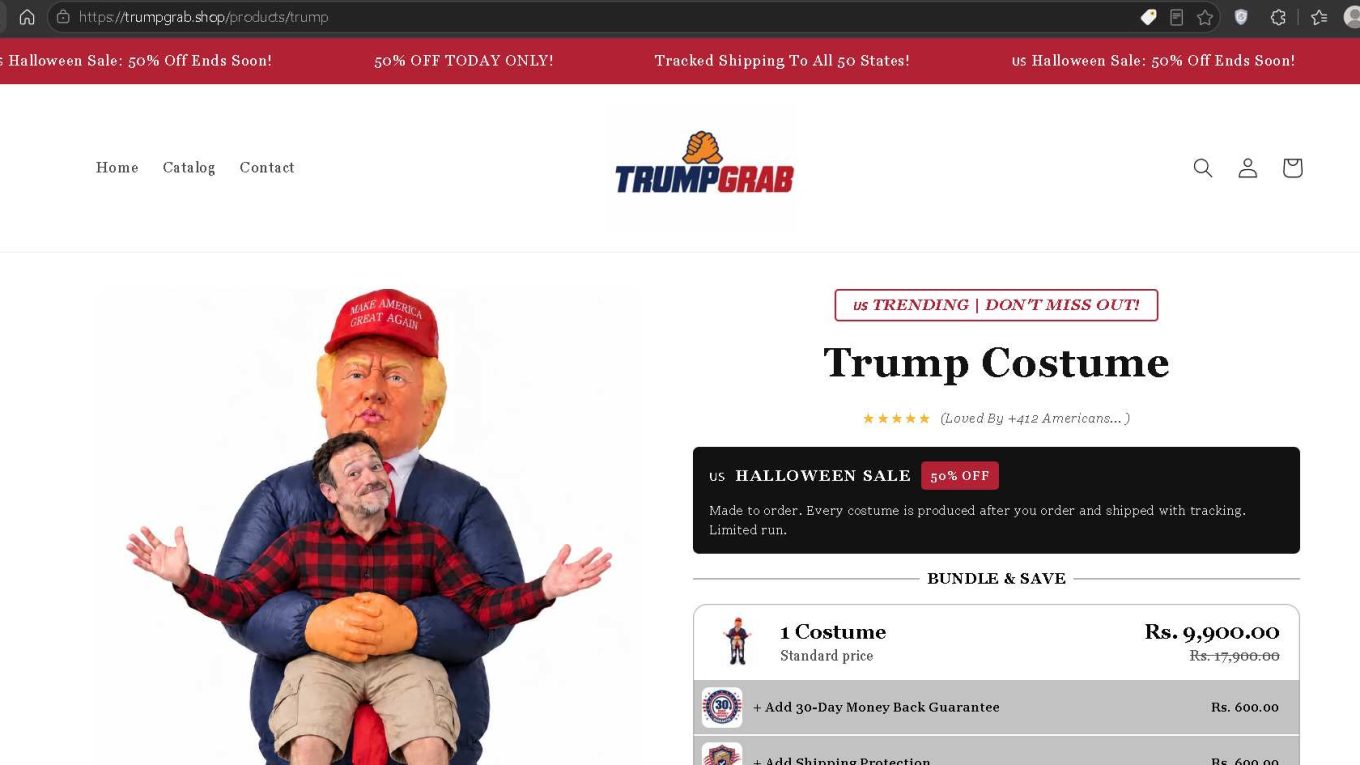
Trumpgrab.shop positions itself as a specialized novelty outlet built around a singular, high-visibility product: an inflatable piggyback “carry-me” Donald Trump Halloween costume.
The website frames the product as an exclusive, viral holiday piece:
- The Promise: Premium construction, custom “made-to-order” tailoring, and domestic expedited transit with real-time tracking across all 50 states.
- The Deal: An urgent “50% Off Today Only” promotion slashing the standard retail price in half.
- The Upsell: Checkbox add-ons at checkout promising extra “shipping protection” and a “30-Day Money-Back Guarantee” for an added fee.
How the Operation Actually Works Behind the Screen
While the storefront paints a picture of a dedicated domestic brand operating out of the United States, the real machinery at work tells a very different story:
- Mass Sourcing from Wholesale Repositories: The inflatable costume featured on Trumpgrab.shop is neither proprietary nor custom-made. It is a widely duplicated novelty item produced by generic manufacturers and available on open wholesale directories such as AliExpress, Taobao, and 1688 for $10 to $18.
- Arbitrage and Misdirection: The operator marks up the cheap item by 300% to 500% (or charges inflated local currency equivalents). Instead of shipping inventory from an actual domestic warehouse, customer orders—if fulfilled at all—are simply routed to third-party overseas bulk suppliers using the lowest-cost, untracked postal transit options available.
- The Disappearing Act: Because maritime or budget air logistics from overseas factories can take 4 to 8 weeks, the estimated delivery date falls well past Halloween. Once buyers realize their costume never arrived for their event, the domain will likely be offline or completely unresponsive.
Every safe click counts. If this post helped, a coffee gesture fuels more scam‑busting investigations.

5 Critical Red Flags Uncovered on Trumpgrab.shop
Before typing payment information into an unfamiliar checkout portal, run through this five-point diagnostic checklist. Trumpgrab.shop triggers every single alarm:
| Storefront Integrity Audit | |
|---|---|
| Diagnostic Check | Storefront Reality |
| 1. Top-Level Domain (TLD) Check | Low-cost, disposable .shop |
| 2. Geolocation & Currency Logic | Dynamic currency mismatches |
| 3. False Scarcity / Psychological | Perpetual “Today Only” countdowns |
| 4. Monetized Legal Protections | Fees charged for basic refund rights |
| 5. Corporate Verifiability | Zero corporate filing or phone |
1. Disposable .shop Top-Level Domain
Established retail brands invest heavily in their primary .com domains and long-term brand equity. High-turnover operations, on the other hand, favor cheap, throwaway top-level domains like .shop, .top, or .store. These domains cost pennies to register, can be acquired anonymously using basic privacy proxy services, and are treated by operators as disposable assets destined for the trash heap within 60 to 90 days.
2. Glaring Currency & Geo-Targeting Inconsistencies
The top announcement banner prominently guarantees “Tracked Shipping To All 50 States!” accompanied by an eye-catching “US Trending / US Halloween Sale” tag. Yet, when accessed by international visitors, the site automatically converts product values into native currencies (such as displaying Rs. 9,900.00 alongside an extra Rs. 600.00 fee) without altering the US-centric shipping language. This reveals an unrefined, mass-deployed Shopify or WooCommerce checkout template that was quickly automated without localized inventory oversight.
3. Fabricated Scarcity and Manufactured Panic
The landing page relies on relentless pressure tactics designed to bypass critical thinking:
- “50% Off Ends Soon!”
- “50% OFF TODAY ONLY!”
- “DON’T MISS OUT!”
- “Every costume is produced after you order… Limited run.”
Legitimate manufacturers do not custom-make cheap vinyl blow-up suits on a per-order basis while running an indefinite, 24-hour flash sale. These messages are automated psychological levers intended to force a rapid purchase before the visitor leaves the page to verify merchant reviews.
4. Monetizing Basic Consumer Rights
In one of the most glaring warning signs on the product page, customers are asked to pay extra line-item surcharges for standard purchase rights—such as paying an extra fee for a “30-Day Money-Back Guarantee” or “Shipping Protection.”
Under standard consumer banking rules (such as the Fair Credit Billing Act in the US or global credit card network standards), merchants are already legally obligated to deliver what was advertised or issue a reversal. Charging customers a supplementary fee for the mere privilege of receiving a refund or basic shipping accountability is an egregious tactic commonly seen on untrusted storefronts.
5. Absence of Verifiable Corporate Ownership
A look through the site’s footer and navigation bars reveals a complete vacuum of corporate transparency:
- No physical business address or warehouse registration.
- No registered Limited Liability Company (LLC) or corporate incorporation details.
- No direct telephone line for human customer service.
- A basic web contact form with no documented Service Level Agreements (SLAs).
When a website conceals the legal identity of its operators, consumers have zero recourse if the seller pocketing the funds fails to fulfill the contract.
Financial Self-Defense: What to Do If You Already Paid
If you entered your payment card details on an unverified platform, take proactive steps immediately:
- Initiate an Unauthorized Transaction or Fraud Dispute: Contact the fraud department of your credit card issuer or bank. Explain that the merchant engaged in deceptive e-commerce practices, misrepresented their location, or failed to provide tracking. Request an immediate chargeback.
- Lock or Reissue the Compromised Card: Unregulated payment gateways on pop-up sites can leak card data or store it unencrypted. Request a replacement card with a new CVV and card number to stop unauthorized recurring subscription fees or follow-up billing.
- Save Supporting Documentation: Capture full-screen screenshots of the site’s product page, your order confirmation, shipping estimates, and any correspondence with their customer service inbox. This material serves as primary evidence during a merchant dispute.
- Monitor Credit Reports: If you created an account and shared sensitive personal data (such as birth dates or shared passwords), monitor your identity profiles and watch for follow-up phishing emails impersonating parcel couriers (e.g., USPS, FedEx, or DHL delivery exception scams).
Frequently Asked Questions (FAQ)
1. Is Trumpgrab.shop scam or legit?
Trumpgrab.shop displays the primary operational hallmarks of a scam storefront. It uses a disposable domain, masks its corporate owners, uses manufactured countdown timers, and lists marked-up generic wholesale items disguised as exclusive branded products.
2. Is Trumpgrab.shop legit?
No. Trumpgrab.shop lacks verifiable business licensing, customer service telephone numbers, and legitimate physical addresses. It operates on an automated pop-up storefront model designed to collect rapid sales during short seasonal cycles without providing long-term merchant accountability.
3. How does a short-lived drop-shipping scam work?
A short-lived drop-shipping scam works by creating a sleek, single-product storefront around a trending viral item, running targeted social media advertisements, collecting payments, and either shipping nothing or sending an inferior, low-cost replica weeks later before quietly shuttering the domain to avoid refunds.
4. Can you recover lost money from an online shopping scam?
Yes. If you used a credit card or a major payment processor like PayPal, you have strong buyer protections. You can file a chargeback under merchant dispute codes for non-receipt of merchandise, significantly misrepresented goods, or deceptive merchant billing.
5. Why are disposable .shop websites used by scammers?
Domains utilizing extensions like .shop or .top are inexpensive to register in bulk, require minimal verification, and can be discarded with little financial loss once payment gateways ban the operator or search engines blacklist the URL.
Always search for an official business entity name, verified corporate physical address, human-monitored phone number, independent trust reviews on platforms like Trustpilot, transparent return policies that don’t charge for refunds, and realistic shipping timeframes.
7. Why do pop-up stores charge an extra fee for a money-back guarantee?
Charging extra for a money-back guarantee or shipping insurance is an abusive tactic used by unverified stores to inflate the average order value. Reputable consumer protection laws already require merchants to deliver promised goods without demanding an extra guarantee fee.
8. How long do seasonal drop-shipping scam sites stay active?
Most deceptive seasonal websites remain online for only a few weeks to three months. They usually launch right before major holidays or events (such as Halloween, Black Friday, or election cycles) and shut down as soon as consumer complaints and chargebacks trigger payment gateway freezes.
For more shady sites exposed, check our Shopping Scam Directory — your quick guide to staying safe online.
Help Us Spread Awareness
Please share this article to spread awareness. Follow us on social media for more scam alerts.