Shock-Bait Retail Exposed: The Viral Machinery Fueling Epsteingrab.shop
Shoppers scrolling across social feeds may suddenly encounter advertisements targeting Epsteingrab.shop, an aggressive pop-up store exploiting dark humor and viral controversy to engineer impulse sales. Far from an authentic holiday merchant, this portal functions as an exploitative short-lived drop-shipping scam built to harvest payment credentials and disappear before fulfillment deadlines expire.
Unraveling modern e-commerce fraud requires an understanding of how syndicated cyber rings weaponize automated storefront software. Rather than maintaining legitimate inventory or adhering to commercial consumer standards, these setups target trending, high-shock cultural themes during seasonal shopping peaks.
Below is an exhaustive forensic breakdown of Epsteingrab.shop, exposing how clone syndicates fabricate urgency, misrepresent supply chains, and evade post-purchase accountability.
Anatomy of Seasonal E-Commerce Exploitation
To identify why stores like this vanish without a trace, one must dissect the deceptive evolution of drop-servicing and third-party fulfillment.
Drop-shipping inherently operates as a legitimate fulfillment framework in which retailers outsource inventory management and freight logistics to wholesale distributors. The deceptive variant—a short-lived drop-shipping scam—subverts this mechanism into hit-and-run retail arbitrage:
- Operators monitor viral search volume, provocative internet memes, or holiday spikes (such as Halloween party outfits).
- Automated website builders spin up single-item storefronts on disposable domain extensions.
- Aggressive social media ad campaigns drive instant traffic directly to checkout pages featuring artificial discounts.
- The operational lifespan is intentionally capped at 30 to 60 days—just long enough for transaction settlements to clear merchant accounts before the wave of consumer disputes, chargebacks, and domain takedowns collapses the infrastructure.
Suspicious Link or Courier SMS?
Verify URLs, APKs, or parcel alerts against our threat database before clicking.
Forensic Case Study: Inside Epsteingrab.shop
The Facade: Promises and Promotional Hook
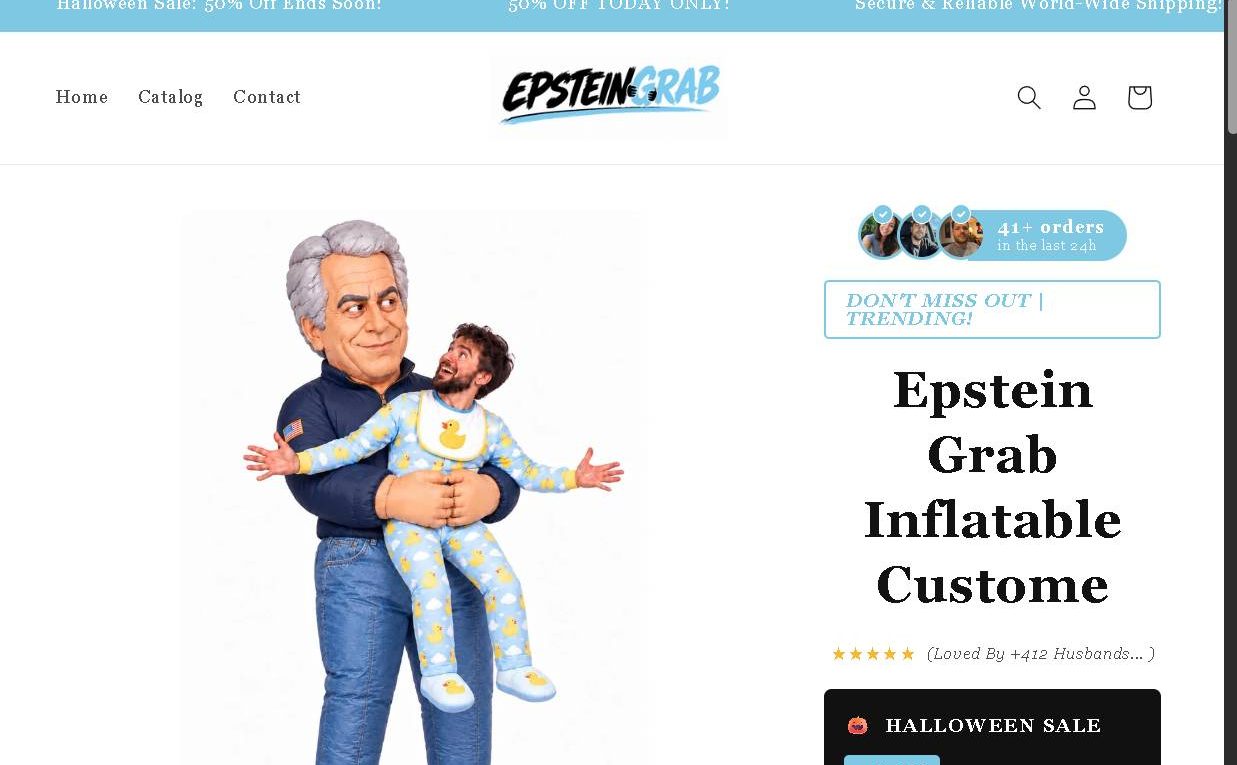
Epsteingrab.shop centers its entire marketing funnel around an inflatable piggyback optical illusion costume featuring a controversial likeness holding an adult dressed in infant attire.
The storefront promotes several specific guarantees to drive fast conversions:
- Exclusivity Claims: The item is framed as a limited viral design, labeled with urgent “Trending” and “Don’t Miss Out” badges.
- Deep Price Slashing: The header pushes an artificial “50% Off Today Only” discount accompanied by a ticker warning that seasonal savings end immediately.
- Expedited Logistics: Banners claim reliable, fully tracked global delivery alongside tight shipping cutoffs designed to force instant orders.
The Operational Reality: A Syndicated Clone
Examining the code and structural framework reveals that Epsteingrab.shop is not an independent brand, but part of a multi-domain scam network:
- Recycled Template Infrastructure: The visual layout, color blocking, and typography are lifted from identical clone storefronts (such as Trumpgrab.shop). The operators merely swap character mockups and brand titles while retaining identical checkout logic.
- Mass-Market Wholesaling: The inflatable suit shown is neither bespoke nor manufactured in-house. It is a standard novelty garment sourced from overseas supplier repositories like AliExpress and 1688 for under $15.
- Logistical Failure by Design: Budget shipping lines from overseas factories take between four and eight weeks. Because the storefront advertises near-instant holiday arrival, consumers invariably receive tracking numbers that stall indefinitely or arrive weeks after their event has passed, leaving them with no customer service recourse.
Every safe click counts. If this post helped, a coffee gesture fuels more scam‑busting investigations.

5 Critical Red Flags Found on Epsteingrab.shop
| Storefront Forensic Diagnostic: Epsteingrab.shop | |
|---|---|
| Security & Authenticity Vector | Observed Evidence on Site |
| 1. High-Level Spelling & URL Defects | Product titled and slugged as “custome” instead of “costume” |
| 2. Hardcoded Social Proof | Fabricated “+412 Husbands” rating string copied across clones |
| 3. Perpetual Manufactured Scarcity | Static “50% OFF TODAY ONLY” urgency loops |
| 4. Burner Domain Architecture | Disposable .shop TLD registered behind privacy proxies |
| 5. Complete Corporate Anonymity | Missing corporate registration, physical hub, and contact line |
1. Blatant Typographical Errors in Production URLs
Legitimate retail platforms execute rigorous quality control before launching commercial campaigns. On Epsteingrab.shop, the primary product title and URL slug explicitly misspell the item as "epstein-grab-inflatable-custome". These crude errors are hallmark indicators of mass-cloned websites rapidly spun up by offshore operators deploying dozens of template sites per day.
To lower buyer hesitation, the page features a review banner reading “★★★★★ (Loved By +412 Husbands…)” next to a floating pop-up claiming “41+ orders in the last 24h”. This metric is entirely fabricated:
- The previous domain in the syndicate used the exact same numeric variable (
+412), merely swapping “Americans” for “Husbands”. - The activity counter relies on client-side JavaScript loops showing static stock images rather than live backend database transactions.
3. False Scarcity and Manipulation Timers
The storefront relies heavily on psychological pressure triggers:
- Persistent announcement bars claiming “50% OFF TODAY ONLY!” and “Halloween Sale Ends Soon!”.
- Warnings claiming that items must be ordered immediately to guarantee arrival before the holiday.
These triggers are hardcoded into the theme and never expire. Their sole purpose is to compel users to input their payment cards before taking time to research the domain’s background.
4. Disposable .shop Top-Level Domain
Established businesses build equity on recognized corporate domains. In contrast, fraudulent pop-up rings almost universally register burner Top-Level Domains (TLDs) such as .shop, .top, or .xyz. These domains can be purchased for negligible fees with no administrative verification, making them ideal for high-turnover scams intended to be abandoned when complaints surface.
5. Opaque Ownership and Unverifiable Identity
A complete absence of corporate accountability permeates the site:
- No registered corporate entity or business registration number.
- No verifiable headquarters or warehouse fulfillment address.
- No operational customer support phone line.
- Basic contact forms routing to unmonitored email aliases.
When an online vendor provides zero legal identity, consumers have no legal standing or direct recourse when paid orders fail to arrive.
If you have already entered debit or credit card credentials on Epsteingrab.shop, take action immediately to safeguard your funds:
- File an Urgent Merchant Dispute: Contact your credit card issuer’s fraud division. State that you purchased from an unverified storefront engaged in deceptive merchant billing and misrepresentation. Request a formal chargeback under non-receipt of merchandise guidelines.
- Cancel and Replace the Affected Card: Pop-up retail traps frequently utilize insecure payment iframes or unencrypted gateways that leak financial details. Have your issuing bank cancel the card number and issue a new card with an updated CVV to prevent unauthorized recurring debits.
- Compile Transaction Proof: Take screenshots of the confirmation receipt, bank statement line items, product descriptions, and unanswered customer support tickets. This documentation serves as necessary evidence during financial arbitration.
- Guard Against Escalated Phishing: Watch for unexpected text messages or phishing emails claiming your package is held at a distribution depot pending payment of an “unpaid customs fee.” Scam networks frequently resell victim contact lists to parcel-delivery phishing rings.
Frequently Asked Questions (FAQ)
1. Is Epsteingrab.shop scam or legit?
Epsteingrab.shop exhibits the classic indicators of a fraudulent pop-up store. It relies on a disposable domain, conceals its corporate operators, contains severe typographical errors in its product listings, and recycles assets from a wider network of deceptive storefronts.
2. Is Epsteingrab.shop legit?
No, Epsteingrab.shop is not a legitimate merchant. It lacks an incorporated business entity, physical address, published phone support, and verifiable customer feedback. It is engineered as a short-lived retail arbitrage funnel targeting impulsive seasonal buyers.
3. What is a short-lived drop-shipping scam?
A short-lived drop-shipping scam is a deceptive retail scheme where operators build single-product online shops targeting viral trends, run paid social ads, collect customer money, and shut down after a few weeks without fulfilling orders or processing legitimate refunds.
4. How can I get a refund if Epsteingrab.shop does not reply?
Because rogue storefronts typically ignore refund requests, your best course of action is to contact your bank or credit card company directly and file a chargeback for non-delivery or deceptive merchant practices.
5. Why do scam websites misspell words like “custome” in their links?
Scam syndicates deploy dozens of automated websites simultaneously to capitalize on seasonal events. These rushed deployments often skip basic proofreading, leading to glaring typos in product descriptions and URL slugs like "inflatable-custome".
6. Can scammers steal my credit card details through these websites?
Yes. Unregulated pop-up checkouts often use untrusted gateways that can capture your credit card number, expiration date, and CVV code, putting you at risk for future unauthorized charges.
7. How do I know if an inflatable costume website is genuine?
Authentic retailers provide clear company registration details, physical street addresses, telephone customer service, realistic domestic shipping timeframes, and independent reviews across third-party consumer protection directories.
8. What should I do if a fake store provides a non-updating tracking number?
Many fraudulent operators generate placeholder tracking labels from overseas logistics couriers to delay buyer disputes. If tracking does not update within a few days, report the transaction to your financial institution immediately.
For more shady sites exposed, check our Shopping Scam Directory — your quick guide to staying safe online.
Help Us Spread Awareness
Please share this article to spread awareness. Follow us on social media for more scam alerts.