Is Mycrazywife.ca a Scam? Ghost Return Scheme Analysis & Review
A viral novelty costume circulating on social media might seem harmless, but consumers landing on Mycrazywife.ca are increasingly waking up to what consumer advocates identify as a Ghost Return & Phantom Guarantee Scheme Scam. These slick, direct-to-consumer storefronts specialize in converting impulse social media clicks into non-refundable transactions through deceptive checkout guarantees.
Before you enter your payment details, it pays to peel back the polished e-commerce veneer. Understanding how storefronts deploy fabricated buyer protections can save you from high-priced billing disputes, unfulfilled deliveries, and unresponsive customer service.
Other sister sites: Wifehug.shop; Trumpgrab; Epsteingrab
Deconstructing the “Ghost Return” & Phantom Guarantee Scheme
A Ghost Return & Phantom Guarantee Scheme Scam operates on psychological reassurance rather than logistical reality. The architecture of the deception relies on front-loading visible trust badges while hiding impassable friction within fine-print disclaimers or customer service dead ends.
Unlike classic phishing operations that siphon banking credentials directly, phantom guarantee platforms collect money legitimately through standard merchant merchant processors. Their trick lies in post-purchase evasion:
- The Phantom Guarantee: The customer sees reassuring promises before buying—”30-Day Money-Back Guarantee,” “Hassle-Free Exchanges,” or “100% Satisfaction Assured.” This effectively lowers the buyer’s risk perception at checkout.
- The Procedural Ghosting: When the product arrives—frequently delayed, poorly stitched, or completely dysfunctional—the customer contacts support for return instructions. The merchant either disappears entirely, directs inquiries to non-responsive web forms, or imposes surprise conditions that make a physical return economically irrational.
- The Dispute Clock Run-Out: The operator offers trivial partial refunds (e.g., 10% to 15%) or drags out email chains with endless verification demands until the consumer’s bank chargeback window expires.
This gray-market maneuver allows the store to harvest substantial margins on cheap wholesale inventory while minimizing returns through manufactured friction.
Suspicious Link or Courier SMS?
Verify URLs, APKs, or parcel alerts against our threat database before clicking.
Case Study: Analyzing the Mechanics of Mycrazywife.ca
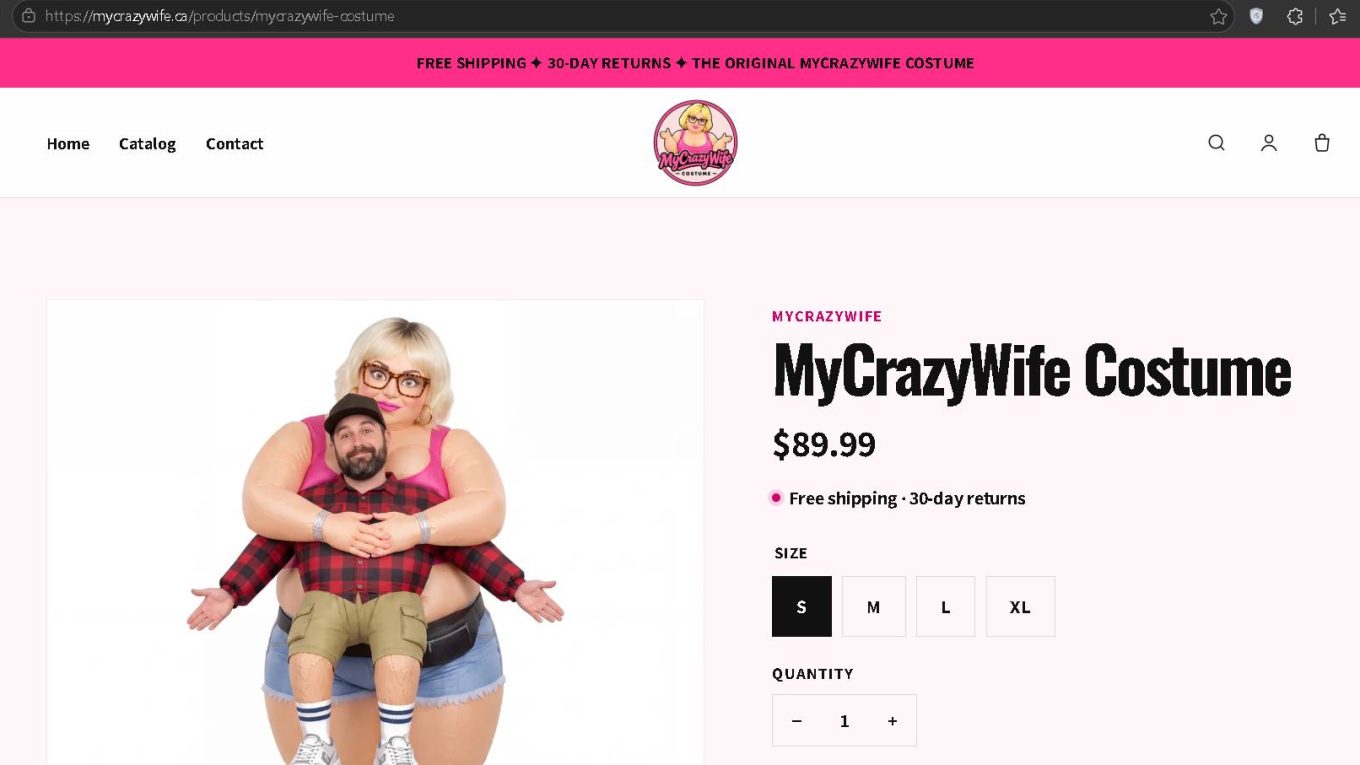
A prime example of this operational profile in action is Mycrazywife.ca. Designed as a minimalist, single-product storefront, the portal funnels incoming traffic directly into a checkout flow built around a viral gag item: the inflatable piggyback husband-and-wife costume.
What Mycrazywife.ca Claims and Offers
At first glance, the platform mimics the design standards of a focused boutique apparel brand:
- The Flagship Product: The site prominently markets the “MyCrazyWife Costume”, showcasing polished lifestyle product imagery depicting an adult carrying an oversized inflatable caricature.
- The Commercial Offer: The product carries a steep retail price of $89.99.
- The Trust Anchor: Running directly across the top utility banner is a bold promise: “FREE SHIPPING ✦ 30-DAY RETURNS ✦ THE ORIGINAL MYCRAZYWIFE COSTUME”. Under the pricing block, the claim is reiterated with an active reassurance tag: “Free shipping · 30-day returns”.
- The Sizing & Checkout Flow: A basic selector displays standard sizes (S, M, L, XL) alongside a direct cart addition button, offering zero garment measurement charts, material specifications, or technical details.
How the Operational Funnel Works Behind the Scenes
Despite carrying a Canadian country-code top-level domain (.ca), storefronts structured in this fashion rarely hold domestic inventory or operate local fulfillment hubs. Instead, they leverage direct-to-consumer drop-shipping frameworks:
- Traffic Acquisition: Traffic is acquired through viral short-form video campaigns on TikTok, Instagram Reels, and Facebook ads showing the funny, finished costume in action.
- Inflated Price Arbitrage: The operator lists the novelty suit for $89.99. Identical mass-produced inflatable suits sourced via bulk overseas manufacturing hubs generally carry a base production cost between $12 and $18.
- Third-Party Fulfillment: Upon completing the transaction, the customer’s shipping information is relayed to an overseas supplier who packages the garment into untracked or slow international mail channels.
- The Post-Purchase Snag: If the package arrives after the party has already passed, or if the internal battery-operated air blower fails, the consumer attempts to claim the advertised “30-Day Return”—only to encounter policy loopholes or an unmonitored mailbox.
E-Commerce Protection Checklist
-
1
Break the In-App Browser Funnel
Never check out inside Instagram or TikTok web-views. Copy the link and open a standalone browser to remove referral tracking tokens and inspect the real root domain.
-
2
Run a 60-Second Background Check
Look up the domain age via WHOIS (avoid sites under 6 months old) and reverse-search product imagery on Google Lens to verify whether cheap wholesale duplicates exist.
-
3
Verify Corporate Entity Details
Check the website footer for a registered legal company name, verifiable physical address on Google Maps, and dedicated phone support—not just an anonymous web form.
-
4
Demand Insulated Payment Options
Refuse direct bank deposits, UPI QR codes, crypto, or debit transfers. Use zero-liability credit cards or protected checkout channels like PayPal Goods & Services.
-
1
Stop Waiting for Merchant Email Replies
Do not waste dispute windows negotiating with automated helpdesks or generic tracking updates. Deceptive pop-up storefronts stall purposely to exhaust chargeback timelines.
-
2
Initiate a Bank Chargeback Within 24-48 Hours
Call the phone number printed on the back of your card. Request an immediate dispute categorized under Merchant Fraud, Goods Not Delivered, or Misrepresentation.
-
3
Freeze Billing and Replace Card Credentials
Instruct your bank’s fraud desk to block future merchant authorizations under that descriptor and re-issue a fresh card number to prevent hidden recurring subscription debits.
-
4
Preserve Order & Ad Evidence
Save full-page screenshots of the product page, transaction debit receipts, and tracking communications to upload directly into your card issuer’s dispute portal.
5 Critical Red Flags Found on Mycrazywife.ca
Examining the visual layout and structural footprint reveals several telltale signals common to transient dropshipping storefronts:
1. Significant Price Markups on Mass-Market Novelties
Novelty nylon inflatables rely on inexpensive blowers and polyester shells. Charging $89.99 for an unbranded holiday outfit represents an aggressive markup intended to maximize profit margins before seasonal search interest drops off.
2. Barren Site Architecture and Omitted Corporate Identity
Legitimate retailers provide clear institutional details: a physical headquarters, a corporate registration number, telephone lines, and warehouse return locations. The navigation on Mycrazywife.ca contains only three bare links: “Home”, “Catalog”, and “Contact”. There is no verifiable company history, no founder attribution, and no formal legal entity listed.
3. Vague Returns Policy vs. Front-Page Guarantees
While the header loudly claims “30-Day Returns”, single-item viral stores frequently conceal return caveats within unlinked or standard boilerplate terms. Common tactics include demanding that costumes remain unopened in airtight packaging, or requiring buyers to pay tracked international postage back to an Asian logistics facility—a cost that often rivals or exceeds the item’s purchase price.
4. Absence of Independent, Verifiable Product Reviews
The product page presents clean catalog photos without an integrated, verified buyer feedback engine. You will not find unedited customer photos, verified delivery timestamps, or reviews addressing the costume’s durability, noise level, or sizing accuracy.
5. Transient Seasonal Infrastructure
The visual presentation follows a standard template commonly used for short-lived stores. These domains are routinely stood up for Halloween, festive holiday rushes, or viral meme spikes, and are subsequently taken offline once consumer dispute rates escalate.
How Consumers Can Protect Themselves and Recover Funds
If you placed an order or are currently attempting an unfulfilled return on a phantom guarantee site, follow these actionable steps:
- Document Everything: Screenshot the product page, the checkout banner advertising “30-day returns”, your order confirmation email, and any tracking updates.
- Initiate a Written Return Request: Send a formal return notice to the designated contact email. Request a domestic return authorization address and establish a clear 48-hour deadline for response.
- File a Merchant Dispute Immediately: If the merchant goes silent, offers an inadequate partial refund (e.g., 10%), or demands that you pay exorbitant overseas shipping for an item advertised locally, contact your issuing credit card company or PayPal. Request a chargeback under “Significantly Not as Described” or “Failure to Honor Advertised Return Policy.”
- Report the Domain: Submit an online fraud and deceptive business complaint to the Canadian Anti-Fraud Centre (CAFC) and the Better Business Bureau (BBB) to help alert financial networks to the domain’s merchant account.
Frequently Asked Questions (FAQ)
1. Is Mycrazywife.ca scam or legit?
Mycrazywife.ca displays operational patterns common to temporary dropshipping operations. While buyers may eventually receive a physical item, the steep retail markup ($89.99), lack of business transparency, and risks associated with its advertised return policy mean buyers should exercise caution.
2. Is Mycrazywife.ca legit for timely costume delivery?
Because the platform relies on third-party overseas fulfillment networks, shipping times can be unpredictable. Anyone ordering for a specific date or holiday risks delayed delivery.
3. What is a Ghost Return and Phantom Guarantee Scheme scam?
It is a deceptive e-commerce practice where an online store advertises risk-free shopping with generous return policies, but uses unresponsive support, fine-print exclusions, or expensive overseas return shipping to prevent customers from securing refunds.
4. Can I get a full refund from Mycrazywife.ca?
Securing a refund through direct support can prove difficult once an item is shipped. If customer support fails to provide a viable return address, you may need to file a formal dispute with your credit card provider.
5. Where is Mycrazywife.ca located and who owns it?
Despite using a .ca domain, the website does not disclose a verifiable business address, parent corporation name, or executive leadership.
6. Why is the Mycrazywife.ca costume priced at $89.99?
The $89.99 price point reflects an arbitrage pricing model. Operators leverage paid social ads to sell viral products at a steep markup compared to base wholesale costs.
7. What should I do if Mycrazywife.ca ignores my return request?
Save copies of all correspondence and your initial return request. Contact your credit card provider’s dispute department to open a formal chargeback claim.
8. How can I verify if an e-commerce website has a genuine return policy?
Before purchasing, locate the merchant’s physical address, inspect their return policy for overseas shipping requirements or restocking fees, and confirm they provide responsive customer service channels beyond a simple web form.
Every safe click counts. If this post helped, a coffee gesture fuels more scam‑busting investigations.

For more shady sites exposed, check our Shopping Scam Directory — your quick guide to staying safe online.
Help Us Spread Awareness
Please share this article to spread awareness. Follow us on social media for more scam alerts.