Zablend.shop Under the Lens: Fancy Trends, Clever Blends, and the Markup at Both Ends
Discovering trending gadgets through viral social media algorithms often lands curious shoppers directly on zablend.shop, a website currently driving a high-margin White-Label Dropshipping Markup campaign under the guise of an innovative lifestyle brand.
While promotional clips make the featured device appear to be an exclusive, in-house technical breakthrough, a closer examination reveals an operation that charges substantial premiums for mass-market, factory-direct inventory.
Navigating contemporary direct-to-consumer funnels requires understanding how digital arbitrage stores turn inexpensive wholesale goods into viral luxury sensations. Investigating the operational footprint of zablend.shop provides a clear case study in how white-label dropshipping models operate, highlighting critical transactional red flags, legal fulfillment pitfalls, and the exact steps international consumers should take to secure their banking funds against non-delivery or deceptive retail practices.
The Fundamentals of a White-Label Dropshipping Markup
To assess websites like zablend.shop, consumers must understand the economic mechanisms behind modern supply chain arbitrage. A White-Label Dropshipping Markup is a commercial practice where an independent digital marketer identifies an unbranded, mass-produced product from an overseas manufacturing plant, renames the item with custom digital branding, and sells it at an inflated retail price without maintaining physical inventory or handling quality assurance.
In standard e-commerce, a legitimate brand invests capital into research, prototype development, material safety testing, domestic warehousing, and dedicated customer service infrastructure. Because these companies carry inventory risk and overhead costs, their profit margins reflect tangible product development.
Suspicious Link or Courier SMS?
Verify URLs, APKs, or parcel alerts against our threat database before clicking.
In contrast, a white-label dropshipper operates exclusively as a digital middleman. The marketer creates a streamlined storefront using templates from hosting platforms like Shopify or WooCommerce, sources pre-existing video clips from Chinese supplier directories (such as AliExpress, 1688, Taobao, or CJ Dropshipping), and sets up automated software hooks. When an end consumer purchases the item:
- The customer pays the inflated retail price (often $40 to $60).
- The dropshipper’s backend software places an identical order with the wholesale manufacturer using the customer’s personal delivery address, paying the base wholesale rate ($8 to $14).
- The merchant pockets the remaining margin as profit while transferring all fulfillment, transit delays, and mechanical defects entirely onto the overseas factory and the unsuspecting buyer.
This framework introduces substantial consumer risk. Because the store owner never inspects the physical goods, items often arrive defective, underpowered, or missing critical safety disclosures. When consumers seek refunds, dropshippers frequently rely on delayed email responses or complex return terms to prevent chargebacks.
E-Commerce Protection Checklist
-
1
Break the In-App Browser Funnel
Never check out inside Instagram or TikTok web-views. Copy the link and open a standalone browser to remove referral tracking tokens and inspect the real root domain.
-
2
Run a 60-Second Background Check
Look up the domain age via WHOIS (avoid sites under 6 months old) and reverse-search product imagery on Google Lens to verify whether cheap wholesale duplicates exist.
-
3
Verify Corporate Entity Details
Check the website footer for a registered legal company name, verifiable physical address on Google Maps, and dedicated phone support—not just an anonymous web form.
-
4
Demand Insulated Payment Options
Refuse direct bank deposits, UPI QR codes, crypto, or debit transfers. Use zero-liability credit cards or protected checkout channels like PayPal Goods & Services.
-
1
Stop Waiting for Merchant Email Replies
Do not waste dispute windows negotiating with automated helpdesks or generic tracking updates. Deceptive pop-up storefronts stall purposely to exhaust chargeback timelines.
-
2
Initiate a Bank Chargeback Within 24-48 Hours
Call the phone number printed on the back of your card. Request an immediate dispute categorized under Merchant Fraud, Goods Not Delivered, or Misrepresentation.
-
3
Freeze Billing and Replace Card Credentials
Instruct your bank’s fraud desk to block future merchant authorizations under that descriptor and re-issue a fresh card number to prevent hidden recurring subscription debits.
-
4
Preserve Order & Ad Evidence
Save full-page screenshots of the product page, transaction debit receipts, and tracking communications to upload directly into your card issuer’s dispute portal.
Case Study: Deconstructing the zablend.shop Operation
Applying these principles to zablend.shop (trading as Za Blender or ZaBlendPro) reveals how direct-response digital marketing exploits viral enthusiasm to drive high-margin impulse sales.
           [ Wholesale Factory Platform ]
          (AliExpress / CJ Dropshipping OEM)
         • Generic 2-in-1 Grinder & Cone Filler
         • Wholesale Factory Cost: $9 – $14
                         │
                         ▼
   ┌────────────────────────────────────────────────────────┐
   │            Sales Funnel: zablend.shop                  │
   │  ┌─────────────────────────┐  ┌─────────────────────┐  │
   │  │ Rebranded Lifestyle UI  │  │ Arbitrage Economics │  │
   │  │ • Rebadged "ZaBlendPro" │  │ • Listed: $40 - $55 │  │
   │  │ • Looping Scarcity Clock│  │ • ~300% Markup      │  │
   │  │ • Unverified 5★ Badges  │  │ • Zero Local Stock  │  │
   │  └─────────────────────────┘  └─────────────────────┘  │
   └────────────────────────────────────────────────────────┘
                         │
        (Targeted Social Media Ad Traffic)
                         │
                         ▼
             [ Consumer Places Order ]
                         │
       ┌─────────────────┴─────────────────┐
       ▼                                   ▼
 [ Order Routed Overseas ]      [ Customer Support Gap ]
 • Slow cross-border transit    • Ghosted refund requests
 • Budget postal tracking      • Costly overseas returns
Digital Architecture and Operating Flow
The site is built as a single-product conversion engine, structured specifically to prevent users from navigating away to compare prices across open marketplaces. Rather than functioning as a standard department catalog, every headline, product photography carousel, and call-to-action button pushes the visitor toward a single transactional goal: the immediate checkout of the “ZaBlendPro”.
The site operators source short-form promotional footage showing young adults effortlessly packing pre-rolled paper cones using an automated, battery-operated dispenser. These clips are published as paid advertisements across social feeds. The ads lead directly to a landing page featuring trust badges, customer satisfaction claims, and streamlined payment options designed to minimize hesitation.
What the Site Claims and Offers
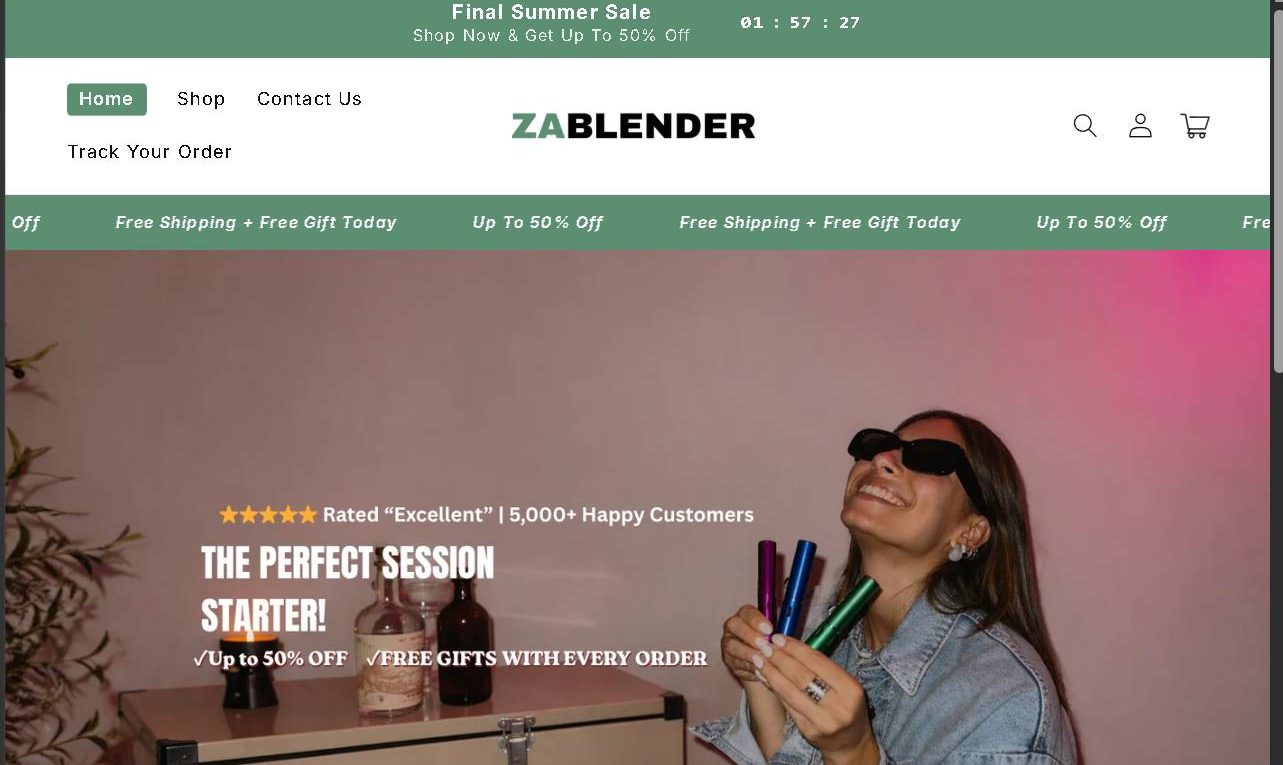
- Proprietary Innovation Claims: Markets the device as a custom-engineered, patent-style lifestyle accessory (“The Perfect Session Starter!”) featuring high-torque electric grinding teeth and smooth funnel dispersion.
- Deep Percentage Markdowns: Claims the product is currently discounted by “Up to 50% Off” down from an artificial reference price, accompanied by offers of “Free Gifts With Every Order”.
- Manufactured Scarcity: Features a sitewide announcement bar with a ticking countdown clock labeled “Final Summer Sale”, suggesting that the discount will expire within minutes.
- Unsubstantiated Social Proof: Prominently advertises that the device is Rated “Excellent” | 5,000+ Happy Customers, despite running on a newly registered storefront with minimal external audit trails.
5 Critical Red Flags on zablend.shop
1. Substantial Price Inflation Over Identical Wholesale Items
The flagship device advertised on zablend.shop is not a proprietary invention. A visual audit reveals the exact same motorized, rechargeable cone roller and grinder manufactured across industrial hubs in Guangdong and Zhejiang, China.
The item is sold on major e-commerce platforms and wholesale directories under interchangeable labels (such as Apexora, Yanzhenglip, or generic OEM numbers) for roughly $10 to $18 with domestic warranty options. On zablend.shop, consumers pay upwards of $40 to $50—a markup exceeding 300% for the exact same manufacturing run.
2. Fabricated Scarcity and Looping JavaScript Timers
The countdown banner counting down from two hours is an artificial sales tactic. If you refresh the browser, clear your tracking cookies, or revisit the link on a separate device, the timer resets to its initial position.
Authentic commercial enterprises schedule promotional sales around concrete fiscal periods, whereas dropshipping landing pages deploy artificial countdown loops to induce fear of missing out (FOMO) and deter price cross-referencing.
3. Customer Service Ghosting and Support Bottlenecks
Multiple consumer reports on public review registries point to severe post-purchase support issues. While automated confirmation receipts are issued immediately, buyers who reach out regarding delayed shipments, defective motors, or damaged packaging report receiving no substantive assistance from the listed contact address (zablendpro@gmail.com).
Using a free webmail address rather than a domain-level enterprise portal (support@zablend.shop) is an established indicator of an under-resourced dropshipping side venture.
4. Burdensome and Impractical Return Clauses
The storefront’s stated return policy requires products to be returned in their original, unopened packaging, with the consumer bearing all international shipping, tracking, and customs expenses.
Because returning a small battery-powered electronic parcel to an overseas fulfillment depot via tracked air courier often costs between $25 and $40, returning the product is financially unviable. The merchant leverages these shipping logistics to effectively nullify its satisfaction guarantee.
5. Ephemeral Infrastructure on Disposable Domain Extensions
The storefront operates on a .shop top-level domain registered behind identity-cloaking proxy services. Unlike established retail platforms that maintain transparent corporate disclosures, verifiable business tax identification numbers, physical office registrations, and corporate governance documentation, single-product dropshipping outlets rarely last more than a few fiscal quarters.
Once customer complaints accumulate or merchant processors flag their account for dispute volume, operators often abandon the domain and relaunch the same catalog under a new web address.
Action Plan: Direct Guidance for Consumers
Whether you are considering an order or have already completed a purchase on zablend.shop, take these concrete steps to protect your finances:
- Conduct a Reverse Image Search Before Buying: Save the primary product photo and run it through Google Lens or major retail image search tools. You can identify the underlying generic manufacturing model within seconds, read unbiased reviews from thousands of verified purchasers, and buy it at a fraction of the cost through platforms offering clear dispute policies.
- Initiate a Merchant Dispute if Delivery Lags: If you already placed an order and your tracking number remains inactive past the promised delivery window, contact your bank or credit card company immediately. Request a formal credit card chargeback on the grounds of merchant non-fulfillment.
- Document Defective Merchandise Immediately: If the package arrives and the grinder motor fails, jams, or does not operate as advertised, record continuous video footage of the unboxing and testing process. Take high-resolution photographs of the physical package, the shipping label showing the true origin address, and any included documentation. This visual record provides necessary evidence if you need to open a banking dispute for defective goods.
- Escalate Ghosted Customer Support: If the merchant fails to respond to your written cancellation or refund requests within 72 hours, export the email thread into PDF format. Submit this documentation to your payment provider to show that you made a good-faith effort to resolve the dispute directly before requesting an administrative payment reversal.
- Always Avoid Direct Debit Checkout: When testing new niche brands found through social feeds, avoid using direct bank debit cards. Credit cards and verified third-party payment platforms (such as PayPal) provide statutory buyer protections and fraud dispute mechanisms that keep your primary bank account insulated from unauthorized charges.
Frequently Asked Questions
Is zablend.shop scam?
While zablend.shop is not an outright phishing portal designed to harvest and sell credit card information, it exhibits high-risk operational patterns. It sells generic white-label factory goods at substantial markups, deploys artificial countdown timers to manufacture urgency, and has documented records of poor customer support responsiveness.
Is zablend.shop legit?
Technically, it is an active e-commerce storefront operating on the Shopify platform. However, it is not an original manufacturer or an innovative consumer technology enterprise. It functions strictly as an intermediary dropshipper reselling mass-produced electronic herb grinders sourced from wholesale channels.
What is the primary product offered by Za Blender?
The platform focuses almost exclusively on marketing a portable, USB-rechargeable electric herb grinder combined with a direct-pour cone filler, marketed under the proprietary product name “ZaBlendPro 2in1 Roller”.
Why is the Za Blender grinder available for significantly less money elsewhere?
The gadget is manufactured in volume by third-party white-label factories that sell the item without branding to anyone willing to buy wholesale. Dropshipping storefronts rebrand these units and apply large markups to cover their paid social media advertising costs, whereas high-volume marketplace sellers price them closer to wholesale cost.
What should I do if my shipment from zablend.shop never arrives?
If your order does not arrive within the advertised shipping timeline and the merchant fails to provide valid, traceable delivery updates via their support email, contact your card-issuing bank and file an official merchant fraud dispute or payment chargeback for non-delivery.
How does a white-label dropshipping markup affect consumer warranties?
Because dropshippers do not maintain authorized relationships with component manufacturers or run local service centers, they rarely honor multi-year warranties. If an electronic component fails after the initial chargeback window closes, the consumer has virtually no way to claim replacement parts or technical repairs.
Can an SSL certificate verify that zablend.shop is a trustworthy business?
No. An SSL certificate simply guarantees that the digital communication between your personal web browser and the site’s server is encrypted in transit. It does not verify the merchant’s business integrity, inventory ownership, or customer fulfillment standards.
Look for single-product storefront designs, looping promotional countdown timers, vague “About Us” pages without corporate addresses, absence of working phone support, and reviews limited exclusively to the merchant’s proprietary product page.
Every safe click counts. If this post helped, a coffee gesture fuels more scam‑busting investigations.

For more shady sites exposed, check our Shopping Scam Directory — your quick guide to staying safe online.
Help Us Spread Awareness
Please share this article to spread awareness. Follow us on social media for more scam alerts.