Yuwdk Review: Is It a Scam or Legit Shopping Site?
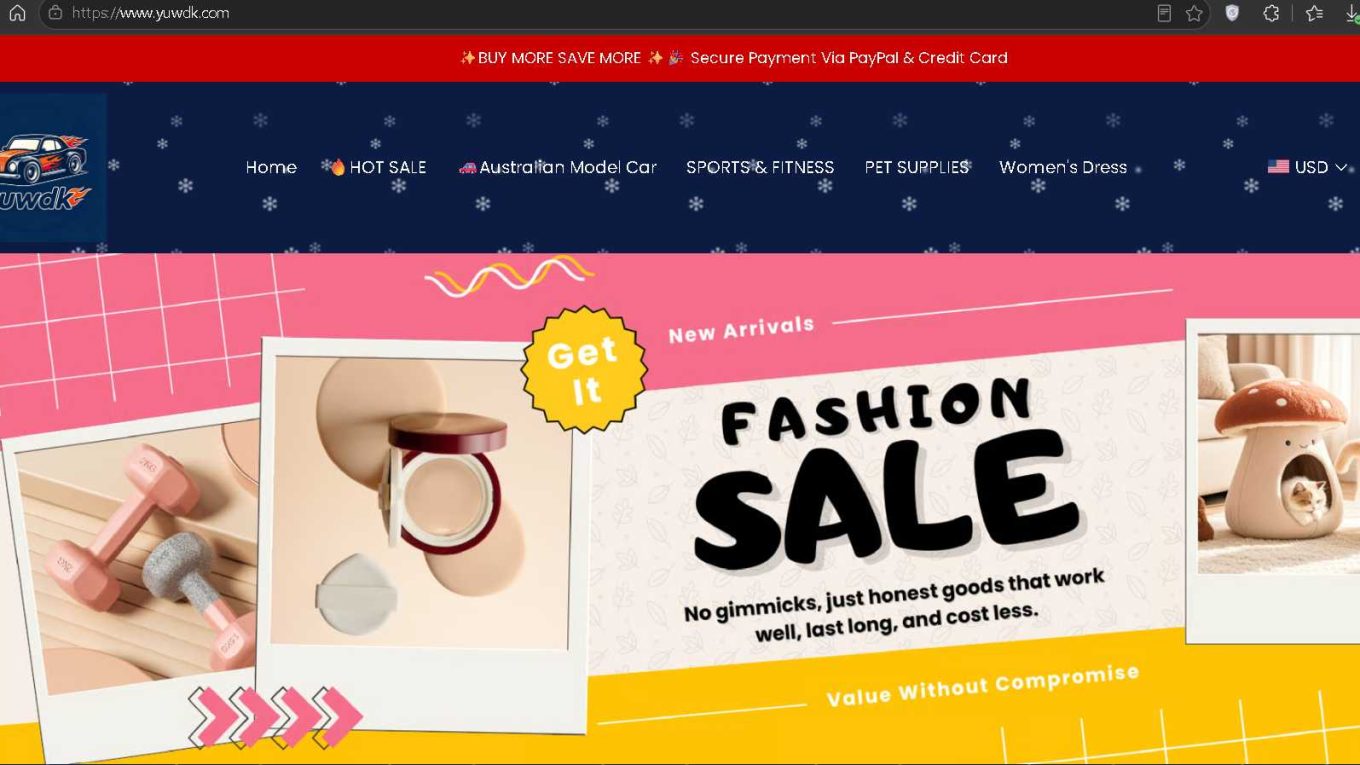
Yuwdk markets itself as a modern, catch-all retail emporium offering massive promotional markdowns across lifestyle goods, apparel, and specialty hobby gear. The storefront targets cross-border online shoppers in the United States, the United Kingdom, Canada, and Australia through aggressive promotional discounts, cutting prices by 50% or more under permanent “Hot Sale” banners.
The catalog presents a jarring array of inventory, ranging from niche Australian model cars and pet furniture to women’s floral maxi dresses and home workout gear. Despite the colorful web design and claims of trusted, secure checkouts, the platform is an unauthorized storefront. It is entirely unsafe for consumer transactions.
Our technical examination reveals that Yuwdk operates as an untraceable synthetic storefront linked directly to an established syndicate of disposable scam portals. The platform utilizes scraped catalog assets from legitimate online retailers while completely obscuring its corporate ownership behind anonymized registry shields.
This investigative audit breaks down the underlying network infrastructure of the domain, examines its payment collection channels, and provides clear recovery steps for defrauded consumers.
What Is Yuwdk Doing?
Yuwdk functions as an ephemeral e-commerce shell built to siphon card payments and harvest consumer personal identifiable information (PII). The operators acquire incoming traffic by purchasing programmatic social media placements on platforms like Facebook, Instagram, and Pinterest. These campaigns exploit discount-hunting shoppers by presenting niche hobby products or seasonal apparel as temporary overstock or liquidation events.
Once a user visits the storefront, the site deploys automated cart prompts and discount countdown timers. It mimics legitimate e-commerce retailers through modern layout grids, floating shopping carts, and trust badges advertising safe transactions. Behind this facade, the platform lacks authentic commercial infrastructure. It functions without official distribution rights or direct merchant relationships with brand manufacturers, operating solely to funnel customer payments into unverified third-party accounts.
What Yuwdk Site Selling?
The storefront lists an incoherent mix of merchandise that lacks any retail focus. Its primary navigation menu features disparate categories: Australian Model Car, Sports & Fitness, Pet Supplies, and Women’s Dress. Specific items include scale diecast vehicles, plush mushroom-shaped cat beds, cosmetic cushion compacts, dumbbell sets, and casual summer maxi dresses.
This inventory profile is economically unfeasible for an authentic, independent business. Legitimate specialty merchants do not curate high-precision diecast collectors’ models alongside fast-fashion dresses and pet accessories under one roof. Furthermore, every item carries a permanent 50% discount paired with multi-buy incentives like “Buy 2 Free Shipping.” The platform populates this catalog by mass-scraping product photography, descriptions, and proprietary studio assets from legitimate merchants without authorization.
How the Scam Works
The operational lifecycle follows a four-stage extraction process:
- Ad Click to Cart Checkout: Shoppers discover sponsored promotions on search pages or algorithmic social media feeds. Clicking the ad directs the shopper to an optimized product page featuring low prices, “Buy More Save More” banners, and free shipping thresholds set at $69.99.
- The Payment Diversion: During checkout, the customer submits their full name, shipping destination, phone number, and card details. Although the page displays recognizable Visa, Mastercard, and PayPal logos to imply safety, the backend diverts transactions through high-risk payment aggregators or offshore shell entities. Billing descriptors on customer statements frequently display unrelated merchant codes rather than a verified corporate entity matching the domain.
- The Post-Purchase Blackout: After payment processing, the platform issues automated transactional receipts with non-existent or falsified logistics tracking numbers. Communication ceases, or support staff stalls by claiming packages are in customs. If physical packages arrive weeks later, they routinely contain cheap plastic trinkets, counterfeit jewelry, or low-grade foam items that do not match the order. This tactic exploits postal delivery confirmation loopholes to complicate bank disputes.
- The Financial Fallout: Beyond losing the initial purchase funds, buyers face compromised personal data. The operators retain payment card numbers, billing addresses, and personal contact parameters. This information is routinely packaged into darknet credential dumps or used for unauthorized recurring charges across secondary merchant processors.
Critical Red Flags
| Signal / Feature | Yuwdk.com Status | Legitimate Retail Standard |
|---|---|---|
| Domain Construction | Random 5-letter jumble string; privacy-redacted WHOIS | Descriptive brand domain; verifiable corporate ownership history |
| Syndicate Metadata | Customer support directed to serviceteam@adorebuy.com | Dedicated corporate email domain matching the storefront name |
| Catalog Coherence | Unrelated mix (model cars, pet supplies, dresses) | Cohesive inventory curated around specific retail categories |
| Customer Service | Shared webmail address; non-functional live chat | Verifiable physical office address, live phone, dedicated support |
| Pricing Strategy | Permanent 50% markdown on entire catalog with multi-buy traps | Sustainable retail margins based on authentic wholesale costs |
- Connection to the “Adorebuy” Scam Network: Yuwdk lists its customer service email as
serviceteam@adorebuy.com. Threat intelligence data confirms this exact inbox serves as the shared clearinghouse for dozens of identical, short-lived scam storefronts (including domains like zokws.com and glimlair.com). - Randomized Jumble Domain: The domain name
yuwdkis an arbitrary string of characters designed for rapid, programmatic deployment to evade domain-level search blacklists. - Absence of Physical Corporate Nexus: The storefront provides no corporate registration, business tax identification, or physical corporate address anywhere within its legal policies.
Risk Parameters & Technical Profile
- Domain Registration Age & Registrar: Registered anonymously through a commercial domain registrar with complete WHOIS privacy redaction, concealing registrant name and physical location.
- SSL Certificate Configuration: Uses a basic, automated Domain Validated (DV) certificate. This encrypts data in transit but provides zero verification of the business operating the server.
- Hosting Infrastructure: Hosted on shared cloud networks utilizing reverse-proxy firewalls, hiding the real hosting origin and frustrating IP-level enforcement.
- Payment Gateway Security: Operates without transparent, Level-1 PCI-DSS compliant direct gateways. Transactions route through merchant aggregators, exposing shoppers to unvetted surcharges and unauthorized capture.
- Consumer Legal Recourse Level: Zero corporate accountability within US, UK, Canadian, or Australian consumer protection jurisdictions.
These technical indicators represent a severe risk to consumer financial security. Transacting on this platform exposes personal identity records and financial accounts to international card-not-present (CNP) fraud syndicates.
Conclusion
Yuwdk displays every hallmark of a synthetic drop-shipping shell and credential harvesting storefront. Its scraped catalog, randomized domain name, and operational ties to the notorious adorebuy.com scam network confirm it exists outside legitimate retail standards. Transacting with this storefront exposes your money to theft, with virtually no possibility of receiving the advertised merchandise.
If you have already submitted payment credentials on Yuwdk, take immediate defensive action. Contact your bank or credit card company to report the transaction as fraud and request an immediate card cancellation and reissuance. Initiate an administrative chargeback citing non-delivery and merchant fraud under Regulation E, Fair Credit Billing Act protocols, or UK Section 75 consumer protections. Monitor your bank statements closely for unauthorized micro-transactions over the coming months.
“When an online store pairs random domain letters with unrelated clearance goods and a recycled support inbox, you are not browsing a bargain—you are viewing a synthetic trap designed to harvest your credit card.”
👉 For more shady sites exposed, check our Shopping Scam Directory — your quick guide to staying safe online.
Every safe click counts. If this post helped, a coffee gesture fuels more scam‑busting investigations.

Call to Action
Please share this article to spread awareness. Follow us on Facebook, Twitter, and Instagram for more scam alerts. If you doubt the legitimacy of any website or investment plan, DM us on social media — we’ll help you verify.
“Scammers evolve daily. Subscribe to our scam‑alert list and stay one step ahead.”