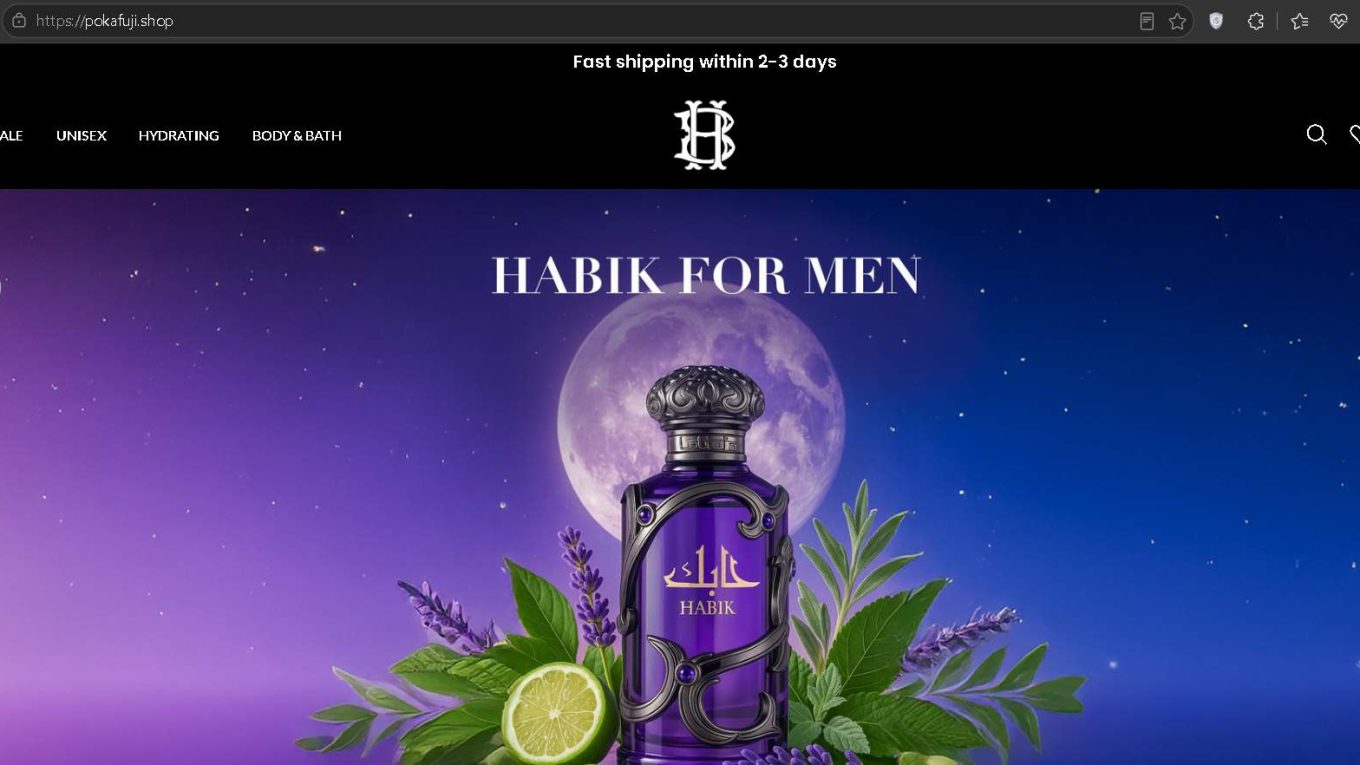
Pokafuji.shop Scam Warning: Red Flags, Fake Discounts & Checkout Risks
Pokafuji.shop markets itself as a premier digital boutique offering luxury fragrances and designer cosmetics at steep clearance rates. The storefront targets shoppers across the United States, the United Kingdom, Canada, and Australia through aggressive promotional discounts promising up to 70% to 80% off retail list prices.
The digital catalog showcases prestige brands such as Lattafa, Acqua Di Parma, and Boadicea The Victorious. Despite the polished exterior and promises of fast dispatch, the platform is an unauthorized storefront. It is entirely unsafe for consumer transactions.
Our technical examination reveals that Pokafuji.shop operates as a synthetic storefront designed to capture consumer financial details and process unauthorized payments. The platform utilizes duplicated assets from legitimate perfume distributors and masks its corporate ownership behind anonymized domain records.
This investigative audit breaks down the underlying infrastructure of the domain, analyzes the payment routing mechanics, and outlines critical recovery protocols for impacted shoppers.
What Is Pokafuji.shop Doing?
Pokafuji.shop operates as an ephemeral e-commerce shell designed to siphon customer capital and harvesting personal identifiable information (PII). The operators drive top-of-funnel traffic by purchasing programmatic social media placements on platforms like Facebook, Instagram, and TikTok.
These sponsored campaigns exploit discount-seeking consumer habits by framing luxury brand inventory as sudden overstock or warehouse liquidations.
Once a visitor lands on the site, the platform deploys basic session-capture scripts within a templated WooCommerce and WordPress framework. It mimics genuine high-end retail through clean catalog formatting, security trust badges, and floating cart interfaces.
Behind this exterior, the site lacks legitimate commercial integration. The storefront functions without a merchant processing agreement with legitimate luxury distribution houses, operating solely to divert incoming funds into unmonitored accounts.
What Is Pokafuji.shop Selling?
The storefront lists an expansive catalog of high-end perfumes, colognes, and luxury skincare. High-demand inventory includes Acqua Di Parma Blu Mediterraneo, 4711 Eau de Cologne, and elite niche releases such as Boadicea The Victorious Valiant. These bottles carry legitimate Manufacturer Suggested Retail Prices (MSRP) ranging from $150 to well over $900 in official department stores. Pokafuji.shop lists these exact luxury items between $11 and $198.
This pricing model is economically unfeasible for authentic retail operations. Luxury fragrance producers enforce strict Minimum Advertised Price (MAP) policies and tightly limit distribution to authorized, vetted retail partners. Offering 70% to 80% off on prestige formulations does not align with wholesale distribution realities. The site populates its catalog by scraping high-resolution product imagery, promotional banners, and marketing descriptions directly from authentic brand portals without permission.
How the Scam Works
The operational lifecycle follows a systematic extraction pipeline:
- Ad Click to Cart Checkout: Prospective victims encounter sponsored promotions on algorithmic social feeds. Clicking the ad routes the user directly to a product page optimized for impulse checkout. The site creates a false sense of security with prominent header banners promising fast shipping within two to three days.
- The Payment Diversion: During checkout, the customer inputs their name, physical address, and payment card details. While the checkout interface displays standard Visa, Mastercard, and PayPal logos to imply safety, the backend routes the transaction through high-risk, unverified third-party merchant accounts or offshore shell entities. In many cases, billing statements reveal unrelated business descriptors rather than an authorized charge from the domain.
- The Post-Purchase Blackout: Once funds clear, genuine order confirmation fails to materialize. Customers receive either automated transactional emails with non-functional tracking numbers or completely bogus logistics updates. The platform either ceases communication entirely or generates fake international shipping manifests that track phantom logistics hubs overseas. If physical parcels arrive weeks later, they routinely contain cheap plastic trinkets, counterfeit samples, or unrelated low-value accessories designed to exploit postal delivery confirmation loopholes.
- The Financial Fallout: Beyond the immediate loss of purchase funds, buyers face severe secondary risks. The operators retain the unencrypted payment card numbers, billing addresses, and contact parameters. This data is either resold across darknet retail dumps or weaponized for recurring, unauthorized micro-charges across diverse digital merchant accounts.
Critical Red Flags
| Signal / Feature | Pokafuji.shop Status | Legitimate Retail Standard |
| Domain Lifecycle | Freshly registered .shop asset; anonymous registrar profile | Established multi-year domain history; verifiable corporate entity |
| Corporate Identity | Anonymous operators; metadata lists disconnected domains | Registered business name, corporate registry filing, and tax ID |
| Catalog Asset Sourcing | Scraped stock imagery; stolen trademark collateral | Direct brand authorization; original studio product photography |
| Contact Nexus | Web form only; external email (service@beautyhousehub.shop) | Physical headquarters address, dedicated corporate email, direct phone |
| Pricing Viability | 70% to 80% below luxury wholesale minimums | Strict adherence to brand MAP policies and sustainable margins |
- Metadata and Policy Discrepancies: Internal site code and privacy documentation refer to the business simply as “Beauty,” directing support requests to an entirely separate domain (
beautyhousehub.shop). This confirms the platform is a clone from an automated scam template factory. - ICANN Registry Anonymity: WHOIS records show strict domain privacy shielding via the registrar, completely obscuring the registrant name, administrative organization, and geographic jurisdiction.
- Absence of Physical Nexus: The site lists no physical corporate address, direct telephone support line, or verified commercial registration anywhere within its documentation.
Risk Parameters & Technical Profile
- Domain Registration Age & Registrar: The domain is a newly registered asset utilizing the low-cost
.shopgeneric top-level domain (gTLD), provisioned through a mass registrar with total privacy redaction. - SSL Certificate Configuration: Employs a free, automated Domain Validated (DV) certificate. It confirms transient transport encryption but offers zero vetting of the underlying corporate entity.
- Hosting Infrastructure: Operates behind shared IP clusters and reverse-proxy firewalls designed to obfuscate the real server origin and prevent IP-based blacklisting.
- Payment Gateway Security: Lacks standard Level-1 PCI-DSS compliant direct integrations. Transactions route through merchant account aggregators, exposing users to unauthorized surcharges and unvetted payment capture.
- Consumer Legal Recourse Level: Zero jurisdictional presence in the US, UK, Canada, or Australia. The absence of corporate accountability leaves consumers with zero recourse under domestic small-claims or standard consumer protection frameworks.
These parameters represent a critical risk to user financial assets and personal identity integrity. Supplying credentials to this platform exposes banking data to card-not-present (CNP) fraud networks.
Conclusion
Pokafuji.shop displays all the operational indicators of an untraceable drop-shipping shell and credential harvesting storefront. Its reliance on stolen brand imagery, economically unviable fragrance discounts, and cloaked registrar records confirms it operates entirely outside legal retail frameworks.
Engaging with this platform places your capital at immediate risk of theft, with zero reasonable expectation of receiving genuine luxury goods.
If you have already submitted payment details on this site, initiate defensive financial actions immediately. Contact your issuing bank or credit card company to report the transaction as fraud and request an immediate card cancellation and replacement.
File for an administrative chargeback citing non-delivery and merchant fraud under Regulation E, Fair Credit Billing Act protocols, or UK Section 75 consumer protections. Finally, monitor your monthly statements closely for unauthorized recurring micro-transactions.
“Authentic luxury goods never abandon basic economic math; when prices plunge below wholesale reality, you are not buying discounted inventory—you are financing an untraceable merchant trap.”
👉 For more shady sites exposed, check our Shopping Scam Directory — your quick guide to staying safe online.
Every safe click counts. If this post helped, a coffee gesture fuels more scam‑busting investigations.

Call to Action
Please share this article to spread awareness. Follow us on Facebook, Twitter, and Instagram for more scam alerts. If you doubt the legitimacy of any website or investment plan, DM us on social media — we’ll help you verify.
“Scammers evolve daily. Subscribe to our scam‑alert list and stay one step ahead.”