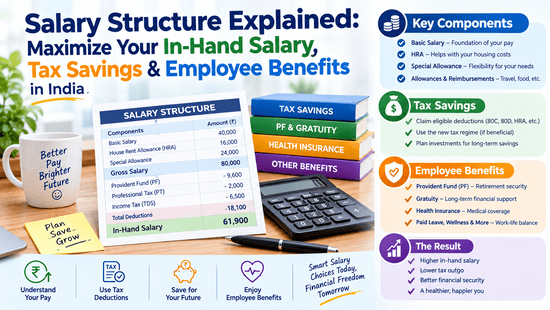
Salary Structure Explained: Maximize Your In-Hand Salary, Tax Savings & Employee Benefits in India
When most professionals receive a job offer, the first thing they usually look at is the CTC (Cost to Company). A higher CTC often feels exciting, but many employees are surprised when their actual in-hand salary is much lower than expected.
Why does this happen?
The answer lies in understanding your salary structure and its components.
Whether you’re a fresher comparing job offers, an experienced professional negotiating compensation, or an HR manager designing salary packages, understanding salary structure is essential. A well-designed salary structure not only determines take-home pay but also impacts tax liability, retirement benefits, and overall financial planning.
Having worked in HR and recruitment, I’ve noticed that one of the most common questions from candidates is:
“My CTC is ₹8 lakh, so why is my monthly salary much lower?”
The confusion usually comes from not understanding how salary components are divided.
In this guide, we’ll break down salary structure in simple terms and explain every major component that forms part of an employee’s compensation package in India.
What is Salary Structure?
A salary structure is the detailed breakdown of an employee’s compensation package.
Instead of paying the entire salary as one lump sum, organizations divide compensation into different components such as:
- Basic Salary
- House Rent Allowance (HRA)
- Special Allowance
- Provident Fund (PF)
- Bonuses
- Gratuity
- Tax Deductions
These components collectively determine:
✅ In-hand salary
✅ Tax liability
✅ Retirement benefits
✅ Employer contributions
✅ Employee benefits
A properly structured salary package benefits both employees and employers.
Understanding CTC (Cost to Company)
Before discussing salary components, it’s important to understand CTC.
Cost to Company (CTC) represents the total annual cost incurred by an employer for an employee.
CTC typically includes:
- Fixed Salary
- Variable Pay
- Bonuses
- Provident Fund Contributions
- Gratuity
- Insurance Benefits
- Other Benefits
Example
Suppose a company offers:
CTC = ₹10,00,000 per year
This does not mean the employee receives ₹10,00,000 directly in their bank account.
The actual take-home salary will be lower after deductions and employer contributions.
Major Components of Salary Structure
Let’s understand each salary component in detail.
1. Basic Salary
The Basic Salary is the core component of an employee’s compensation.
It typically constitutes:
30% to 50% of total CTC
Many other salary components are calculated based on Basic Salary.
Why Basic Salary Matters
Basic Salary influences:
- Provident Fund contributions
- Gratuity calculations
- Bonus eligibility
- Retirement benefits
Example
If an employee’s CTC is ₹8 lakh, the Basic Salary may be around ₹3 lakh to ₹4 lakh annually depending on company policy.
2. House Rent Allowance (HRA)
HRA is provided to employees who live in rented accommodation.
Purpose
To help employees meet housing expenses.
Benefits
HRA can offer tax advantages under applicable tax provisions if the employee lives in rented accommodation and meets required conditions.
Why It Matters
HRA is one of the most significant tax-saving components in a traditional salary structure.
3. Dearness Allowance (DA)
Dearness Allowance is more commonly associated with:
- Government employees
- Public sector employees
Its purpose is to help employees manage the impact of inflation.
Private organizations may or may not include DA in salary packages.
4. Special Allowance
Special Allowance is often used as a balancing component in salary structures.
It includes the remaining amount after accounting for:
- Basic Salary
- HRA
- Other allowances
Many private-sector salary structures use Special Allowance extensively.
5. Conveyance Allowance
Traditionally, employers provided conveyance allowance to compensate for travel expenses incurred while commuting to work.
Although compensation structures have evolved over time, some organizations continue to include transportation-related benefits in various forms.
6. Medical Allowance and Healthcare Benefits
Many employers provide medical-related benefits through:
- Group health insurance
- Medical reimbursements
- Employee wellness programs
Healthcare benefits play an important role in overall compensation packages.
7. Leave Travel Allowance (LTA)
LTA is offered to support employee travel expenses during leave periods.
Employees may be eligible for tax benefits under specific conditions and applicable tax regulations.
Organizations usually define LTA policies in their compensation structure.
8. Meal and Food Benefits
Many companies provide:
- Meal cards
- Food coupons
- Cafeteria benefits
- Digital meal wallets
These benefits improve overall employee welfare and compensation value.
Employer Contribution Components
Many employees forget that salary packages often include employer-funded benefits.
9. Provident Fund (PF)
Provident Fund is one of India’s most important retirement savings mechanisms.
Both employer and employee contribute to PF where applicable.
Benefits of PF
✅ Long-term savings
✅ Retirement corpus
✅ Financial security
Personal Observation
Many candidates focus only on take-home salary and overlook PF contributions. However, over a long career, PF can become one of the most valuable financial assets an employee accumulates.
10. Gratuity
Gratuity is a retirement-related benefit paid by employers under applicable conditions.
It acts as a reward for long-term service.
Why Gratuity Matters
- Long-term financial security
- Additional retirement benefit
- Employer-funded component
Many employees ignore gratuity during offer evaluation, even though it forms part of total compensation.
11. Employee Insurance Benefits
Organizations increasingly provide:
- Group health insurance
- Term life insurance
- Accident insurance
These benefits significantly enhance overall compensation value.
A package with stronger insurance coverage can sometimes be more valuable than a slightly higher salary.
Salary Deductions Every Employee Should Know
Now let’s discuss deductions that impact take-home salary.
12. Provident Fund Deduction
The employee’s contribution toward PF is deducted from salary.
While it reduces current in-hand salary, it increases long-term savings.
13. Professional Tax (PT)
Professional Tax is applicable in certain states.
The deduction amount varies depending on state regulations.
14. Tax Deducted at Source (TDS)
Employers deduct income tax based on:
- Annual income
- Tax declarations
- Selected tax regime
Proper tax planning can help optimize deductions.
15. Loan or Advance Recovery
If employees have taken:
- Salary advances
- Company loans
Repayments may be deducted from monthly salary.
Fixed Pay vs Variable Pay
Modern salary structures often contain both fixed and variable components.
Fixed Pay
Fixed pay includes guaranteed earnings such as:
- Basic Salary
- HRA
- Fixed Allowances
Employees receive these regularly.
Variable Pay
Variable compensation may depend on:
- Performance
- Company profits
- Sales targets
- Incentive plans
Variable pay introduces earning flexibility but is not always guaranteed.
CTC vs Gross Salary vs Net Salary
One of the biggest areas of confusion for employees involves these three terms.
| Component | Meaning |
|---|---|
| CTC | Total employer cost |
| Gross Salary | Salary before deductions |
| Net Salary | Actual take-home salary |
Example
CTC: ₹10,00,000
Gross Salary: ₹8,80,000
Net Salary: ₹7,50,000 (approx., depending on deductions and taxes)
This example illustrates why understanding salary structure matters.
Sample Salary Structure
For a professional earning ₹12 lakh CTC:
| Component | Annual Amount (₹) |
|---|---|
| Basic Salary | 4,80,000 |
| HRA | 1,92,000 |
| Special Allowance | 2,40,000 |
| Bonus | 1,00,000 |
| Employer PF | 57,600 |
| Gratuity | 23,000 |
| Other Benefits | Remaining Amount |
Actual structures vary across employers.
How HR Teams Design Salary Structures
HR departments typically consider:
Market Standards
Competitive compensation attracts talent.
Tax Efficiency
Balanced salary structures can improve employee satisfaction.
Compliance Requirements
PF, gratuity, and statutory obligations must be considered.
Organizational Budget
Compensation plans should align with business objectives.
Common Salary Structure Mistakes Employees Make
Throughout my HR career, I’ve noticed several recurring mistakes.
Focusing Only on CTC
A higher CTC doesn’t always mean a higher in-hand salary.
Ignoring Variable Pay
Some candidates assume incentives are guaranteed when they may be performance-linked.
Overlooking Insurance Benefits
Medical and life insurance benefits can provide substantial financial protection.
Not Understanding Deductions
Employees often discover PF and tax deductions only after receiving their first salary.
Tips to Maximize Your In-Hand Salary
Compare Entire Compensation Packages
Evaluate:
- Basic Salary
- Variable Pay
- Insurance
- Retirement Benefits
Not just CTC.
Understand Tax Implications
Tax-efficient structuring can improve take-home income.
Review Variable Components Carefully
Always ask:
- Is bonus guaranteed?
- Is incentive performance-based?
- What are payout conditions?
Consider Long-Term Benefits
Retirement and insurance benefits contribute significantly to total compensation value.
How Modern HRMS Software Simplifies Salary Management
Organizations increasingly use payroll and HRMS solutions such as:
These platforms help automate:
- Salary processing
- Tax computation
- PF calculations
- Payslip generation
- Compliance management
This improves both employee experience and administrative efficiency.
Frequently Asked Questions (FAQs)
What is salary structure?
Salary structure is the breakdown of compensation into different components such as Basic Salary, HRA, allowances, bonuses, and deductions.
What is the most important component of salary?
Basic Salary is generally considered the foundation of the compensation structure because many benefits and calculations depend on it.
What is the difference between CTC and in-hand salary?
CTC includes total employer costs, while in-hand salary refers to the actual amount received after deductions.
Does a higher CTC always mean higher take-home pay?
No. Variable pay, employer contributions, taxes, and deductions can significantly impact take-home salary.
Why should employees understand salary structure?
Understanding salary structure helps employees evaluate offers, plan taxes, and make informed financial decisions.
Final Thoughts
A salary structure is much more than a collection of numbers on an offer letter. It determines how much money reaches your bank account, how much you save for retirement, what benefits you receive, and even how efficiently you manage taxes.
From my experience in HR and recruitment, candidates who understand salary components tend to negotiate better, compare offers more effectively, and make smarter career decisions. Instead of focusing only on the CTC figure, take the time to understand every component of your compensation package.
A well-structured salary isn’t just about earning more today. It’s about building financial security for the future.
Sweta Rawat is an HR professional with over 2.5 years of experience and an MBA in Human Resources. She writes on modern HR practices, employee engagement, and workplace culture, blending professional expertise with creative insight.