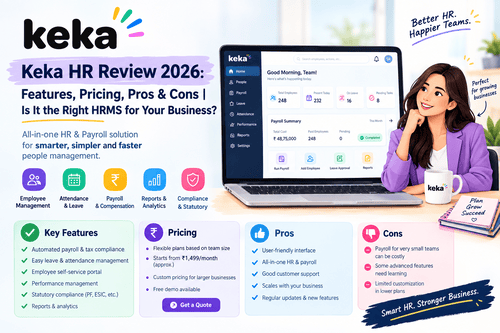
Keka HR Review 2026: Features, Pricing, Pros & Cons | Is It the Right HRMS for Your Business?
Managing people has always been one of the most important responsibilities in any organization. However, as businesses grow, managing employees becomes increasingly complex. Payroll processing, attendance tracking, performance reviews, recruitment, compliance management, and employee engagement can quickly turn into time-consuming tasks if handled manually.
This is where Keka HR comes into the picture. Over the past few years, Keka has established itself as one of the most popular HRMS and payroll software solutions for growing businesses by offering a unified platform for HR, payroll, talent management, attendance, recruitment, and performance management. According to Modern HR & Payroll Software for Growing Enterprises | Keka HR, Keka combines HR, payroll, hiring, performance management, attendance, and talent management within a single interconnected platform.
As someone who has worked in HR and talent acquisition, I understand how quickly administrative tasks can take over an HR professional’s day. I remember spending hours following up on attendance discrepancies, updating employee records, coordinating performance review schedules, and handling payroll inputs. These activities are necessary, but they leave little room for strategic HR initiatives. That’s why modern HRMS platforms like Keka have become increasingly valuable.
In this detailed Keka HR review, we’ll explore its features, benefits, pros and cons, and whether it’s the right choice for your business.
What is Keka HR?
Keka HR is a cloud-based Human Resource Management System (HRMS) designed to help organizations automate and streamline HR operations.
The platform provides tools for:
- Payroll management
- Leave and attendance tracking
- Recruitment and onboarding
- Performance management
- Employee engagement
- HR analytics
- Employee self-service
Keka promotes itself as a unified people platform that integrates various HR functions into a single system while incorporating AI-powered capabilities across workflows.
For organizations that have outgrown spreadsheets and disconnected HR tools, Keka offers a centralized solution to manage the employee lifecycle from hiring to exit.
Why Keka HR Is Gaining Popularity
The expectations of both employees and employers have evolved significantly. Today’s employees want:
- Faster HR services
- Mobile accessibility
- Self-service capabilities
- Transparent communication
- Seamless digital experiences
At the same time, businesses want:
- Process automation
- Better compliance
- Accurate payroll
- Real-time analytics
- Improved employee retention
Keka bridges these needs by creating a people-first HR platform that simplifies administrative processes while enhancing employee experience.
One of the reasons many organizations are attracted to Keka is its modern user interface. Unlike traditional HR systems that often feel complicated and outdated, Keka emphasizes usability and employee engagement.
Why Businesses Choose Keka HR
With hundreds of HR software solutions available today, many businesses choose Keka HR because it combines payroll, attendance, recruitment, performance management, and employee engagement into a single platform. Modern HR & Payroll Software for Growing Enterprises | Keka HR states that the platform brings HR, payroll, hiring, performance, attendance, and talent management together within one interconnected system.
Organizations often prefer Keka for the following reasons:
Modern User Experience
Unlike traditional HR software that can feel outdated and complex, Keka focuses on a clean and intuitive interface designed for both HR teams and employees.
All-in-One HRMS Platform
Businesses can manage multiple HR processes from a single dashboard, including:
- Payroll
- Attendance
- Recruitment
- Onboarding
- Performance reviews
- Employee engagement
This eliminates the need for multiple disconnected tools.
Strong Payroll Automation
Keka is recognized for its payroll processing and compliance management capabilities, helping organizations simplify salary calculations, deductions, and statutory requirements.
Employee-Centric Approach
In my experience, HR software succeeds when employees actually use it. Keka places significant emphasis on employee self-service and user experience, making everyday HR interactions easier for employees and managers alike.
Key Features of Keka HR
1. Payroll Management and Compliance
Payroll remains one of the most critical responsibilities of HR teams.
Keka offers payroll automation capabilities that include:
- Salary processing
- Tax deductions
- Payslip generation
- Full and final settlements
- Compliance management
- Statutory calculations
The platform supports payroll and compliance workflows designed to help organizations reduce manual effort and improve payroll accuracy.
Why This Matters
Payroll errors can impact employee trust and create compliance risks. Automating payroll significantly reduces these challenges.
2. Attendance and Leave Management
As businesses adopt hybrid and remote work models, attendance management has become more complex.
Keka supports:
- Biometric attendance
- Mobile attendance
- GPS-based tracking
- Shift scheduling
- Leave applications
- Attendance regularization
Attendance data flows directly into payroll calculations, minimizing manual reconciliation.
Why This Matters
Accurate attendance ensures correct salary processing and greater workforce transparency.
3. Employee Self-Service Portal
Modern employees expect immediate access to their HR information.
Keka’s self-service portal allows employees to:
- View payslips
- Apply for leave
- Download tax documents
- Update personal information
- Submit reimbursement requests
- Access attendance records
According to product information, employee self-service is one of Keka’s core features designed to improve employee experience and reduce routine HR queries.
Why This Matters
Self-service reduces HR workload while empowering employees.
4. Performance Management
Performance management is one of Keka’s strongest capabilities.
The platform offers:
- Goal setting
- OKRs (Objectives and Key Results)
- 360-degree feedback
- Review cycles
- Self-assessments
- Performance analytics
Keka includes performance reviews, rewards and recognition, goals management, and employee engagement tools as part of its talent management suite.
Why This Matters
Modern organizations require continuous feedback rather than relying solely on annual appraisals.
5. Recruitment and Onboarding
For growing businesses, attracting and retaining talent is crucial.
Keka supports:
- Applicant Tracking System (ATS)
- Resume screening
- Candidate management
- Interview workflows
- Recruitment analytics
- Digital onboarding
The platform centralizes recruitment activities and onboarding processes, creating a smoother experience for HR teams and new hires alike.
Why This Matters
A structured hiring process improves candidate experience and enables faster onboarding.
The Employee Experience Advantage
One area where Keka differentiates itself is employee experience.
Many HRMS platforms focus primarily on administration. Keka, however, emphasizes usability and engagement throughout the employee journey.
According to Modern HR & Payroll Software for Growing Enterprises | Keka HR, the platform is designed to be easy for both HR teams and employees while supporting enterprise-scale requirements.
From my own experience, I have seen organizations invest in powerful HR software only to struggle with employee adoption. The reason is simple: employees won’t use systems that are confusing.
Keka’s employee-friendly approach can help organizations achieve better engagement and platform adoption.
AI-Powered HR Operations
Artificial Intelligence is becoming a significant part of modern HR technology.
Keka has embedded AI capabilities within its platform to support:
- Workflow automation
- Hiring processes
- Workforce insights
- Administrative efficiency
The company states that AI is integrated across workflows to help save time and improve productivity.
Benefits of AI in Keka
- Faster approvals
- Better decision-making
- Enhanced reporting
- Automated workflows
- Improved workforce visibility
As HR evolves into a more strategic business function, AI-powered tools can help teams focus on people rather than administrative processes.
Keka HR Pricing
One of the most common questions businesses ask is: How much does Keka HR cost?
According to Keka: Pricing, Free Demo & Features | Software Finder, Keka offers modular pricing plans and custom packages based on company requirements. The source notes that Keka pricing starts from ₹1,700 per user per month (converted from USD pricing), while several advanced modules may require custom quotations depending on organizational needs.
Pricing Factors
The total cost generally depends on:
- Number of employees
- Modules selected
- Payroll requirements
- Performance management needs
- Recruitment features
- Additional integrations
Is Keka HR Worth the Cost?
For growing businesses, the investment may be justified if the platform helps reduce manual HR administration, improve payroll accuracy, and streamline workforce management.
My suggestion for companies evaluating Keka is to focus less on the software cost and more on the time savings and operational efficiency it creates. An effective HRMS often pays for itself by reducing manual work and improving employee productivity.
Pros and Cons of Keka HR
Pros
- User-Friendly Interface: Keka offers a modern and intuitive user experience that encourages adoption across the organization.
- Comprehensive HR Platform: HR, payroll, attendance, recruitment, onboarding, and performance management can all be managed from one platform.
- Strong Payroll and Compliance Features: The payroll module is one of Keka’s most appreciated features.
- Excellent Employee Self-Service: Employees can independently manage common HR tasks without depending heavily on HR teams.
- AI-Powered Automation: Built-in AI capabilities help streamline workflows and support productivity.
Cons
- May Be More Than Some Small Businesses Need: Very small organizations with fewer employees may not utilize all available features.
- Learning Curve for Advanced Modules: Organizations implementing multiple modules may require training to maximize platform value.
- Cost Considerations: As companies scale and add more modules, software costs may increase depending on business requirements. (Organizations should evaluate pricing based on their specific needs.
Keka HR vs greytHR: Which HRMS Is Better?
When comparing HR software solutions in India, Keka HR vs greytHR is one of the most common comparisons.
Both platforms are widely used HRMS solutions, but they serve slightly different priorities.
| Feature | Keka HR | greytHR |
|---|---|---|
| Payroll Management | Strong | Strong |
| Attendance Management | Yes | Yes |
| Employee Self-Service | Yes | Yes |
| Performance Management | Advanced | Available |
| Recruitment Management | Integrated ATS | Available |
| Employee Experience | Major Strength | Strong |
| Compliance Management | Strong | Strong |
| AI Capabilities | Integrated across workflows | AI-powered HR capabilities |
Keka emphasizes employee experience, talent management, performance reviews, recruitment workflows, and workforce engagement.
Meanwhile, AI-First Full Suite HRMS & Payroll Software | greytHR highlights greytHR’s strengths in payroll processing, attendance integration, employee self-service, compliance management, and AI-driven HR automation.
Choose Keka HR If:
- Employee experience is a priority.
- You need advanced performance management.
- Recruitment and onboarding are critical.
- You want a unified talent management platform.
Choose greytHR If:
- Payroll and statutory compliance are the primary focus.
- You need strong attendance-to-payroll integration.
- You want extensive payroll automation.
- Your organization requires robust compliance management.
Who Should Use Keka HR?
Keka is particularly suitable for:
Startups
Businesses planning rapid growth can benefit from automation and scalability.
Small and Medium-Sized Businesses
Organizations transitioning away from manual HR management often find Keka a good fit.
Technology Companies
Tech firms frequently require integrated HR and performance management systems.
Service-Based Organizations
Companies managing geographically distributed teams can leverage attendance and employee self-service features.
Growing Enterprises
Industry reviews indicate that Keka is particularly strong for SMBs and mid-market organizations seeking a unified HR and payroll solution.
Our Verdict: Is Keka HR Worth It?
After evaluating its features, user experience, and workforce management capabilities, Keka HR appears to be a strong choice for businesses seeking a modern and scalable HRMS solution.
Its biggest strengths include:
- Payroll automation
- Employee experience
- Performance management
- Recruitment workflows
- Attendance management
- AI-powered functionality
What stands out most is its focus on making HR processes easier for both employees and HR teams.
In my view, the best HR software isn’t necessarily the one with the most features. It’s the one that removes repetitive work and gives HR professionals more time to focus on people, culture, and business growth. Keka aligns well with that philosophy.
For organizations looking to modernize their HR operations while maintaining a positive employee experience, Keka HR is certainly worth considering.
Frequently Asked Questions
What is Keka HR?
Keka HR is a cloud-based HRMS platform that helps organizations manage payroll, attendance, recruitment, onboarding, performance management, and employee engagement through a centralized system.
Is Keka HR suitable for small businesses?
Yes, Keka is commonly used by startups and small-to-mid-sized businesses seeking HR automation and workforce management solutions.
Does Keka HR offer payroll management?
Yes, Keka includes payroll automation, tax calculations, statutory compliance support, payslip generation, and full-and-final settlement management.
What are some alternatives to Keka HR?
Popular alternatives include greytHR, Darwinbox, Zoho People, PeopleStrong, and factoHR.
Is Keka HR good for performance management?
Yes, Keka provides goal setting, OKRs, 360-degree feedback, review cycles, performance analytics, and rewards and recognition features.
Sweta Rawat is an HR professional with over 2.5 years of experience and an MBA in Human Resources. She writes on modern HR practices, employee engagement, and workplace culture, blending professional expertise with creative insight.