Meliuslyhomefurnish.shop Review: Investigating the Meliusly Impersonation Storefront
When hunting for smart home upgrades and DIY hardware online, discovering a shop offering steep promotional discounts feels like finding gold. That is precisely why shoppers are landing on Meliuslyhomefurnish.shop, an online outlet claiming to sell genuine home goods and engineer-designed household solutions under the recognizable Meliusly brand. With claims of sweeping sitewide savings and effortless ordering, Meliuslyhomefurnish.shop positions itself as a specialized retailer ready to ship home-improvement fixes directly to your doorstep.
Beneath that familiar trademarked logo, however, lies an unaccredited digital mirror designed to intercept payment details from shoppers looking for the authentic brand. Rather than functioning as a genuine partner channel, this storefront exhibits the classic characteristics of a brand impersonation operation engineered to harvest financial details or deliver non-existent merchandise.
Before entering your payment card data or trusting this domain with your shipping address, let us explore the anatomy of this cloned shop and look at what happens behind the scenes.
The Mechanics of Modern E-Commerce Brand Impersonation
Online retail fraud has moved past the days of generic, misspelled websites selling nondescript sunglasses. Today, illicit operators focus on high-intent search traffic by building exact replicas of reputable niche manufacturers.
   [ Authentic Brand Builds Trust & Product Authority ]
                            │
                            ▼
     [ Scammers Register Lookalike TLD: .shop / .store ]
                            │
                            ▼
     [ Cloned Assets: Logo, Slogans, Copied Marketing ]
                            │
                            ▼
     [ Shopper Arrives via Social Ads or Keyword Searches ]
                            │
                            ▼
     [ Checkout Capture: Card Data Harvested or Funds Taken ]
Legitimate consumer brands spend years building customer goodwill, securing registered trademarks, and refining problem-solving products. Fraud syndicates capitalize on this by copying trusted assets. When buyers spot an official logo and standard brand terminology, they lower their natural defenses. The cognitive shortcut is straightforward: if the brand is legitimate, the buyer assumes the website carrying its name must be legitimate too.
2. High-Intent Domain Spoofing
Instead of purchasing expensive primary .com domains, modern copycats register inexpensive alternative top-level domains (gTLDs) such as .shop, .store, .top, or .site. By prefixing or suffixing the original brand name with common e-commerce terms—like “home”, “furnish”, “outlet”, or “official”—they create web addresses that look plausible to an in-a-hurry shopper on a mobile browser.
3. Disposable Infrastructure
Unlike genuine retailers who invest heavily in inventory management systems, multi-tiered logistics, and secure customer relationship hubs, impersonation shops are built to be disposable. They run on off-the-shelf e-commerce templates that can be copied, launched, or migrated overnight when complaints arise or merchant processors ban their gateway.
📧 Need Legal Assistance?
Contact the author for legal consultations, case evaluations, and professional inquiries.
Case Study: Investigating Meliuslyhomefurnish.shop
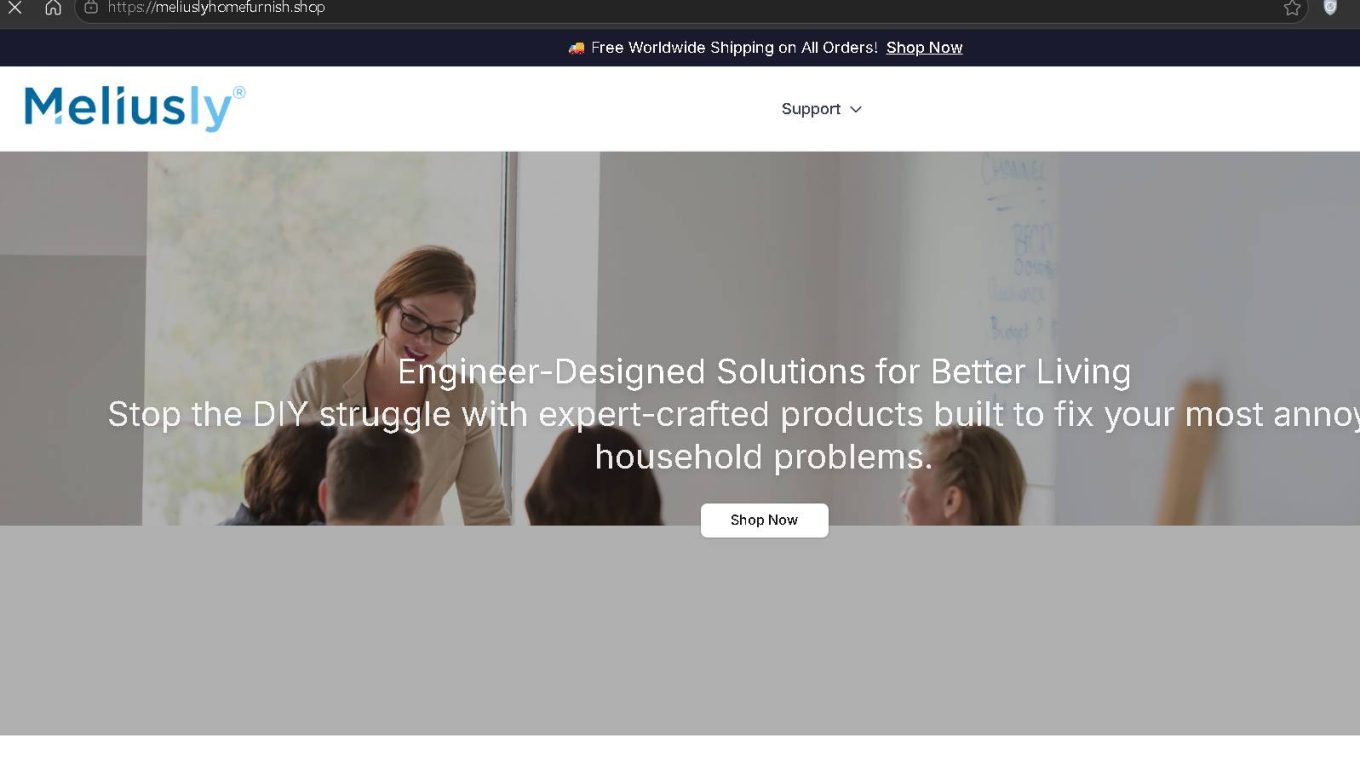
Examining the landing page and layout of Meliuslyhomefurnish.shop shows a clear disconnect between the brand identity it projects and its technical execution.
  ┌────────────────────────────────────────────────────────────┐
  │                 Meliuslyhomefurnish.shop                   │
  │ • Stolen Logo: Official "Meliusly®" Branding               │
  │ • Banner Hook: "Free Worldwide Shipping on All Orders!"    │
  │ • Value Pitch: "Engineer-Designed Solutions for Living"   │
  └─────────────────────────────┬──────────────────────────────┘
                                │
         ┌──────────────────────┴──────────────────────┐
         ▼                                             ▼
┌──────────────────────────────┐        ┌──────────────────────────────┐
│     Critical Visual Mismatch │        │     Broken Architecture      │
│ • Corporate meeting image    │        │ • No category hierarchy      │
│   used for home DIY brand    │        │ • Stripped-down navigation   │
│ • Unrelated stock assets     │        │ • Anonymous legal footer     │
└──────────────────────────────┘        └──────────────────────────────┘
Stated Marketing Claims and Products Sold
The platform positions itself as an authorized retail distributor of Meliusly home goods. Prominently across its top navigation, the site advertises:
- The Brand Banner: A copy of the registered Meliusly® logo in its signature blue typography.
- The Core Tagline: “Engineer-Designed Solutions for Better Living – Stop the DIY struggle with expert-crafted products built to fix your most annoying household problems.”
- The Conversion Hook: A high-contrast top notification bar claiming “Free Worldwide Shipping on All Orders! Shop Now.”
- The Call to Action: A centered “Shop Now” button surrounded by a bare-bones header sporting only a basic “Support” dropdown.
The genuine Meliusly company built its reputation on practical, engineer-designed home repair hardware—such as specialized toilet seat hinges and household fastener kits. By claiming to offer these problem-solving products with global free delivery, the shop appeals directly to DIY homeowners seeking straightforward fixes.
Modus Operandi: How the Deceptive Storefront Operates
Behind the simple front-end interface, storefronts of this profile follow a standard blueprint designed to extract money and sensitive consumer information:
1. Attracting High-Intent Searchers
Shoppers rarely browse random web addresses; they search for specific products or click targeted sponsored links on social platforms like Facebook, Pinterest, or Instagram. The operators configure their metadata and ad campaigns around popular branded hardware terms, drawing in customers who believe they are visiting an authorized sales portal.
2. Eliminating Purchase Friction
To maximize checkout rates, the site removes typical shopping barriers. It claims to offer “Free Worldwide Shipping” on all orders regardless of size, accompanied by discounted pricing that undercuts established retail benchmarks. This discourages shoppers from taking the time to verify the domain.
3. The Checkout Data Harvest
When a customer adds an item to their cart and proceeds to checkout, they are prompted to enter their full legal name, shipping address, phone number, credit card number, expiration date, and CVV code. Unregulated clone portals frequently utilize unencrypted, direct form captures or unvetted payment gateways.
4. The Two Fulfillment Traps
Once payment details are submitted, one of two scenarios generally follows:
- The Non-Delivery Trap: The card is immediately charged, an automated, fictitious tracking number is generated to buy time, and no product ever arrives. Inquiries to the support address bounce or receive canned delays until the payment dispute window closes.
- The Bait-and-Switch Dropship: The buyer receives a package weeks later, but instead of the engineer-grade hardware pictured on the site, it contains a cheap, unbranded plastic trinket shipped from an overseas fulfillment clearinghouse.
Red Flags Uncovered on Meliuslyhomefurnish.shop
A focused inspection of the website uncovers several telltale indicators of an unauthorized storefront:
| Feature Checked | Finding on Meliuslyhomefurnish.shop | Risk Level |
| Domain Authenticity | Uses an elongated .shop extension rather than the brand’s genuine primary domain (meliusly.com). | Critical |
| Hero Image Relevance | Displays a generic corporate office meeting room entirely unrelated to home hardware. | High |
| Catalog Navigation | Lacks standard product categories, department filters, search bars, and clear cart menus. | High |
| Shipping Plausibility | Claims unrestricted “Free Worldwide Shipping” on every order, an unrealistic model for physical goods. | Medium |
| Corporate Transparency | Missing physical address, registered company numbers, and verifiable corporate identity. | Critical |
- Unrelated Stock Visuals: A genuine home improvement and hardware brand showcases its actual physical products, technical specifications, and practical installation photos. This site uses a generic corporate office photograph showing professionals around a whiteboard—a visual disconnect that highlights a rushed template build.
- Stripped-Down Navigation: Mainstream retail platforms provide detailed category trees, brand disclosures, return policies, and searchable help databases. This site features only an isolated “Support” dropdown and a generic “Shop Now” trigger.
- Discrepancy with the Authentic Brand: The legitimate Meliusly brand maintains its own official website and authorized seller accounts on major marketplaces. It does not distribute its primary catalog through an unlinked, obscure
.shopdomain.
Final Verdict: Do Not Order from Meliuslyhomefurnish.shop
Meliuslyhomefurnish.shop is an unauthorized brand impersonation storefront and should not be trusted.
The site uses the registered Meliusly name and logo to mimic legitimate operations without authorization. Placing an order on this platform exposes you to lost funds, non-delivery of goods, and the potential theft of your personal payment details.
If you are looking to purchase genuine Meliusly products, purchase exclusively through the official brand website or their verified brand store on established platforms like Amazon.
If you have already submitted payment information on this site:
- Contact your bank or credit card company immediately to report the transaction as fraud and request a new card.
- Dispute any posted or pending charges associated with the transaction.
- Monitor your credit statements closely for unauthorized recurring charges or fraudulent attempts.
Frequently Asked Questions (FAQ)
Is Meliuslyhomefurnish.shop Scam?
Yes, Meliuslyhomefurnish.shop exhibits the core characteristics of an e-commerce scam. It uses the trademarked identity of Meliusly without authorization, relies on an unverified .shop domain, and lacks verifiable corporate contact information.
Is Meliuslyhomefurnish.shop Legit?
No, Meliuslyhomefurnish.shop is not legit. It is not an authorized distributor, retailer, or affiliate of the real Meliusly brand, and customers risk losing their money or compromising their credit card information by ordering through it.
What is the official website for Meliusly products?
The authentic brand operates through its established primary domain at meliusly.com and distributes through authorized storefronts on recognized marketplaces. It does not operate through unverified third-party .shop domains.
How do I know if an online furniture or home hardware store is fake?
Look for mismatched domain extensions (like .shop or .top appended to well-known brand names), unrealistic offers like free worldwide shipping with no minimum spend, missing physical business addresses, and generic stock imagery that has nothing to do with the products being sold.
What happens if I buy something from a counterfeit storefront?
In most cases, the order is never fulfilled, or the customer receives an inferior, unbranded counterfeit item weeks later. Additionally, your payment card numbers and personal details may be retained by the site operators for unauthorized transactions.
If you paid using a major credit card or PayPal, you have strong consumer protection rights. Contact your card issuer, report that you purchased from an unauthorized lookalike site, and initiate a chargeback under merchant fraud or goods not delivered.
Why do scammers use .shop and .store domains for brand clones?
Alternative domain extensions like .shop are inexpensive to register and readily available when the official .com is owned by the real brand. Scammers register them alongside targeted keywords to make their fake storefronts appear convincing to casual visitors.
For more shady sites exposed, check our Shopping Scam Directory — your quick guide to staying safe online.
Every safe click counts. If this post helped, a coffee gesture fuels more scam‑busting investigations.

Help Us Spread Awareness
Please share this article to spread awareness. Follow us on social media for more scam alerts.