The Cyanwin Crypto Trap: Anatomy of a Modern Online Gambling Syndicate
If you have stumbled across Cyanwin while searching for high-yield iGaming platforms or promotional bonus drops, exercise extreme caution. A technical evaluation of the website reveals that it operates as a calculated fraudulent crypto casino scam, designed to drain deposits under the guise of an authentic decentralized gaming platform.
Behind sleek neon visuals and promises of instant digital asset payouts, Cyanwin functions as an unregulated financial trap. This deep-dive investigation strips down how the operation recruits players, inspects the mechanics powering the contemporary fraudulent crypto casino scam model, and presents an unvarnished audit of why your funds will never leave this portal once deposited.
Deconstructing the Fraudulent Crypto Casino Scam Model
The explosion of decentralized finance, stablecoins, and private ledger transactions has revolutionized online gambling. Legitimate crypto platforms leverage cryptographic protocols such as provably fair algorithms, allowing users to verify every dice roll or card shuffle on a public blockchain. However, this same pseudonymous infrastructure has created an unprecedented attack vector for cyber-fraud syndicates.
A modern fraudulent crypto casino scam bypasses traditional banking guardrails entirely. In standard fiat-based digital fraud, banking institutions and payment processors enforce know-your-customer (KYC) measures, chargeback systems, and account freezes that protect consumer deposits. By forcing transactions through private Bitcoin, Ethereum, USDT, or Tron wallet addresses, fraudulent gambling operators eliminate the possibility of a transaction reversal.
Suspicious Link or Courier SMS?
Verify URLs, APKs, or parcel alerts against our threat database before clicking.
These setups rely on off-the-shelf software templates. A central malicious syndicate buys or clones an aesthetic front-end interface, connects an automated wallet collector, and deploys dozens of identical domain names simultaneously. The games are not tied to verified random number generators (RNG) licensed by reputable jurisdictions such as Malta, Gibraltar, or Curaçao; instead, they run locally executed visual scripts calibrated to simulate massive wins and keep the victim emotionally invested.
Case Study: What Cyanwin Claims and Offers
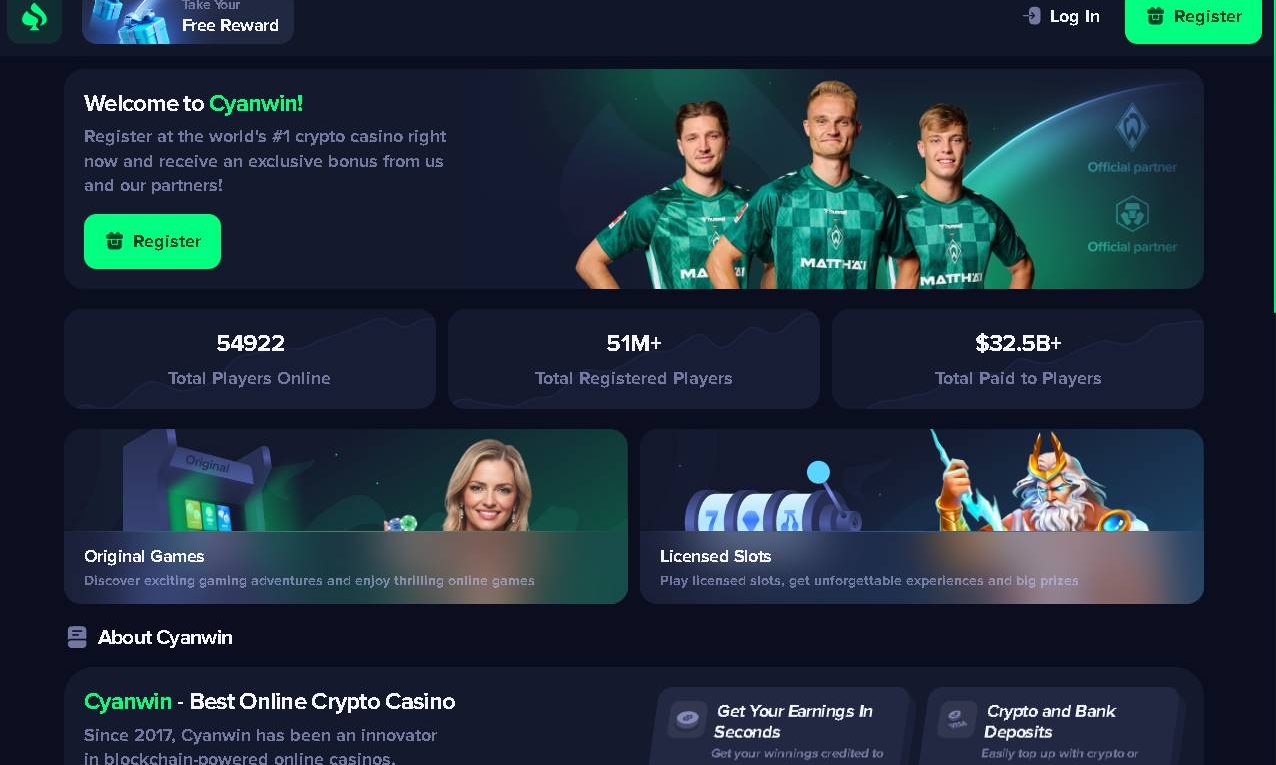
At surface level, Cyanwin presents itself as a Tier-1 international iGaming operator. Navigating to the domain reveals a modern dark-mode dashboard tailored to appeal to Web3 native gamblers and sports betting enthusiasts alike.
The platform pitches an all-in-one ecosystem:
- Massive Signup Incentives: Direct banners offering “Free Rewards,” matched deposit packages up to 200%, and risk-free VIP spin packages designed to lower user suspicion.
- Proprietary Original Games & Licensed Slots: Banners featuring recognizable slot aesthetics and proprietary crypto crash games, claiming complete fairness and real-time execution.
- Fictitious Corporate Longevity: The footer and about panels assert that Cyanwin has stood as an “innovator in blockchain-powered online casinos since 2017.”
- Fabricated Operational Volume: The interface showcases real-time counters declaring over 51 Million registered players, tens of thousands of active online bettors, and more than $32.5 Billion paid out across its lifespan.
- High-Profile Sports Partnerships: Visual assets feature prominent professional European soccer stars—specifically SV Werder Bremen players like Marvin Ducksch dressed in official team kits—implying licensed sponsorships.
How Cyanwin Actually Works Behind the Scenes
The internal architecture of Cyanwin bears no resemblance to an authentic casino. Every layer of the site is engineered around capital capture rather than game execution.
1. The Lure and Account Creation
Victims rarely discover platforms like Cyanwin via organic, highly regulated search channels. Instead, traffic is driven through automated Discord messages, Telegram trading bots, phishing emails, or hijacked social media profiles advertising exclusive “no-deposit promo codes” worth $500 to $1,000 in free crypto credits. Users sign up with disposable credentials, enter the code, and immediately see a balance credited to their dashboard.
2. Simulated Winning Streaks
When a user begins wagering their promotional credits on slots or roulette, the games respond with abnormally high return-to-player (RTP) rates. You do not lose; you win consistently. The interface rapidly inflates an initial balance into thousands of dollars. This simulated outcome exploits psychological reward loops, tricking the player into believing they have hit an actual financial windfall.
3. The Deposit Trigger
When the user clicks the “Withdraw” button to claim their earnings, the platform hits them with an engineered roadblock: “To prevent bonus abuse and verify your external wallet address, an initial verification deposit of 0.01 BTC (or equivalent USDT) is required.”
4. The Advance-Fee Black Hole
Once the user sends cryptocurrency to the assigned deposit address, the funds are swept within seconds into an unhosted aggregation wallet controlled by the syndicate. The withdrawal, however, never processes.
Instead, the dashboard changes states to demand further payments:
- An “Anti-Money Laundering (AML) audit fee.”
- An “EU Gambling Commission tax clearance charge.”
- A “VIP Tier-2 activation fee.”
The demands escalate until the victim realizes they are being extorted, at which point the admin team bans the user account, blocks the IP address, or shuts down the domain entirely.
5 Critical Red Flags Exposing the Cyanwin Scam
1. Copy-Paste Clone Architecture
Cyanwin is not an independent brand. It shares identical underlying cascading style sheets (CSS), text strings, database structures, and button configurations with known scam networks including Feastwin, Porewin, Skywin, and Rezowin. These operators use automated deployment scripts to spin up new domains as quickly as cybersecurity registrars take old ones down.
2. Mathematically Impossible Player Statistics
The landing page boasts over 51,000,000 registered accounts and $32.5 Billion in distributions. To put that in perspective, those metrics would place Cyanwin above publicly traded global gambling giants such as Flutter Entertainment (FanDuel) or Entain. For a website with minimal verifiable organic search footprint and no industry audit trail, these figures are pure fiction hardcoded directly into the static HTML.
Displaying SV Werder Bremen players in MATTHÄI-sponsored kits is an intentional trademark violation used to manufacture trust. Official football clubs publish every commercial partner within their corporate press rooms. Werder Bremen has never signed an endorsement deal with Cyanwin, nor does Cyanwin possess sports licensing agreements in Germany or anywhere else.
4. Domain Age Versus Stated History
While claiming an operational footprint dating back to 2017, historical WHOIS registration lookups tell a completely different story. The domain was registered recently, containing no historic domain name system (DNS) records, web archive snapshots, or forum discussions predating its recent launch. A six-year gap between reality and marketing claims is a telltale sign of an advance-fee fraud scheme.
5. Absence of Provably Fair Verification Keys and Gaming Licenses
Legitimate blockchain casinos embed client seeds, server seeds, and cryptographic nonces that can be plugged into open-source third-party verifiers like GitHub tools. Cyanwin provides no hashing keys, no verifiable smart contracts, and no valid licensing badge link to regulatory bodies like the Curaçao Gaming Control Board or Anjouan Gaming Authority.
Technical Audit Summary
| Evaluation Parameter | Legitimate Crypto Casino Baseline | Cyanwin Reality |
| Licensing | Verifiable license seal linked to government registry | None; dead text labels or fabricated emblems |
| Game Auditing | Certified RNG testing via eCOGRA, iTech Labs, or GLI | Unaudited, local JavaScript game scripts |
| Withdrawal Requirements | Standard wager-through rollover (1x-3x) on fiat/crypto | Mandated external capital deposits to “unlock” payouts |
| Affiliations | Public corporate ownership with verifiable contracts | Stolen athlete photography and unauthorized logos |
| Support Channels | 24/7 tracked ticket portal with agent escalation | Unresponsive generic chat boxes or complete silence |
Email: ApexLegalSolutionsMumbai@gmail.com
What to Do If You Interacted with Cyanwin
If you have already deposited digital assets or submitted details to this platform, prioritize loss prevention:
- Stop Depositing Immediately: Disregard all claims that another payment will release your stuck balance. Every additional transfer sent to “unlock” funds is permanently lost.
- Sever Wallet Permissions: If you connected an interactive Web3 browser wallet (like MetaMask or Phantom) via WalletConnect, open your wallet settings and revoke any active token approvals or contract allowances linked to the site.
- Change Shared Credentials: If you reused the password you registered on Cyanwin across other crypto exchanges, personal emails, or financial services, update those passwords and enable hardware/authenticator-based Two-Factor Authentication (2FA) instantly.
- Report the Infrastructure: File abuse notifications with the registrar hosting the domain and lodge a complaint with national cybercrime tracking divisions (such as the IC3 in the United States, Action Fraud in the UK, or the National Cyber Crime Reporting Portal in India).
Every safe click counts. If this post helped, a coffee gesture fuels more scam‑busting investigations.

Frequently Asked Questions
Is Cyanwin legit?
No. Cyanwin is not a legit online casino. It operates without gaming licenses, relies on forged sports partnership images, publishes fabricated player statistics, and uses cloned site architecture identical to documented fraudulent iGaming syndicates.
Is Cyanwin a scam?
Yes. Cyanwin is an advance-fee fraudulent crypto casino scam. It uses demo software to display artificial account balances, then prevents users from cashing out by requiring mandatory out-of-pocket “verification” deposits.
Can I withdraw money from my Cyanwin account?
No. Genuine payouts are technically disabled on the platform. Any attempt to withdraw will prompt error alerts demanding secondary payments for verification, tax clearance, or VIP upgrades. Even if these fees are paid, withdrawals are never processed.
How do I report a Cyanwin crypto scam?
You should report the platform’s deposit wallet addresses and website domain to your local national cybercrime authority (e.g., the FBI’s Internet Crime Complaint Center at ic3.gov or your country’s equivalent), mark the URLs on anti-phishing databases like PhishTank, and notify the domain’s registrar abuse desk.
No. Promo codes distributed across Discord, Telegram, TikTok, or X offering free $500–$1000 betting balances are coordinated affiliate lures designed to bring victims into the advance-fee deposit loop.
How does a fraudulent crypto casino scam steal user funds?
These operations rely on irrevocable blockchain transactions. They lure users with unrealistic signup bonuses, display rigged winning streaks, and then lock the balance behind mandatory “unlock fees” or “account verification deposits” that flow straight into syndicate-managed cold wallets.
Can blockchain forensic recovery services recover money lost to Cyanwin?
Exercise extreme skepticism toward third-party “asset recovery experts” or social media accounts claiming they can hack back or refund your lost crypto. Most of these services are secondary recovery scams targeting individuals who have already lost capital.
How can I spot a fake crypto casino before depositing?
Check for verifiable regulatory seals (such as Curaçao or Malta) that resolve to an official registry database, confirm the registration date of the domain via WHOIS lookups, test whether the games feature verifiable provably fair seeds, and ensure the brand is not an exact visual clone of shuttered scam sites.
Want to see how fraudulent Web3 and blockchain gaming traps manipulate deposit funnels? Explore our in-depth investigative guide:
Online Crypto Casino Scam: How Blockchain & Web3 Traps Exploit PlayersHelp Us Spread Awareness
Please share this article to spread awareness. Follow us on social media for more scam alerts.