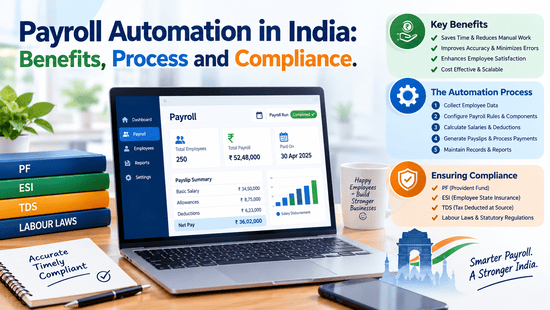
Payroll Automation in India: Benefits, Process and Compliance
Payroll is one of the most critical functions in any organization. Employees expect salaries to be accurate and paid on time, while employers must ensure compliance with various statutory regulations such as Provident Fund (PF), Employee State Insurance (ESI), Professional Tax (PT), Tax Deducted at Source (TDS), and labor laws.
However, managing payroll manually can quickly become complicated as an organization grows. Calculating salaries, tracking attendance, processing leave deductions, managing tax calculations, and ensuring compliance can consume significant HR and finance resources.
This is where Payroll Automation comes into play.
Today, organizations across India are increasingly adopting payroll software and HRMS platforms to automate salary processing and compliance management. Whether you’re a startup with 20 employees or a large enterprise with thousands of workers, payroll automation can improve efficiency, minimize errors, and enhance employee experience.
Having worked in HR operations and recruitment, I’ve seen firsthand how manual payroll processes often create unnecessary stress at month-end. A missing attendance entry or incorrect leave adjustment can lead to salary disputes that consume hours of HR effort. Automated payroll systems help eliminate many of these challenges.
In this guide, we’ll explore payroll automation in India, its benefits, process, compliance requirements, and implementation best practices.
What is Payroll Automation?
Payroll automation refers to the use of software and technology to manage and process employee salaries automatically.
Instead of manually using spreadsheets and calculators, organizations utilize payroll software to:
- Calculate salaries
- Manage attendance
- Process overtime
- Track leave balances
- Calculate deductions
- Generate payslips
- Handle tax calculations
- Maintain compliance records
The goal is to reduce manual intervention while ensuring accuracy and compliance.
Why Payroll Automation is Growing in India
The Indian workforce is evolving rapidly.
Organizations today must manage:
- Hybrid workforces
- Remote employees
- Multiple salary structures
- Compliance requirements
- Frequent regulatory updates
Manual payroll systems often struggle to keep up with these complexities.
Payroll automation addresses these challenges by:
✅ Improving accuracy
✅ Reducing administrative workload
✅ Enhancing compliance management
✅ Providing real-time reporting
✅ Improving employee satisfaction
As businesses expand, automation becomes less of a luxury and more of a necessity.
How Payroll Processing Worked Traditionally
Before automation, payroll processing was largely manual.
The process often included:
Step 1: Collect Attendance Data
HR teams gathered attendance records from registers, biometric systems, or spreadsheets.
Step 2: Calculate Working Days
Attendance and leave data were analyzed manually.
Step 3: Apply Salary Components
HR calculated:
- Basic salary
- HRA
- Conveyance allowance
- Special allowance
- Incentives
Step 4: Calculate Deductions
This included:
- PF
- ESI
- TDS
- Loan recovery
- Leave deductions
Step 5: Generate Payslips
Payslips were created manually.
Step 6: Process Salary Transfers
Finance teams uploaded salary data for bank transfers.
This process was time-consuming and highly prone to errors.
How Payroll Automation Works
Modern payroll software streamlines the entire payroll cycle.
Data Collection
Employee information is stored digitally:
- Salary details
- Tax declarations
- Attendance records
- Leave balances
Automated Calculations
The system automatically calculates:
- Gross salary
- Deductions
- Net salary
- Statutory contributions
Compliance Processing
PF, ESI, PT, and TDS calculations are handled automatically based on predefined rules.
Payslip Generation
Employees receive digital payslips through portals or email.
Reporting
Management receives payroll reports and dashboards instantly.
Key Benefits of Payroll Automation
1. Improved Accuracy
One of the biggest advantages of payroll automation is accuracy.
Manual calculations can result in:
- Salary discrepancies
- Incorrect deductions
- Compliance issues
A payroll system reduces human errors significantly.
Personal Observation
In many organizations, payroll-related employee complaints often arise from simple calculation mistakes. Automated systems help build employee trust because salary processing becomes more consistent and transparent.
2. Time Savings
Payroll processing can take days when handled manually.
Automation enables HR teams to:
- Complete payroll faster
- Reduce repetitive activities
- Focus on strategic HR functions
Instead of spending hours on calculations, HR professionals can focus on employee engagement and workforce planning.
3. Better Compliance Management
Payroll compliance in India can be complex.
Organizations need to comply with various requirements, including:
Provident Fund (PF)
Applicable contributions and reporting requirements.
Employee State Insurance (ESI)
Employee and employer contributions must be calculated accurately.
Professional Tax (PT)
Applicable in certain states.
Tax Deducted at Source (TDS)
Income tax deductions must align with employee declarations and applicable tax regulations.
Automated software updates compliance rules and calculations, reducing risks associated with manual processing.
4. Enhanced Employee Experience
Employees expect easy access to payroll information.
Modern payroll systems provide self-service features allowing employees to:
- Download payslips
- Access tax documents
- View leave balances
- Update personal information
This reduces dependency on HR teams.
5. Cost Reduction
While payroll software requires investment, automation often reduces:
- Administrative costs
- Error correction expenses
- Compliance penalties
- Processing time
Over time, these savings can outweigh software costs.
6. Real-Time Reporting
Automated payroll systems generate reports instantly.
Common reports include:
- Salary register
- Department payroll costs
- Tax reports
- Attendance summaries
- Compliance reports
Management can make better workforce decisions using real-time insights.
The Payroll Automation Process
Organizations implementing payroll automation generally follow these stages:
Stage 1: Employee Data Setup
Employee records are entered into the system.
This includes:
- Employee ID
- Salary structure
- Department details
- Tax information
- Bank details
Stage 2: Attendance Integration
The payroll system integrates with:
- Biometric devices
- HRMS platforms
- Attendance software
Attendance data is automatically synced.
Stage 3: Leave Management Integration
Leave records are integrated into payroll calculations.
Examples:
- Paid leave
- Casual leave
- Sick leave
- Loss of pay (LOP)
Stage 4: Salary Computation
The software calculates:
- Earnings
- Incentives
- Reimbursements
- Deductions
Net salary is generated automatically.
Stage 5: Compliance Calculation
Automated systems calculate:
- PF contributions
- ESI contributions
- Professional Tax
- TDS deductions
Stage 6: Payslip Generation
Employees receive digital payslips instantly.
Stage 7: Salary Transfer Processing
Payroll reports are generated for bank salary transfers.
Payroll Compliance Requirements in India
Compliance is one of the most important aspects of payroll management.
Provident Fund (PF)
Organizations covered under PF regulations must ensure accurate contribution calculations and timely deposits.
Payroll software simplifies these calculations.
Employee State Insurance (ESI)
For eligible employees, ESI deductions and employer contributions must be processed correctly.
Automation minimizes risks associated with incorrect calculations.
Professional Tax (PT)
Certain states require employers to deduct and deposit professional tax according to local regulations.
Automated systems manage varying state requirements efficiently.
Income Tax (TDS)
Payroll systems calculate taxes based on:
- Employee declarations
- Tax regime selection
- Applicable exemptions
This helps maintain transparency throughout the financial year.
Challenges of Manual Payroll Management
Organizations using manual methods often face:
Calculation Errors
Spreadsheet mistakes can impact employee salaries.
Compliance Risks
Incorrect deductions may lead to penalties or disputes.
Lack of Visibility
Manual reports often provide limited workforce insights.
Increased Administrative Burden
HR teams spend excessive time on repetitive tasks.
Poor Employee Experience
Employees may experience delays in receiving payroll information.
Payroll Automation for Small Businesses
Many small business owners assume payroll automation is only suitable for large enterprises.
This is no longer true.
Modern payroll solutions offer affordable plans designed specifically for:
- Startups
- SMEs
- Growing businesses
Automation becomes valuable even for organizations with fewer than 50 employees.
Popular Payroll Software in India
Several HRMS and payroll platforms offer automation capabilities.
Commonly used solutions include:
greytHR
Popular among SMEs for payroll, attendance, and compliance management.
Keka
Known for employee experience and payroll automation features.
Darwinbox
Widely used by growing and enterprise organizations.
Zoho People
Offers HR and workforce management capabilities.
PeopleStrong
Provides integrated HR and payroll solutions.
When selecting software, companies should evaluate their workforce size, compliance needs, and budget.
Best Practices for Successful Payroll Automation
Standardize Payroll Policies
Clearly define:
- Salary structures
- Leave policies
- Overtime rules
- Reimbursement policies
Maintain Accurate Employee Data
Payroll accuracy depends on accurate information.
Regular audits help maintain data quality.
Train HR Teams
Automation works best when users understand system capabilities and compliance requirements.
Monitor Compliance Updates
Labor laws and tax rules can change periodically.
Organizations should keep systems updated.
Review Payroll Reports Regularly
Even automated systems require periodic review to ensure accuracy.
The Future of Payroll Automation in India
Payroll technology continues to evolve.
Future trends include:
AI-Powered Payroll
Artificial Intelligence can identify anomalies and payroll errors automatically.
Cloud-Based Payroll Systems
Cloud platforms enable payroll processing from anywhere.
Employee Self-Service Portals
Employees increasingly expect digital access to payroll information.
Integrated HR Ecosystems
Payroll, attendance, performance management, and recruitment systems are becoming interconnected.
Organizations adopting these technologies will be better positioned for long-term growth.
Frequently Asked Questions (FAQs)
What is payroll automation?
Payroll automation is the use of software to automate salary calculations, deductions, compliance management, and payroll processing.
Is payroll automation suitable for small businesses?
Yes. Modern payroll software solutions offer affordable options for startups and SMEs.
What are the benefits of payroll automation?
Key benefits include improved accuracy, reduced processing time, better compliance, cost savings, and enhanced employee experience.
How does payroll automation improve compliance?
Payroll software automatically applies predefined compliance rules and reduces the risk of manual calculation errors.
Which payroll software is popular in India?
Popular options include greytHR, Keka, Darwinbox, Zoho People, and PeopleStrong.
Final Thoughts
Payroll is much more than salary calculation. It directly impacts employee trust, regulatory compliance, and operational efficiency.
In my experience, payroll is one of those HR functions that employees notice only when something goes wrong. A delayed salary, incorrect deduction, or missing payslip can quickly affect employee confidence. That’s why investing in payroll automation is not just about saving time; it’s about creating a reliable employee experience.
As Indian businesses continue embracing digital transformation, payroll automation will remain a critical component of modern HR strategy. Organizations that automate payroll effectively can reduce risks, improve compliance, and enable HR teams to focus on what truly matters: supporting employees and driving business growth.
Sweta Rawat is an HR professional with over 2.5 years of experience and an MBA in Human Resources. She writes on modern HR practices, employee engagement, and workplace culture, blending professional expertise with creative insight.