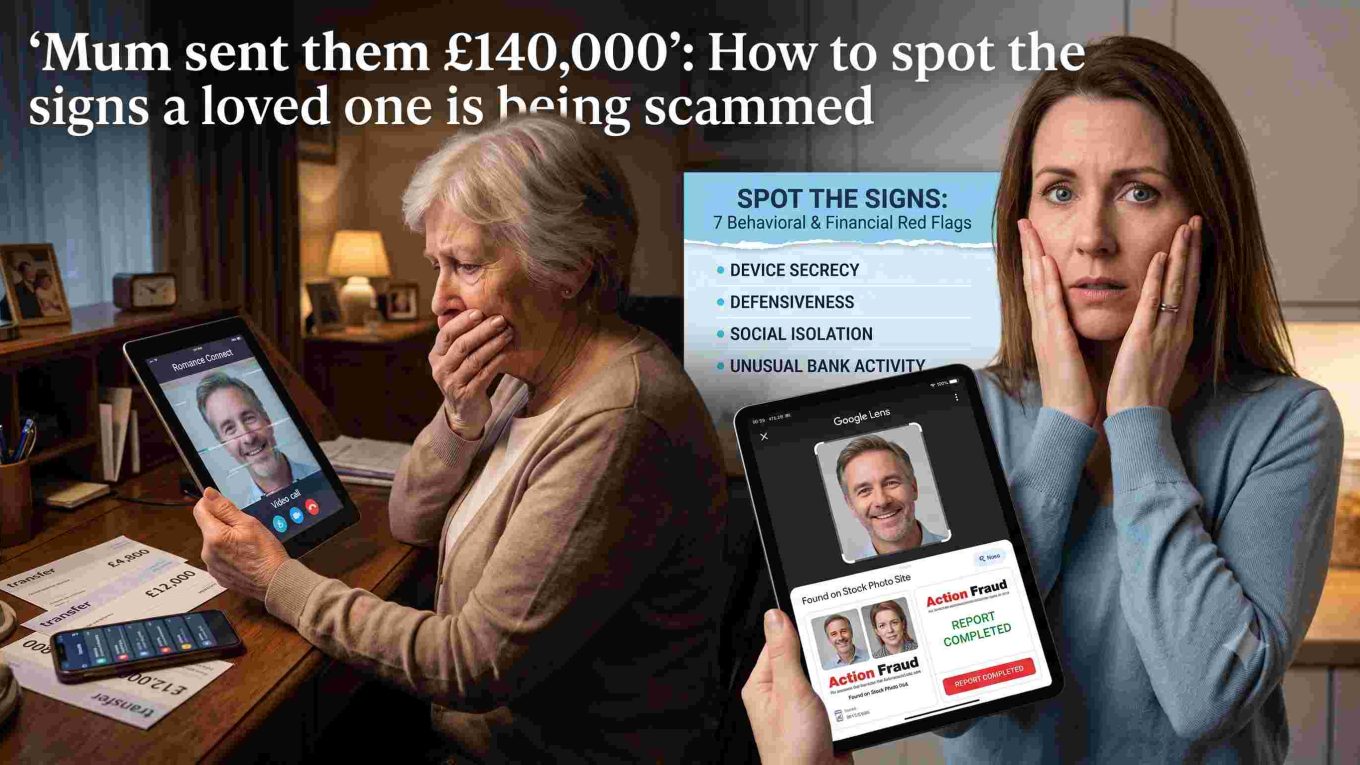
‘Mum Sent Them £140,000’: How Sophisticated Romance Fraud Drains Savings—and How to Intervene
It started with a casual direct message and ended with £140,000 drained from a lifetime of hard-earned savings.
When Helen first noticed her mother in her 80s spending hours glued to her mobile screen, she assumed it was a harmless digital hobby. What Helen didn’t realize was that an organized cybercriminal syndicate was running a calculated social-engineering playbook right in her living room.
By the time the reality surfaced, the emotional and financial wreckage was catastrophic: retirement funds wiped clean, lines of communication fractured, and an elderly parent trapped in profound psychological denial.
The 3-Point Gut Check: Are You Overreacting?
If you are reading this because an older relative’s recent behavior feels unusual, you are likely torn between wanting to protect them and fearing you are being paranoid or invasive.
The 3-Point Gut Check: Are You Overreacting?
Select any behaviors you have observed over the past 30 days:
The “My Parent Is Too Smart for This” Fallacy
One of the most dangerous misconceptions about romance fraud is that it only happens to naive or gullible people.
When families first suspect something is wrong, adult children frequently talk themselves out of intervening: “Mum was a senior accountant,” or “Dad managed corporate teams for 35 years—he’d spot a scam in seconds.”
Fraud syndicates do not target intellectual capacity; they target emotional vulnerability.
Scammers seek out the isolated, the recently bereaved, or retirees adjusting to a quiet home. In fact, research shows that educated, financially independent older adults are actively prioritized by fraud rings: they have direct control over pensions, home equity, and fixed deposits, and they rarely have everyday financial gatekeepers questioning their choices.
Falling for a modern romance scam is not a failure of intelligence. It is the result of relentless, professional psychological grooming.
Anatomy of the £140k Trap: How the Syndicate Operated
Modern romance fraud relies on an asymmetry of trust. Fraud syndicates systematically dismantle a victim’s rational defenses using three coordinated phases:
1. The Isolation & Grooming Phase
Scammers do not ask for money on day one. They spend weeks establishing an intensive emotional rhythm:
- Digital Love-Bombing: Sending dozens of messages a day, remembering birthdays, and mirroring personal values.
- Driving a Wedge: Once emotional trust is cemented, scammers deliberately plant suspicion against family members: “Your children only care about their inheritance,” or “They don’t want you to find happiness at this stage in your life.”
2. High-Tech Deception (AI Deepfakes & Voice Cloning)
When Helen urged her mother to demand a real-time video call, the fraudsters adapted rather than retreating:
- Synthetic Video Calls: During short calls, the caller’s face flickered, and the audio sync lagged slightly behind mouth movements—classic hallmarks of real-time deepfake manipulation filters.
- Audio Voice Clones: Fraud rings generate realistic voice notes from scraped or brief audio samples, validating the illusion while continually blaming “poor Wi-Fi” for avoiding longer, high-definition calls.
3. The Escalating Crisis Ladder
Once the victim is emotionally isolated and convinced the relationship is real, financial requests escalate through manufactured emergencies.
What Manipulation Actually Looks Like: Real-World Text Scripts
Scammers rely on consistent emotional templates to extract funds while preventing the victim from consulting anyone else:
What Scam Scripts Actually Look Like
Tap each message below to reveal the psychological traps hidden inside.
Verify domains or APK links before opening them.
Why Direct Confrontation Backfires
When families discover that money is leaving an account, the natural reaction is disbelief and anger: “How could you send money to someone you’ve never met? It’s an obvious scam!”
This approach almost always backfires.
Acknowledging the truth requires a victim to confront three devastating realities at the same time:
- The person they love does not exist.
- Their judgment and independence have been compromised.
- Their hard-earned life savings may be permanently lost.
Blunt accusations trigger intense shame and defensive denial, driving the victim directly back into the scammer’s arms for comfort. To intervene effectively, move from aggressive confrontation to side-by-side investigation.
How to Talk to Your Loved One: What to Say vs. What to Avoid
| What Families Typically Say (Avoid) | Why It Causes Harm | What to Say Instead (Effective) |
| “You’re being completely taken advantage of; this person is a criminal!” | Sparks immediate defensiveness and shame; causes them to shut down and hide their devices. | “I love you too much to see you get hurt. You’ve worked hard for your independence, and I want to make sure your savings are secure. Can we review this together?” |
| “Hand over your phone right now. I’m blocking them.” | Feels like a violation of autonomy and forces communication onto secret messaging apps or burner phones. | “Let’s take the photo they sent you and run a quick reverse image search together on my laptop so we can be 100% confident.” |
| “How could you be so careless with your retirement money?” | Induces deep guilt, making them more likely to send follow-up funds in a desperate attempt to prove the relationship is real. | “Sophisticated criminal rings do this for a living using AI and fake corporate fronts. Anyone could be caught out. Let’s look at their company registry together.” |
The First 24 Hours: Emergency Response Checklist
First 24 Hours: Emergency Response Checklist
If you suspect an active transfer or manipulation scheme, execute these steps systematically:
“I am reporting an in-progress Authorized Push Payment (APP) fraud involving coercive control and suspected romance scam syndicates on account number [XXXX-XXXX]. Please place an immediate hold on outgoing overseas transfers and flag the profile for urgent review.”
1-page guide with emergency bank scripts and fraud checklist.