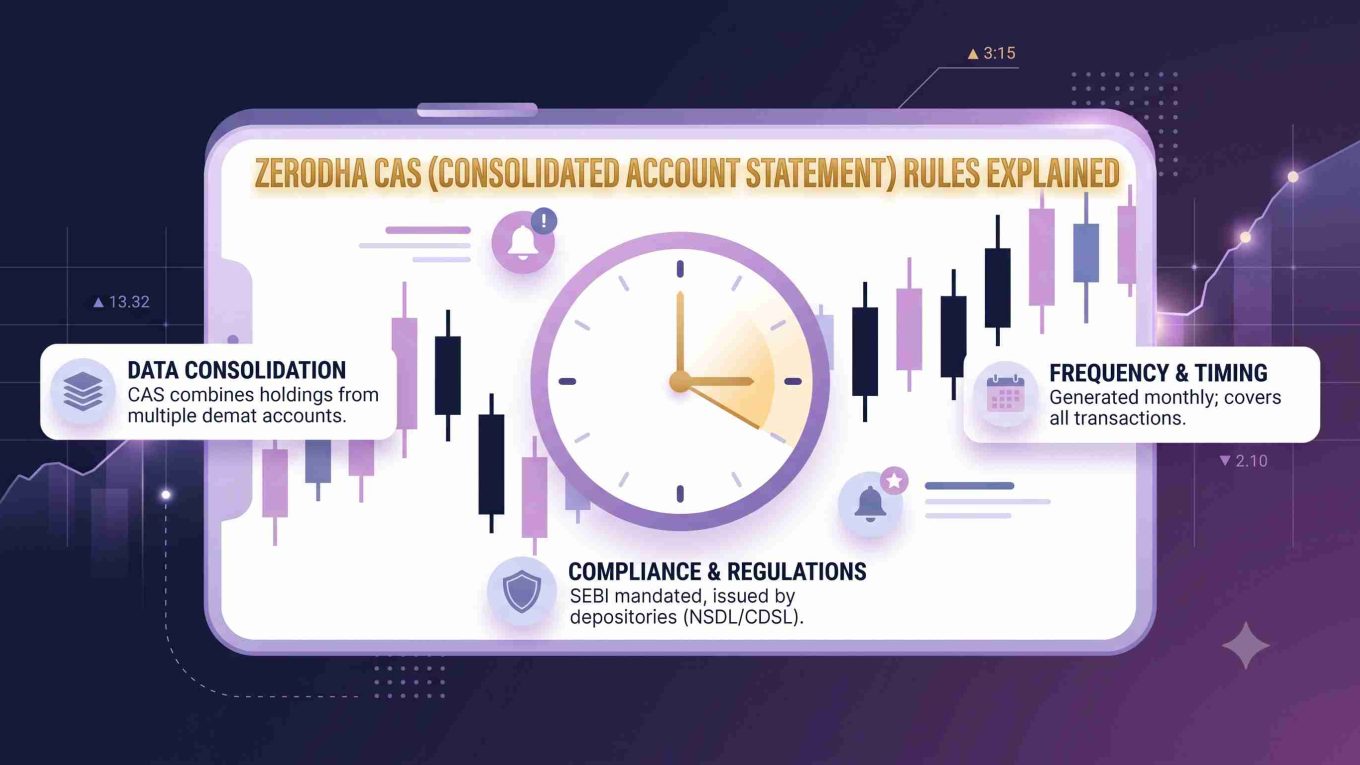
Zerodha CAS Rules Explained
SEBI’s Closing Auction Session (CAS) changed how closing prices are determined for F&O stocks starting August 3, 2026 — but the practical, day-to-day impact on your trades depends heavily on how your broker implements it.
If you trade on Zerodha, the platform has made specific adjustments to auto square-off timings, GTT triggers, and order handling to align with CAS. Here’s exactly what’s changed on Kite and what you need to watch for.
What Is CAS?
CAS is an auction-based mechanism that replaces the old VWAP-based method for determining a stock’s closing price. Instead of calculating the closing price as the average of trades in the last 30 minutes, the exchange collects buy and sell orders during a structured auction window and matches them at a single equilibrium price.
This currently applies only to Category I stocks — those with active F&O contracts. Category II stocks (everything else) continue with the old system for now.
Zerodha, like other brokers, had to rework several platform-level rules to accommodate this shift for Category I stocks specifically.
Zerodha’s Auto Square-Off Changes
This is the change most intraday traders need to know first.
- F&O stocks (Category I): Zerodha now auto-squares off open intraday positions (MIS and CO) by 3:12 PM, ahead of the 3:15 PM continuous trading cutoff. This gives a small buffer to ensure your position is closed before the auction window begins.
- Non-F&O stocks (Category II): No change. Standard intraday auto square-off remains at 3:25 PM, as it always has.
If you’re used to exiting F&O-linked intraday positions closer to 3:20–3:25 PM, that habit no longer works — Zerodha will square off the position for you before you get the chance, and you may incur square-off charges if you don’t exit manually first.
GTT Orders and Price Alerts on Kite
Good Till Triggered (GTT) orders and price alerts also follow different cutoff times depending on the stock category:
- F&O stocks: GTT orders and price alerts can trigger only until 3:15 PM, since continuous trading stops there.
- Non-F&O stocks: GTT orders and price alerts continue to trigger until 3:30 PM, the standard market close.
- F&O contracts themselves (derivatives): These can trigger until 3:40 PM, matching the extended derivatives segment close.
This means a GTT order you’ve set on an F&O stock expecting it to trigger near the old close may simply never fire, because the window has effectively shortened.
How Kite Handles Open Orders During CAS
For F&O stocks, Zerodha’s Kite platform automatically carries forward unexecuted limit orders from the regular session into the CAS window. However, this doesn’t apply to every order type. The following are excluded from carry-forward:
- Stop-loss orders
- Iceberg orders
- Orders placed outside the CAS price band (typically ±3% of the reference price)
If your order falls into one of these categories, it won’t automatically move into the auction session — you’ll need to place a fresh order during the CAS window if you still want it executed.
Placing Orders During the CAS Window
During the auction session on Kite, only limit orders are accepted — market orders are not allowed. Order entry closes at a randomized time between roughly 3:28 PM and 3:30 PM, a deliberate design choice by SEBI to prevent traders from timing orders to the exact last second. Once this window closes, the exchange matches orders and determines the closing price during the final matching phase.
Common Mistakes to Avoid on Zerodha
- Assuming the old square-off time still applies to F&O stocks — it’s now 3:12 PM, not 3:25 PM.
- Placing an order far outside the price band and expecting it to sit in the book — it gets auto-rejected instead.
- Confusing GTT cutoffs across F&O stocks (3:15 PM), non-F&O stocks (3:30 PM), and F&O contracts (3:40 PM) — these are three different timings, not one.
- Not checking whether a stock is Category I or II before assuming which rules apply — this can change if F&O contracts are added or removed from a stock.
How to Check a Stock’s Category on Kite
The simplest way is to check whether the stock has an active F&O contract listed on Kite or the NSE/BSE F&O list. If it does, Category I (CAS) rules apply. If not, the stock still follows the standard Category II timings and VWAP-based closing price.
Frequently Asked Questions
Does Zerodha apply CAS rules to all stocks?
No. Zerodha’s CAS-related changes — earlier auto square-off, shortened GTT trigger windows, and auction order handling — apply only to Category I (F&O) stocks. Category II stocks continue with standard timings.
What time does Zerodha auto-square-off intraday positions for F&O stocks?
Zerodha auto-squares off open MIS/CO positions on F&O stocks by 3:12 PM, ahead of the 3:15 PM continuous trading cutoff.
Will my GTT order still trigger after 3:15 PM on an F&O stock?
No. GTT orders and price alerts on F&O stocks can only trigger until 3:15 PM. For F&O contracts (derivatives) themselves, the cutoff is 3:40 PM.
Does Kite carry forward all my pending orders into the CAS auction window?
Only some. Unexecuted limit orders are generally carried forward for F&O stocks, but stop-loss orders, iceberg orders, and orders outside the price band are excluded and won’t move into the auction session automatically.
Can I place a market order during Zerodha’s CAS window?
No. Only limit orders are accepted during the CAS order entry session on Kite.
Not currently. Category II stocks continue with the standard 3:30 PM close, VWAP-based pricing, and unchanged square-off and GTT timings until SEBI extends CAS to this category.
About the Author
Suyesh Gusain holds an MA in Mass Communication and is NISM-certified in Equity Derivatives and Research Analysis, with two years of hands-on experience trading Indian equity markets. He writes about SEBI regulations and market mechanics in practical, easy-to-understand terms for retail traders and investors.
Disclaimer: This article is for informational purposes only and does not constitute investment or trading advice. Broker-specific rules can change — always verify current timings and order handling directly through Zerodha’s official announcements and Kite platform notifications.