
Smurf Hunting Season: Inside Riot’s Aggressive Anti-Smurfing & Rank Manipulation Overhaul
For competitive FPS grinders, nothing derails a ranked climb quite like running into a default-card Jett dropping 40 kills in a Silver lobby. Smurfing, win-trading, and paid account boosting have long plagued competitive tactical shooters.
In response, Riot Games has overhauled its competitive integrity architecture, rolling out aggressive detection algorithms, direct in-game reporting pipelines, and severe Rank Rating (RR) and Matchmaking Rating (MMR) rollbacks.
This complete breakdown covers how the new anti-smurfing systems operate, who gets penalized, and what it means for the competitive ecosystem.
The Anatomy of Rank Manipulation: Who Is Being Targeted?
Riot’s detection net has expanded well beyond the blatant aimbotter. The modern enforcement model explicitly categorizes and targets multiple forms of competitive manipulation:
- The Booster: A high-elo player who logs into a lower-ranked account or uses an alternate profile to artificially boost lower-skilled players up the ladder.
- The Boostee: The player paying for or receiving the unfair rank boost.
- The Hitchhiker: A player who knowingly queues alongside a booster to farm free RR and ride the coattails of an artificially mismatched lobby.
- Win-Traders: Coordinated groups across opposing teams who intentionally throw or fix match outcomes to farm leaderboard position.
- Stream Snipers: Players exploiting live broadcasts to compromise competitive matches for rank gains or disruptive griefing.
How the New Detection Engine Operates
Rather than creating an isolated “smurf queue” that risks trapping fast-improving players or returning veterans, the updated system relies on automated MMR fast-tracking combined with machine-learning heuristics
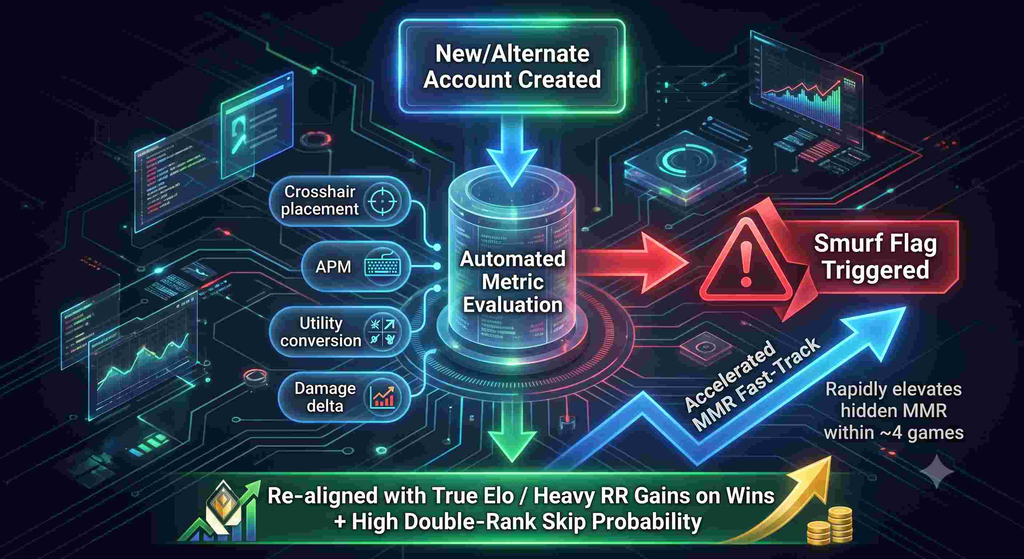
- Behavioral & Performance Heuristics: The system evaluates more than raw K/D ratios. Crosshair placement, utility efficiency, first-blood success rates, and economic management feed into a player’s hidden MMR to identify mismatched skill levels early.
- Accelerated MMR Convergence: Once an account is flagged for performing far above its nominal rank tier, the matchmaking algorithm accelerates its hidden MMR gains. Instead of terrorizing low-elo lobbies for weeks, detected smurfs are matched against high-elo opponents in roughly four games, quickly eliminating one-sided stomps.
- Dedicated “Rank Manipulation” Reporting: Players can directly flag suspected smurfs, account-sharers, or win-traders through the dedicated in-game report category. This trains regional detection models and triggers manual or algorithmic audits on suspicious accounts.
- Vanguard & Multi-Factor Security Checks: Riot utilizes device and client telemetry to identify hardware sharing and suspicious multi-account logins, requiring mobile multi-factor authentication (MFA) on high-rank accounts in competitive regions to curb account-sharing services.
The Penalty Matrix: What Offenders Face
Riot no longer gives offenders a slap on the wrist. When abusive boosting or manipulation is confirmed with high confidence, the system executes tiered penalties across all participating parties:
| Offense Type | Target Accounts | Enforcement Action / Penalties |
| Account Boosting | Booster & Boostee | Temporary suspensions (14–180 days) up to permanent game bans for repeat offenses. |
| Rank Inflation | Boostee & Hitchhikers | Full RR & MMR Reversions: All rating gained while queueing with the booster is stripped back to pre-boost status. |
| End-of-Act Rewards | Boostee Accounts | Complete forfeiture of Act rank gun buddies, loading borders, and ranked titles. |
| Win-Trading / Match Fixing | All Colluding Players | Immediate competitive ban and permanent blacklisting from high-tier leaderboards. |
| Intentional Deranking (Griefing) | Throwing Accounts | Extended queue restrictions, teamplay bans, and progressive game suspensions. |
Furthermore, the updated reporting infrastructure includes bystander feedback notifications, delivering in-game pop-ups to inform players when their reports have directly resulted in rank rollbacks or account bans.
What Is Still Allowed: Normal Play vs. Violations
Players often worry whether pop-off games or playing with lower-ranked friends will trigger automated bans. The line drawn by the competitive operations team is distinct:
- Permitted:
- Having a miraculous game where you drop a 35-bomb and hit every headshot.
- Queuing in standard 5-stacks where rank disparity rules and standard party RR reductions apply.
- Leveling a secondary account organically without intentionally throwing or manipulating placement outcomes.
- Prohibited:
- Logging into a friend’s or client’s account to carry them into higher ranks.
- Purchasing, selling, renting, or trading unrated or ranked accounts.
- Intentionally throwing matches (deranking) to preserve low MMR for pub-stomping.
- Queueing alongside an active booster to harvest unearned RR gains.
Frequently Asked Questions (FAQ)
Can an account get banned just for having a high K/D on an alternate account?
No. High mechanical skill on a new account simply accelerates hidden MMR gains. The system pushes high-performing players into appropriate lobbies faster; bans are reserved for proven account sharing, bought accounts, automated bot leveling, or deliberate deranking.
What happens to RR gained while playing with a friend who turned out to be a booster?
Under the “Hitchhiker” penalty rules, any RR earned in matches where your party member was manipulating rank will be deducted via a rank reversion once the booster is flagged and confirmed.
How do you report rank manipulation in-game?
Press ESC during the match or navigate to the post-game scoreboard, right-click the suspected player, select Report, and choose the Rank Manipulation category.
Conclusion: Restoring Competitive Integrity
Riot’s aggressive crackdown on smurfing, boosting, and rank manipulation marks a turning point for the competitive ladder.
By shifting away from passive detection toward real-time behavioral heuristics, rapid MMR fast-tracking, and severe rollback penalties, the system ensures that inflated ranks are dismantled just as quickly as they are built. For the grinders, this overhaul translates to cleaner lobbies, more accurate matchmaking, and a ladder where true skill dictates the climb.
“A rank is only as meaningful as the integrity of the matches it took to build it. When the system protects the climb, everyone wins.”