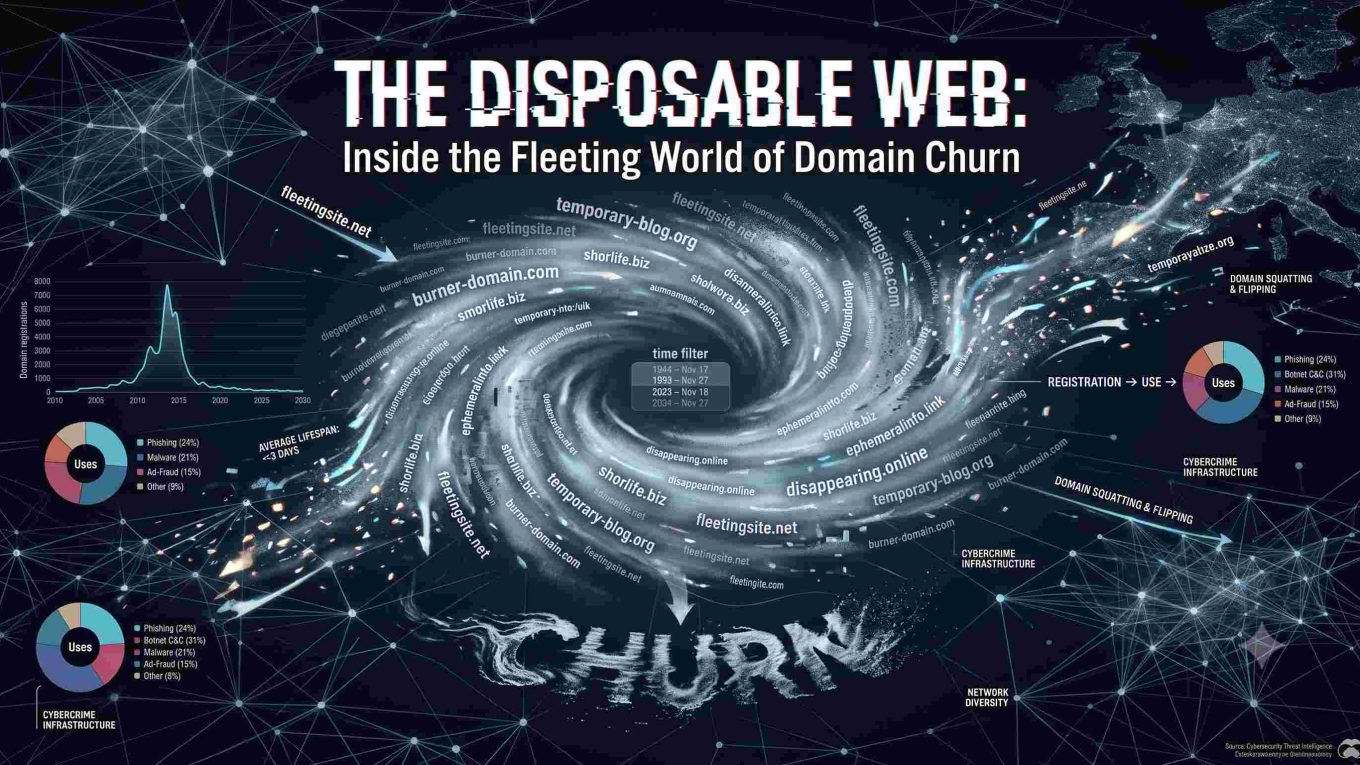
The Disposable Web: Inside the Fleeting World of Domain Churn
It has been eight years in the content business, especially writing about scams. During this time, I have witnessed countless websites that appear to deceive people and then vanish like a speck of dust. As modern technology has changed the way we live, scammers have also evolved their modus operandi.
Most people picture malicious websites as digital fortresses—illicit hubs that persist in dark corners of the web until an authority finally raids and seizes the server. In reality, modern cybercrime runs on a model of planned obsolescence known as domain churn.
Rather than maintaining a persistent digital storefront, threat actors treat domain names like burner phones: cheap, mass-produced, and meant to be tossed away the moment they draw attention.
To understand why modern scams—from fake package tracking alerts to deceptive investment portals—are so pervasive, we have to look under the hood of this disposable infrastructure.
The Cat-and-Mouse Game: Why Longevity Is a Liability
Modern web security relies heavily on reputation scoring. Browsers, secure DNS resolvers, and endpoint firewalls monitor global traffic telemetry. When users begin reporting a suspicious website, or when automated scanners spot cloned brand logos and malicious code, the domain gets slapped with a label: “Deceptive site ahead.”
Once a domain is flagged:
- Browser interstitial warnings appear, scaring away nearly all potential victims.
- Inbound search engine or social media traffic drops to zero.
- Corporate firewalls and mobile carrier SMS filters drop the traffic entirely.
For an attacker, a flagged domain is a dead asset.
Domain churn is the engineering workaround. If an operation rotates domains faster than security scanners can discover and blacklist them, the malicious link stays green and legitimate looking during the critical hours when victims are actively clicking.
The Blueprint: How High Domain Churn Systems Operate
Launching hundreds of websites manually would be impossible. Modern churn campaigns operate like automated assembly lines, orchestrated by code and cheap cloud resources:
- Programmatic Bulk Registration: Attackers use automated registrar APIs to purchase batches of domains at wholesale prices—often under $1 to $2 each—by targeting generic top-level domains (gTLDs) like
.top,.icu,.xyz, or.click. - Algorithmic Generation & Lookalikes: Threat actors rely on Domain Generation Algorithms (DGAs) to mass-generate pseudo-random strings, or craft lookalike permutations mimicking trusted institutions (e.g.,
account-update-notice-support[.]com). - Wildcard & Subdomain Routing: When buying new root domains is inefficient, scammers purchase a single throwaway root domain and churn thousands of dynamic subdomains (
track-order-9823.carrier-logistics[.]com), rotating the prefix for every target or campaign batch. - Fast-Flux DNS: Front-end IP addresses are constantly swapped every few minutes using distributed proxy networks. This creates a moving target that conceals the true backend server hosting the actual malicious payload.
- Continuous Phishing Pipelines: Attackers deploy modular phishing kits that function like modern software deployment pipelines. If Domain A gets flagged at 2:00 PM, an automated webhook deploys the cloned web portal to pre-staged Domain B by 2:01 PM.
The 48-Hour Lifecycle of an Ephemeral Scam
A churned domain moves through a precise, highly calculated life cycle designed to maximize revenue before detection:

- Staging & Aging: The domain is registered days or weeks ahead of time and left parked with benign content to age past initial “brand-new domain” security heuristics.
- Weaponization: DNS records are quietly modified to point to the phishing kit, counterfeit storefront, or fraudulent dashboard.
- Active Harvest (4–48 Hours): Attack vectors launch via automated SMS campaigns, phishing emails, or search engine ad buys. Victims enter credentials, provide payment details, or deposit funds.
- Flagging & Abandonment: Security crawlers flag the domain. Attackers immediately drop the DNS routing, discard the domain, and redirect incoming links to the next pre-warmed address.
Everyday Faces of Domain Churn
You have likely crossed paths with domain churn without realizing it:
- Delivery & Toll “Smishing”: Unsolicited text messages claiming an undelivered parcel or unpaid highway toll almost always use single-day disposable domains to slip past carrier-grade spam filters.
- Malvertising & Ad Hijacking: Fake customer service numbers or counterfeit retail outlets take advantage of search ads. The link survives long enough to trick shoppers during peak traffic windows before manual ad reviewers notice.
- Rotating Task & Crypto Portals: Victims of organized investment scams are often asked to log in to dashboards that change names and URLs weekly. The orchestrators simply frame the migration as a routine “system upgrade” or “server maintenance.”
How the Security Ecosystem Fights Back
Because static blocklists are always a step behind rapid churn, modern defenses focus on behavioral fingerprints rather than domain age:
- Newly Registered Domain (NRD) Quarantines: Enterprise networks and modern DNS providers automatically apply restrictions or isolation environments to any domain registered within the past 15 to 30 days, treating fresh web properties with inherent skepticism.
- Passive DNS & Identity Clustering: Researchers analyze registrant metadata patterns, shared name servers, SSL certificate footprints, and Autonomous System Numbers (ASNs) to identify and block entire clusters of domains simultaneously.
- Sandboxed Visual Analysis: Security engines render unfamiliar websites inside headless browsers, evaluating the page’s visual layout and code structure. If a 12-hour-old domain visually mimics a major bank’s login page, it is flagged immediately—no matter what the URL says.
The Takeaway
Domain churn illustrates an essential truth about modern cybersecurity: malicious behavior rarely hides behind a single, unmovable wall. Instead, it relies on speed, volume, and friction-free automation.
For everyday users, the takeaway is simple: never judge a link by whether your browser lets you through. Just because a web page lacks a warning banner doesn’t mean it is safe—it may simply mean you arrived before the security scanners caught up with the churn.
To understand how fraudulent gambling platforms rapidly rotate disposable URLs to evade detection, read this comprehensiveonline casino domain churn scams guide.
About the Author
Suyesh Gusain is a NISM certified Research Analyst and professional Financial Journalist. With a background in physics and mass communication, he specializes in identifying market anomalies, analyzing technical patterns, and investigating digital fraud. Through Wisdom Ganga, he provides critical research to help retail investors and online shoppers protect their financial footprints from sophisticated automated syndicates.
Call to Action
Please share this article to spread awareness. Follow us on Facebook, Twitter, and Instagram for more scam alerts. If you doubt the legitimacy of any website or investment plan, DM us on social media — we’ll help you verify.
“Scammers evolve daily. Subscribe to our scam‑alert list and stay one step ahead.”