
Chapter 5: Steve Jobs and the Power of Pauses
Steve Jobs—one of the greatest names in the history of mankind. Life is not easy for anybody, which is why we should study people’s journeys and how they overcame their struggles. Jobs was one of the greatest entrepreneurs of the 21st century, single‑handedly changing the way people use electronic gadgets. But what did he do when he didn’t immediately find answers to the questions or problems he faced?
He turned to silence. When Steve Jobs walked onto a stage, the atmosphere in the room shifted. He didn’t merely present products; he orchestrated experiences. While many credit his success to the sleek design of Apple devices or his iconic black turtleneck, his true secret weapon was silence. Jobs intimately understood the profound power of the pause, using it to captivate audiences, heighten anticipation, and etch moments into history.
The Art of the Pause
Jobs’ presentations were masterclasses in timing. He would unveil a product, stop speaking, and let the silence hang in the air. The audience would lean forward, waiting. That deliberate pause transformed a simple corporate announcement into a dramatic revelation.
Consider the legendary 2007 iPhone launch. Jobs systematically built suspense by describing three revolutionary products: a widescreen iPod, a mobile phone, and an internet communicator. He repeated the list, paused, and then delivered the defining line: “Are you getting it? These are not three separate devices. This is one device. And we are calling it iPhone.” The silence preceding the reveal is exactly what made the moment unforgettable.
The Psychology of Silence
Silence is never empty—it is a potent psychological trigger. Pauses create tension, forcing the human brain to anticipate what comes next. They lend gravity to words, allowing audiences to absorb the underlying meaning instead of rushing past the surface information.
Jobs knew that silence could often be louder than speech. By pausing, he afforded his audience the time to process, reflect, and emotionally connect with his vision.
In the architecture of communication, pauses are not gaps; they are the bridges that connect ideas.
Pauses vs. Boredom
At first glance, pauses can resemble boredom—mere moments of nothingness. However, Jobs reframed silence as a highly intentional act. Where boredom feels vacant, a deliberate pause feels loaded with purpose. These spaces serve as vital opportunities to reset attention, highlight importance, and generate lasting impact.
This theme extends far beyond the stage: boredom, when consciously embraced, acts as a necessary pause in life. It becomes an essential opportunity to reflect, recharge, and redirect mental energy. Jobs demonstrated that silence, far from being wasted time, is fundamentally transformative.
Practical Lessons for Everyday Life
Steve Jobs’ mastery of timing offers insights that go far beyond public speaking or product launches. His use of pauses teaches us how silence can be a powerful tool in daily life:
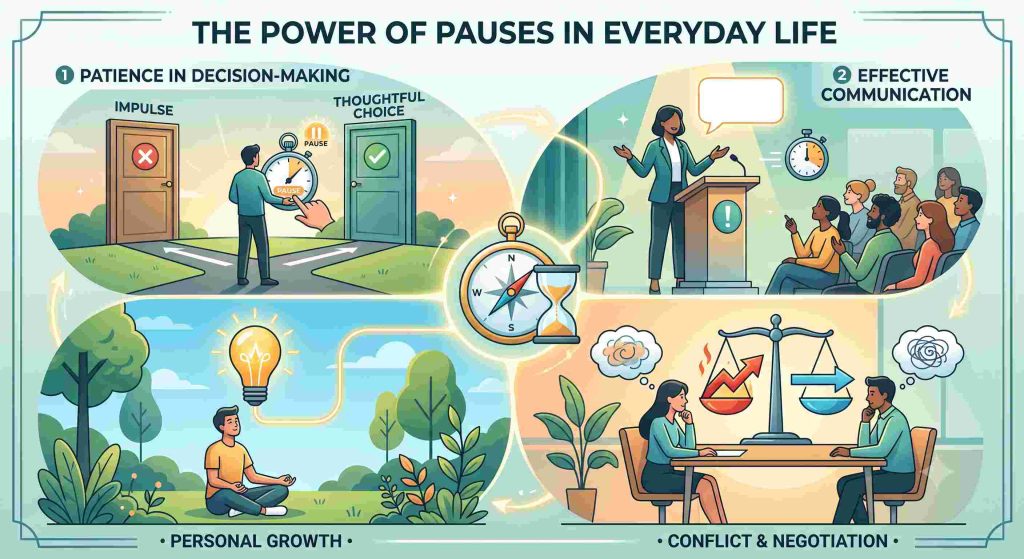
- Patience in Decision‑Making Just as Jobs waited for the perfect moment to speak, we too benefit from waiting before making choices. Whether it’s buying something important, responding to a message, or deciding on a career move, pausing helps us avoid impulsive mistakes.
- Communication and Presentations Pauses give weight to words. Instead of rushing through a conversation or presentation, a moment of silence lets your ideas sink in and shows confidence.
- Conflict and Negotiation In tense situations, pausing before reacting can change the outcome. Silence allows emotions to settle and gives space for wiser, more thoughtful responses.
- Personal Growth Pauses aren’t just about speech—they’re about life. Taking breaks, embracing boredom, or stepping back from constant activity often leads to clarity, creativity, and better problem‑solving.
The Cultural Connection
Jobs’ intentional use of pauses resonates deeply with traditions of meditation and mindfulness. In various philosophies, silence is not viewed as an absence, but as a profound presence. Pauses in speech mirror pauses in thought, serving as the clearing where absolute clarity can emerge.
By embracing the quiet, Jobs tapped into a universal principle: true wisdom often lies in what remains unsaid.
Conclusion
Steve Jobs proved unequivocally that silence is not a weakness, but a formidable strength. His measured pauses amplified meaning, transformed potential boredom into electric anticipation, and elevated standard product launches into global cultural events.
The underlying lesson remains timeless: boredom and pauses are not empty voids. They are the fertile spaces where creativity, clarity, and true impact are born.
“Sometimes, the most powerful statement is the one left unsaid.”
Steve Jobs showed us that silence is not weakness but strength. His pauses amplified meaning, transformed boredom into anticipation, and turned product launches into cultural events.
Yet pauses are only one dimension of boredom’s hidden power. Where Jobs used silence to command attention, Simon Sinek demonstrates how movement through boredom—his famous “boredom walks”—can unlock creativity and clarity.
If Jobs taught us the art of waiting, Sinek teaches us the art of wandering. Together, they reveal that boredom is not a barrier but a gateway: sometimes it is the pause that sharpens focus, and sometimes it is the walk that sparks ideas.
Next Read: Chapter 6: Simon Sinek and the Boredom Walks
Chapter1: The Signal of the Soul
Chapter2: The Hidden Gifts of Boredom
Chapter 3: The Escape from Boredom
Chapter 4: Bill Gates and Think Week