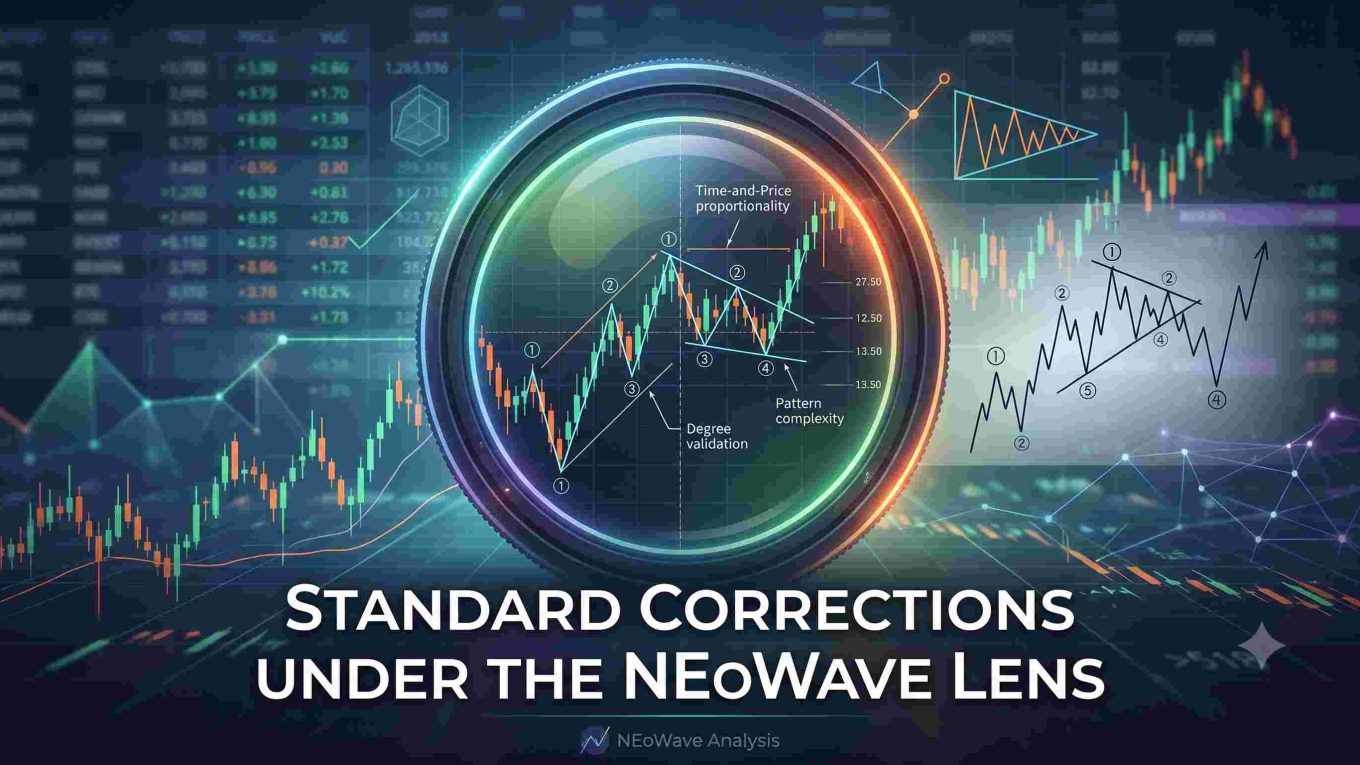
Part3: Standard Corrections Under the NEoWave Lens
Glenn Neely’s NEoWave framework rebuilt the classical Elliott Wave corrections with strict rules. His goal was to eliminate subjectivity and make corrective analysis more scientific, reliable, and testable. In this article, we’ll explore the four key principles Neely introduced — similarity and balance, Fibonacci limits, channeling techniques, and touch‑point rules — with normal, practical examples that traders can relate to.
3.1 Rule of Similarity and Balance
- Concept: All waves inside a correction must belong to the same degree.
- This means they should be comparable in time duration and complexity.
- If one leg is too short or too simple compared to the others, the correction is invalid.
Example:
- Wave A lasts 5 days and has 3 internal swings.
- Wave B should also last several days and show similar complexity.
- If Wave B finishes in just 1 day with a single swing, it breaks the rule.
👉 Think of it like a balanced seesaw — both sides must carry similar weight.
3.2 Strict Fibonacci Limits
- Neely applied precise Fibonacci rules to corrections:
- B‑wave retracements: Cannot exceed certain percentages of Wave A.
- C‑wave extensions: Must fall within strict ranges (often 0.618, 1.0, or 1.618 × Wave A).
Example:
- Wave A drops 100 points.
- Wave B retraces 70 points (acceptable).
- Wave B retraces 95 points (too much — violates the rule).
- Wave C should then extend 100–160 points, not randomly overshoot.
👉 These limits prevent traders from “forcing” counts that don’t respect proportion.
3.3 Channeling Techniques
- NEoWave corrections are validated by drawing base lines and parallel channels.
- These channels help anticipate where the correction will exhaust.
Example:
- In a zigzag, draw a line from the start of Wave A to the end of Wave B.
- Project a parallel line from the end of Wave A.
- Wave C should terminate near this parallel line.
👉 Channels act like guardrails, showing where price is likely to stop.
3.4 Touch‑Point Rules
- Neely introduced rules based on how many times price touches the corrective channel.
- Each touch validates the pattern; too many touches invalidate it.
Example:
- In a triangle, each leg must touch the boundary exactly once.
- If Wave D touches the boundary twice, the triangle is invalid.
👉 Think of it like a tennis ball bouncing exactly five times inside a court — extra bounces break the pattern.
📊 Summary Table
| NEoWave Rule | Purpose | Simple Example |
|---|---|---|
| Similarity & Balance | Waves must be same degree | Wave A = 5 days, Wave B ≈ 5 days |
| Fibonacci Limits | Prevent forced counts | Wave B ≤ 80% of A |
| Channeling | Predict exhaustion | Wave C ends near parallel line |
| Touch‑Point | Validate clean structure | Triangle legs touch boundary once |
FAQs
Why did Neely add strict rules?
To reduce subjectivity and make wave counts more reliable.
Do Fibonacci limits apply to all corrections?
Yes, but each correction type has specific retracement/extension ranges.
How do channels help traders?
They act as predictive guardrails, showing where price is likely to exhaust.
Conclusion
Under the NEoWave lens, corrections are no longer “flexible guesses.” They are rule‑driven structures validated by similarity, Fibonacci limits, channeling, and touch‑point rules.
- Similarity ensures balance.
- Fibonacci limits enforce proportion.
- Channels guide exhaustion points.
- Touch‑points validate clean structures.
“NEoWave corrections are not just patterns — they are disciplined frameworks for market balance.”