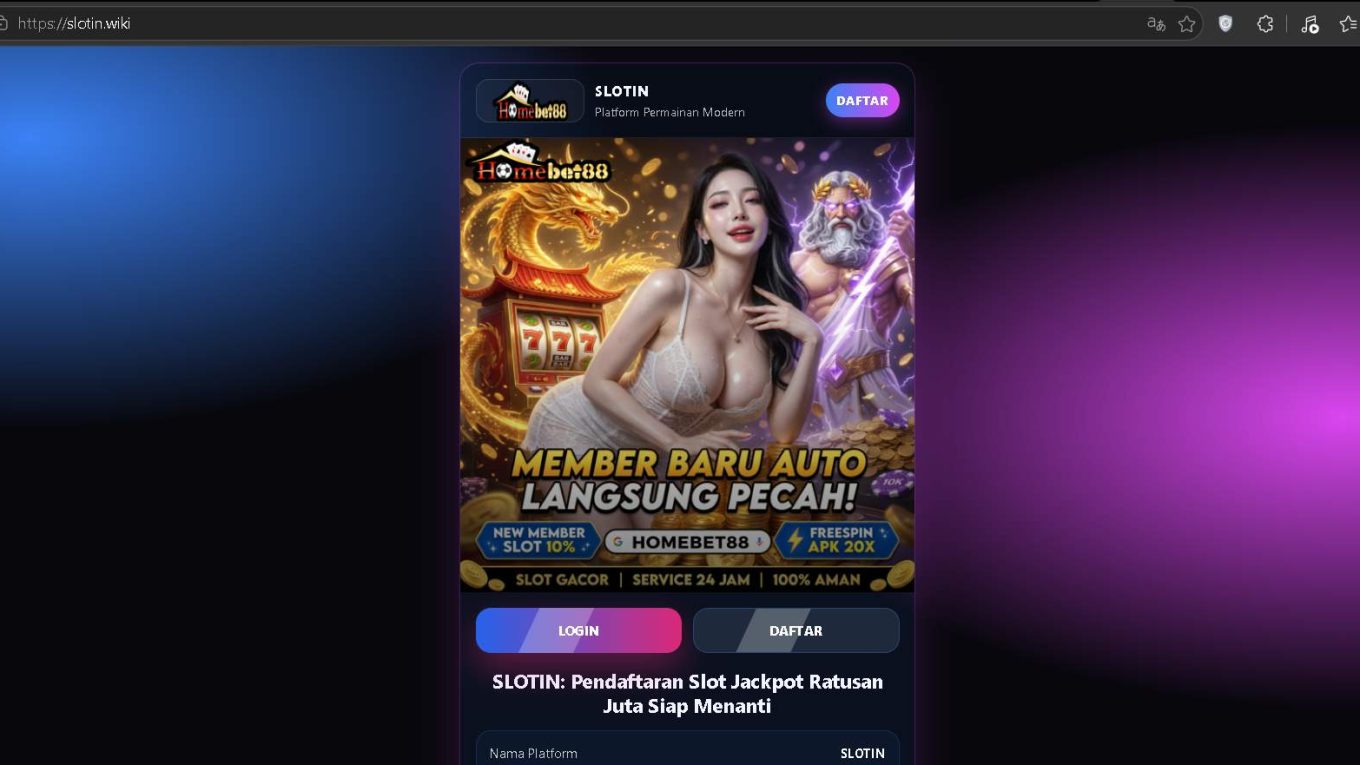
Slotin.wiki Review: Exposing The Bait-and-Switch (RTP Manipulation) in Offshore Slot Portals
Digital casino hubs often project the illusion of effortless windfalls, but a closer examination of Slotin.wiki reveals how digital slot storefronts exploit mathematical illusions to harvest user deposits. When unvetted operations deploy The Bait-and-Switch (RTP Manipulation), the traditional boundaries of odds, probability, and fair play disappear entirely behind rigged digital interfaces.
For anyone who has landed on this Indonesian-facing gambling gateway, assessing financial vulnerability is an urgent necessity. Unlicensed platforms deliberately masquerade as legitimate gaming networks, leaving victims facing frozen capital, non-responsive support desks, and compromised personal banking credentials.
Deconstructing the Mechanics: What Is The Bait-and-Switch (RTP Manipulation)?
In licensed, audited online gaming ecosystems—regulated by jurisdictions such as the Malta Gaming Authority (MGA) or the UK Gambling Commission (UKGC)—slot games operate on strictly certified Random Number Generators (RNG).
Return-to-Player (RTP) figures, typically hovering between 94% and 97%, represent long-term theoretical payout models calculated over millions of spins. Regulators mandate that these parameters remain immutable on the game studio’s secure hosting servers.
Suspicious Link or Courier SMS?
Verify URLs, APKs, or parcel alerts against our threat database before clicking.
In predatory ecosystems, The Bait-and-Switch (RTP Manipulation) flips this paradigm:
- The Dynamic Switch: Instead of static, verified code, backend operators utilize pirate slot engines or whitelabel API aggregators that permit administrative adjustment of win parameters on the fly.
- The Algorithmic Honeymoon: Initial spins and low-tier micro-deposits trigger disproportionately frequent wins, designed to flood the player’s brain with dopamine and establish an artificial sense of predictability.
- The Yield Compression Trap: Once account balances increase or a substantial reload deposit clears via banking channels or e-wallets, backend algorithms dial down actual RTP returns to single digits or absolute zero.
- Statistical Asymmetry: The player assumes they are enduring ordinary market variance, while the platform silently executes deterministic balance depletion.
Player Safety Blueprint: Prevention & Solutions
Protect assets before interacting with unverified mirrors, or follow mitigation steps if data was shared.
Never pay secondary “clearance taxes” or “unlock fees” to release trapped funds.
Uninstall suspicious packages, reboot into Safe Mode, and run an updated antivirus scan.
Reset passwords on linked emails/wallets immediately and enable authenticator-app 2FA.
Contact your bank’s fraud desk to dispute transactions under merchant fraud.
Block unsolicited contacts and disregard third-party “fund recovery” hackers requesting fees.
Case Study: Analyzing the Slotin.wiki Gateway Ecosystem
To understand how deceptive funnels convert cold traffic into systemic financial losses, analyzing Slotin.wiki serves as an operational case study.
       [ Traffic Source: Social / Telegram / SMS Bait ]
                             │
                             ▼
     ┌─────────────────────────────────────────────────┐
     │           Slotin.wiki (Mirror Portal)           │
     │   - Sensational Banners ("Auto Langsung Pecah") │
     │   - Obfuscated Infrastructure (.wiki TLD)       │
     │   - Click-Through Action: "DAFTAR" / "LOGIN"    │
     └─────────────────────────────────────────────────┘
                             │
            Redirects via Unverified API Gateways
                             │
                             ▼
     ┌─────────────────────────────────────────────────┐
     │        Unlicensed Offshore Casino Platform      │
     │   - Scripted Payouts for Initial Micro-Stakes   │
     │   - Administrative RTP Dial-Down on High Bets   │
     │   - Withdrawal Lock & KYC Extortion Funnel      │
     └─────────────────────────────────────────────────┘
What Is Slotin.wiki and How Does It Work?
Contrary to what its generic .wiki domain extension suggests, the site does not host open-source documentation or informational guides. Instead, it serves as an intermediary landing vector and mirror gateway (link alternatif) funneling traffic directly toward unverified offshore betting operations, notably associated with syndicates branded as Homebet88 or SLOTIN.
Because regulatory authorities across Southeast Asia regularly impose DNS-level domain bans (Internet Positif / Komdigi crackdowns), illegal gambling rings rotate throwaway web addresses on low-cost TLDs. Slotin.wiki functions as a throwaway entry point, steering users past local network blocks into offshore server rooms located beyond domestic legal jurisdictions.
The Promises: What Does the Site Claim to Offer?
The landing interface relies heavily on high-converting psychological hooks:
- “Member Baru Auto Langsung Pecah”: Direct marketing copy asserting that new member accounts are algorithmically guaranteed to unlock massive, explosive jackpots immediately upon registration.
- Instant Jackpots of Hundreds of Millions: Promising payouts scaling into hundreds of millions of rupiah without disclosing wagering requirements or turnover constraints.
- Frictionless Onboarding: Minimal identification requirements at the point of deposit, encouraging users to rapidly transfer money via local banking channels, QRIS, and mobile e-wallets.
- 24/7 Service & “100% Aman” Badges: Displaying meaningless, self-fabricated security stamps without a single verifiable cryptographic audit certificate, merchant banking license, or identifiable corporate registration.
Five Critical Red Flags Uncovered on Slotin.wiki
1. Blatant RTP Manipulation Guarantees
Legitimate software providers (such as Pragmatic Play, NetEnt, or Evolution) cannot and do not guarantee instant wins for newcomers. Slotin.wiki’s claim that a newly created account will “Auto Langsung Pecah” is an explicit admission that the software behind the curtain is non-random, mathematically manipulated, and completely decoupled from true RNG protocols.
2. Complete Absence of Regulatory Licensing
A thorough examination of the domain reveals no licensing footprint from established gaming commissions. There is no listed corporate entity, zero jurisdictional accountability, and no compliance officer oversight. If user balances disappear or withdrawals freeze, victims have no ombudsman, legal channel, or regulator to petition for financial remediation.
3. Disposable Domain Architecture
Operating gambling infrastructure on an arbitrary .wiki extension is a hallmark of disposable mirror syndicates. Legitimate financial technology and gaming platforms maintain persistent, multi-year domain equity with enterprise-grade security certificates. Throwaway domains exist solely to facilitate quick exit paths when an address is flagged for fraud, malware, or illicit telecommunications activity.
4. Asymmetric Transaction Friction
The portal is structured to make outbound cash flows painless while placing impenetrable barriers on cash extraction. While incoming capital via QRIS or automated deposit portals registers in seconds, user withdrawal requests trigger administrative roadblocks, fabricated “turnover volume” deficits, or demands for advance verification fees.
5. Sensitive Identity & Financial Data Harvesting
To proceed past the landing page, users must input valid mobile numbers, messaging IDs, and active bank account credentials. In unregulated gambling pipelines, this personally identifiable information (PII) is routinely harvested, indexed, and monetized across illicit telemarketing networks, exposing users to targeted phishing campaigns, financial identity theft, and unlicensed lending schemes.
Financial Protection: How to Respond if You Have Interacted with the Site
If you have already submitted credentials or deposited funds through the portal, take immediate steps to insulate your personal accounts:
- Halt Outbound Capital: Under no circumstances should you deposit additional money to fulfill “clearance charges,” “tax withholding fees,” or “turnover unlocks.” Every additional payment represents an irrecoverable loss.
- Isolate Compromised Banking Channels: Contact your bank’s fraud prevention department immediately. Request an audit of recent merchant charges, freeze exposed debit/credit cards, and reset credentials for any online banking services linked to the portal.
- Harden Communication Channels: Expect an uptick in deceptive SMS, WhatsApp, and email solicitations. Filter unknown senders, activate multi-factor authentication (MFA) via authenticator apps rather than SMS, and report fraudulent transaction accounts to local financial enforcement authorities.
Frequently Asked Questions
1. Is Slotin.wiki Scam?
Yes. Slotin.wiki exhibits classic characteristics of an unverified predatory gambling gateway. It lacks recognized operational licensing, deploys misleading claims of guaranteed payouts, uses disposable domain infrastructure, and directs users toward offshore networks notorious for freezing player balances upon withdrawal.
2. Is Slotin.wiki Legit?
No, the platform is not legitimate. Legitimate gaming and interactive entertainment platforms maintain visible regulatory compliance records, undergo third-party software integrity audits, and do not rely on throwaway top-level domains or deceptive “wiki” titles to distribute casino software.
3. What is the main danger of The Bait-and-Switch (RTP Manipulation)?
The primary hazard is that the game’s payout percentage is artificially suppressed once significant capital is placed. Players are led to believe they are navigating standard probability, when in reality the platform’s backend has been programmed to ensure balance depletion.
4. Can third-party recovery services retrieve funds lost on Slotin.wiki?
Be cautious: claims by self-styled “asset recovery specialists” on social media or message boards are overwhelmingly secondary advance-fee scams. Legitimate fund recovery can only occur through formal bank dispute channels, official fraud affidavits, or direct law enforcement actions.
5. Why do sites like Slotin.wiki change domain extensions frequently?
Unlicensed online betting operations face routine blockades by telecommunication watchdogs and internet service providers. To circumvent automated filtering, syndicate administrators rotate across dozens of low-cost domains to keep user acquisition funnels open.
6. Are online slot algorithms on unlicensed portals truly random?
No. Independent verification by testing labs like eCOGRA, iTech Labs, or BMM Testlabs is completely absent on unvetted mirror sites. Without third-party code verification, backend administrators can adjust volatility, hit frequency, and payout ceilings at will.
7. What should I do if my bank account details were entered on the site?
Notify your financial institution’s fraud operations unit immediately. Request a new account number or card reissue, monitor your credit statements for unauthorized debits, and change passwords across all critical services sharing that email or phone number.
8. How can users verify if an online casino possesses a legitimate gaming license?
Cross-reference the platform’s published license number directly within the public registry of an established regulator, such as the Malta Gaming Authority or the Isle of Man Gambling Supervision Commission. If the platform provides only a static graphical logo without a clickable, verifiable license validation URL, the credential is fake.
Every safe click counts. If this post helped, a coffee gesture fuels more scam‑busting investigations.

Help Us Spread Awareness
Please share this article to spread awareness. Follow us on social media for more scam alerts.