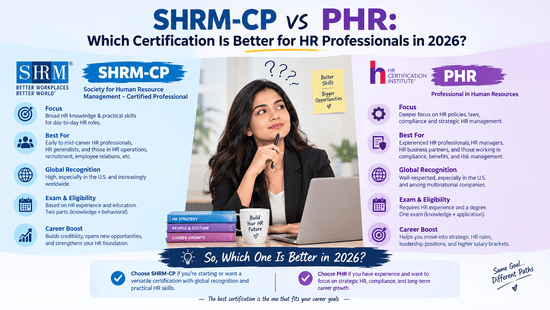
SHRM-CP vs PHR: Which Certification Is Better for HR Professionals in 2026?
Confused between SHRM-CP and PHR? You’re not alone. As someone who has spent years in HR and talent acquisition, I’ve seen professionals struggle with this decision. Both certifications are respected, both can boost your career, and both can increase your earning potential. The real question is: which one aligns better with your career goals?
Whether you’re an HR Executive, Recruiter, HR Generalist, or aspiring HR Manager, this comprehensive guide will help you make the right choice.
The Growing Importance of HR Certifications
Human Resources has evolved dramatically over the last decade. HR professionals are no longer limited to attendance management, hiring, and employee paperwork. Today’s HR teams influence business strategy, workforce planning, employee experience, diversity initiatives, and organizational growth.
As competition increases, certifications have become a powerful way to stand out.
According to industry reports, certified HR professionals often earn higher salaries and enjoy better career progression than their non-certified peers. Both SHRM-CP and PHR are among the most recognized HR certifications globally.
But how do you decide between them?
Let’s break it down.
What is SHRM-CP?
SHRM-CP (Society for Human Resource Management Certified Professional) is offered by SHRM, one of the world’s largest HR professional associations.
This certification focuses on:
- HR competencies
- Leadership skills
- Relationship management
- Critical evaluation
- Ethical practices
- Business acumen
- Employee engagement
- Real-world HR decision-making
Unlike traditional exams that test only theoretical knowledge, SHRM-CP evaluates how HR professionals apply their knowledge in workplace situations.
Best Suited For:
- HR Executives
- Recruiters
- HR Generalists
- HR Business Partners
- Talent Acquisition Professionals
- Professionals aspiring for managerial positions
What is PHR?
PHR (Professional in Human Resources) is offered by the HR Certification Institute (HRCI).
PHR focuses heavily on:
- HR operations
- Employment laws
- Compliance
- Workforce planning
- Talent management
- Compensation and benefits
- Risk management
The certification emphasizes technical HR knowledge and legal compliance more than behavioral competencie.
Best Suited For:
- HR Generalists
- Compliance Specialists
- HR Operations Teams
- Employee Relations professionals
- HR Managers handling policy and legal matters
SHRM-CP vs PHR: Quick Comparison
| Feature | SHRM-CP | PHR |
|---|---|---|
| Issuing Organization | SHRM | HRCI |
| Focus Area | Competency-Based | Knowledge-Based |
| Exam Style | Situational Judgment | Technical Questions |
| Emphasis | Leadership & Strategy | Compliance & Operations |
| Best For | Modern HR Roles | Traditional HR Roles |
| Global Recognition | Strong | Strong |
| HR Law Focus | Moderate | Extensive |
| Business Acumen | High | Moderate |
| Talent Acquisition Relevance | Very High | Moderate |
Understanding the Core Difference
This is where most candidates get confused.
SHRM-CP Asks:
“What would you do in this situation?”
For example:
An employee complains about cultural discrimination.
As an HR professional, what action should you take first?
The exam evaluates judgment, communication, ethics, and decision-making skills.
PHR Asks:
“What do you know?”
For example:
Which federal employment law applies in this specific scenario?
The exam tests your understanding of HR regulations, policies, and practices.
Simple Analogy
Think of it this way:
- PHR tests whether you know the rulebook.
- SHRM-CP tests whether you can use the rulebook effectively in real-life situations.
That is why many modern employers increasingly appreciate SHRM’s competency-based approach.
Which Certification is More Respected?
The honest answer:
Both are respected.
There is no universally “better” certification.
Many multinational companies recognize both SHRM and HRCI credentials. SHRM-CP and PHR are consistently identified as the two primary professional-level HR certifications.
However, hiring trends suggest some differences:
Choose SHRM-CP If:
- You want an HRBP role.
- You work in talent acquisition.
- You contribute to business strategy.
- You work in a multinational environment.
- You focus on employee experience.
Choose PHR If:
- You handle HR operations.
- You work heavily with compliance.
- You manage labor law issues.
- You enjoy policy-driven HR functions.
My Personal Perspective as an HR Professional
When I speak with HR professionals, especially those looking to restart their careers or move into strategic HR roles, I often notice one trend:
Organizations increasingly want HR professionals who can influence business outcomes, not just manage HR processes.
If your ambition is to become:
- HR Manager
- HR Business Partner
- Talent Acquisition Lead
- People Operations Specialist
then SHRM-CP usually offers broader value.
Why?
Because modern organizations care about:
- Employee engagement
- Retention
- Employer branding
- Workforce planning
- Leadership development
These areas go beyond compliance.
That said, if your role revolves around HR administration, policies, audits, and employee relations, PHR can be an excellent choice.
Exam Difficulty: Which One Is Harder?
A common question among HR aspirants is:
“Which exam is easier?”
The reality:
Neither is easy.
SHRM-CP Challenges
- Scenario-based questions
- Multiple correct-looking answers
- Strategic thinking requirements
- Behavioral judgment questions
PHR Challenges
- HR laws
- Technical knowledge
- Compliance standards
- Detailed HR procedures
Many professionals feel PHR requires stronger memorization, whereas SHRM-CP requires stronger application skills. Your difficulty level will depend largely on your experience.
Career Benefits of SHRM-CP
Let’s talk about what really matters.
1. Better Career Visibility
The SHRM brand has global recognition.
Many recruiters actively search for SHRM-certified professionals.
2. Strategic HR Positioning
SHRM-CP supports careers in:
- HRBP
- Talent Management
- Organizational Development
- People Operations
3. Strong Community Support
SHRM provides access to one of the largest HR communities worldwide.
4. Future-Ready HR Skills
Modern HR increasingly focuses on:
- Analytics
- Employee Experience
- Culture
- Leadership
SHRM aligns closely with these trends.
Career Benefits of PHR
PHR offers significant advantages too.
1. Strong Compliance Foundation
If you deal with:
- Legal risks
- Employment regulations
- Internal audits
PHR provides deep expertise.
2. Credibility in HR Operations
The certification demonstrates strong technical HR knowledge.
3. Excellent for Traditional HR Roles
Many established organizations continue to value PHR-certified professionals.
Salary Impact
Certification alone won’t double your salary. However, it can:
- Improve interview opportunities
- Increase credibility
- Support promotions
- Differentiate you from competitors
Industry analyses cited by HR certification resources report salary premiums for certified HR professionals compared with uncertified peers. The bigger benefit is not the certificate itself. It’s the doors the certificate opens.
SHRM-CP vs PHR for Recruiters
This is particularly important for talent acquisition professionals. If your work involves:
- Recruiting
- Employer branding
- Candidate experience
- Hiring strategy
- Workforce planning
I would strongly lean toward SHRM-CP. The competency-based approach aligns closely with modern recruitment practices. PHR remains useful but is generally less recruitment-focused.
SHRM-CP vs PHR for HR Managers
For aspiring HR Managers:
Choose SHRM-CP If You Want:
- Leadership responsibilities
- Strategic HR projects
- Business partnering
- Organizational development
Choose PHR If You Want:
- HR compliance expertise
- Policy management
- Employee relations
- HR governance
Can You Earn Both Certifications?
Absolutely.
Many senior HR leaders eventually earn multiple certifications. A common progression is:
- SHRM-CP or PHR
- SHRM-SCP or SPHR later in the career
Senior-level certifications such as SHRM-SCP and SPHR are designed for experienced HR leaders. If your budget and time allow, having both credentials can be valuable. However, most professionals only need one to start.
Who Should Choose SHRM-CP?
✅ HR Generalists
✅ Recruiters
✅ Talent Acquisition Specialists
✅ HR Business Partners
✅ MBA HR Students
✅ People Operations Professionals
✅ Employee Experience Specialists
✅ Future HR Leaders
Who Should Choose PHR?
✅ HR Operations Professionals
✅ Employee Relations Specialists
✅ Compliance Managers
✅ HR Policy Experts
✅ Labor Law Specialists
✅ Risk Management Professionals
Final Verdict: Which Certification Is Better?
If you’re looking for a short answer:
Choose SHRM-CP if:
You want a modern, strategic, business-oriented HR career.
Choose PHR if:
You want deep expertise in HR operations, compliance, and employment regulations.
For most HR professionals entering today’s evolving workplace, SHRM-CP offers slightly broader career flexibility because of its emphasis on leadership, business impact, and practical decision-making. At the same time, PHR remains one of the most respected certifications for demonstrating strong HR knowledge and compliance expertise.
Conclusion
There is no universal winner in the SHRM-CP vs PHR debate. The best certification is the one that supports your career direction.
If your goal is to become a strategic HR leader, improve talent management capabilities, and contribute directly to business outcomes, SHRM-CP is likely the stronger investment.
If you’re passionate about HR operations, compliance, and mastering the technical foundations of human resources, PHR remains an outstanding choice.
Whichever path you choose, remember this: A certification does not replace experience. It amplifies it. Your success will ultimately come from how effectively you apply HR knowledge to create better workplaces, stronger teams, and meaningful employee experiences.
Sweta Rawat is an HR professional with over 2.5 years of experience and an MBA in Human Resources. She writes on modern HR practices, employee engagement, and workplace culture, blending professional expertise with creative insight.