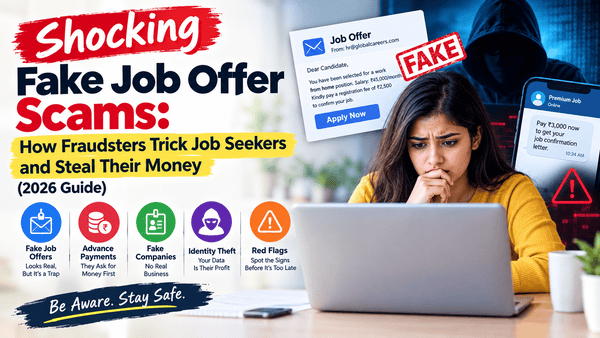
🚨 Shocking Fake Job Offer Scams: How Fraudsters Trick Job Seekers and Steal Their Money (2026 Guide)
Looking for a new job can be exciting, but unfortunately, scammers know that job seekers are often hopeful, eager, and vulnerable. Fake job offer scams have become one of the fastest-growing forms of employment fraud, targeting freshers, experienced professionals, remote workers, and even senior executives. In this guide, we’ll uncover how fake job offer scams work, the warning signs to watch for, and practical steps to protect yourself.
A Job Offer That Seems Too Good to Be True
Imagine this.
You wake up one morning and see an email from a well-known company. The subject line reads:
“Congratulations! You Have Been Selected.”
No lengthy interview process.
No technical round.
No waiting.
Just an attractive salary package, exciting perks, and a joining date.
For many job seekers, especially freshers or those struggling to find employment, this feels like a dream come true.
Unfortunately, that’s exactly what scammers are counting on.
As someone who has worked in Talent Acquisition and recruitment, I’ve seen candidates become victims of fake offer letters, WhatsApp recruitment schemes, and fraudulent background verification requests. The emotional and financial damage can be significant.
The good news is that once you understand how these scams operate, they’re much easier to identify.
What Is a Fake Job Offer Scam?
A fake job offer scam occurs when fraudsters pretend to represent legitimate companies and offer non-existent job opportunities.
The goal is usually to:
- Steal money
- Collect personal information
- Commit identity fraud
- Access banking details
- Spread malware
The scammer may claim to be:
- An HR manager
- Recruitment consultant
- Talent acquisition specialist
- Background verification executive
- Hiring manager
Everything may appear genuine at first glance. That’s what makes these scams dangerous.
Why Fake Job Scams Are Increasing
Several factors have contributed to the rise of fake recruitment scams:
More Online Job Applications
Most hiring now happens online.
Candidates apply through:
- Job portals
- Company career pages
- Social media
This makes it easier for fraudsters to access potential victims.
Remote Hiring Is Common
Virtual interviews are now widely accepted.
Scammers exploit this trend by conducting fake interviews through:
- Telegram
- Fake video calls
- Fraudulent websites
Desperation Creates Opportunity
Candidates facing:
- Career gaps
- Layoffs
- Financial pressure
- Competitive job markets
may be more likely to overlook warning signs.
How Fake Job Offer Scams Work
Step 1: Initial Contact
The victim receives:
- An email
- WhatsApp message
- LinkedIn message
- SMS
Typical messages include:
“Congratulations! Your profile has been shortlisted.”
or
“We found your resume and would like to offer you an exciting role.”
The message often includes a recognizable company name to create trust.
Step 2: Minimal or No Interview
This is one of the biggest warning signs.
Instead of a proper hiring process:
- One phone call may be conducted
- A short chat interview happens
- Some candidates receive offers immediately
Real companies invest time in evaluating candidates.
Scammers don’t.
Step 3: The Offer Letter Arrives
The offer letter often includes:
✅ Company logo
✅ Official-looking formatting
✅ HR signatures
✅ Employee ID numbers
✅ Salary structure
At first glance, everything looks legitimate.
Many fake offer letters are surprisingly convincing.
Step 4: The Payment Request
This is usually where the scam becomes obvious.
Candidates are asked to pay for:
- Training fees
- Security deposits
- Laptop charges
- Identity verification
- Background verification
- Joining formalities
- Uniform costs
- Visa processing
The amount may range from a few hundred rupees to several lakhs.
Step 5: The Disappearance
Once payment is received:
- Emails stop
- Phone numbers become unreachable
- Websites disappear
- Recruiters vanish
The job never existed.
The Most Common Fake Job Offer Scams
1. Fake Work-from-Home Jobs
Scammers promise:
- ₹50,000 to ₹1 lakh monthly income
- Flexible schedules
- No experience required
Examples include:
- Data entry jobs
- Form-filling projects
- Online typing work
Victims are often asked to pay registration fees.
2. Fake MNC Recruitment
Well-known brands are frequently impersonated.
Scammers use names of:
- IT companies
- Banks
- Airlines
- E-commerce companies
Many candidates assume the job is genuine because the company itself is legitimate.
The offer isn’t.
3. WhatsApp Recruitment Scams
Messages often begin with:
“We found your profile online.”
or
“Your resume has been selected.”
Warning signs include:
- Poor grammar
- Urgent hiring claims
- Unrealistic salaries
- Requests for money
4. LinkedIn Job Fraud
Even professional networking platforms attract scammers.
Fake recruiters may:
- Create fake profiles
- Copy company logos
- Contact candidates directly
Always verify the recruiter’s profile before sharing personal details.
5. Overseas Employment Scams
These scams promise jobs in:
- Canada
- Australia
- United Kingdom
- United Arab Emirates
- United States
Victims are often charged for:
- Visa processing
- Work permits
- Immigration services
Red Flags Every Job Seeker Must Know
🚩 The Employer Requests Money
Let’s make this simple.
Legitimate employers do not charge candidates for jobs.
Period.
If someone asks for money in exchange for employment, be extremely cautious.
🚩 Instant Selection
Successful hiring usually involves:
- Resume screening
- Interviews
- Evaluations
- Reference checks
Getting selected immediately should raise questions.
🚩 Unrealistic Salary Packages
Scammers often advertise:
- Entry-level jobs with executive salaries
- Work-from-home positions with extraordinary compensation
A high salary alone isn’t proof of fraud, but it should encourage additional verification.
🚩 Gmail or Yahoo Email Addresses
Example:
❌ companyhr@gmail.com
✅ hr@companyname.com
Most established companies use official domains.
🚩 Poor Communication
Common signs include:
- Grammar mistakes
- Copy-paste messages
- Generic responses
- Inconsistent information
Professional recruiters communicate professionally.
🚩 Pressure to Act Quickly
Scammers frequently say:
- “Offer expires tonight.”
- “Pay immediately.”
- “Limited vacancies.”
Pressure tactics are designed to prevent research and verification.
Real-Life Warning Signs I Often Notice as an HR Professional
One thing that immediately catches my attention is when candidates tell me:
“The company selected me without asking about my experience.”
Recruiters are hired to assess candidates.
No genuine employer spends thousands on salaries without evaluating applicants.
Another common warning sign is when candidates receive communication only through WhatsApp.
While some recruiters may schedule interviews through WhatsApp, critical documents usually come from official systems or company email addresses.
How to Verify a Job Offer
Before accepting any offer:
Check the Email Domain
Compare:
✅ careers@company.com
❌ company.jobs.hr@gmail.com
Visit the Official Website
Most legitimate organizations have:
- Career pages
- Contact details
- Recruitment information
Compare the job offer with publicly listed openings.
Search LinkedIn
Look for:
- HR representative profiles
- Current employees
- Company hiring announcements
If nobody else seems aware of the recruitment drive, investigate further.
Contact the Company Directly
Call:
- Official HR department
- Corporate office
Verify:
- Recruiter’s identity
- Offer letter authenticity
- Job vacancy existence
Review the Offer Carefully
Check for:
- Typographical errors
- Generic language
- Strange payment requests
- Missing company details
What Information Scammers Want
It’s not always about money.
Sometimes fraudsters seek:
Personal Information
- Full name
- Address
- Phone number
- Date of birth
Financial Information
- Bank details
- Credit card information
- UPI IDs
Identity Documents
- Aadhaar card
- PAN card
- Passport
- Driving licence
This information can be used for identity theft and future fraud.
What to Do If You Were Scammed
If you’ve already shared information or made a payment:
Immediately
✅ Stop further communication
✅ Save all emails and screenshots
✅ Contact your bank
✅ Report unauthorized transactions
✅ Change compromised passwords
✅ Monitor financial accounts
Report the Fraud
You can:
- Inform local cybercrime authorities
- Report fake job listings
- Notify the impersonated company
- File complaints through appropriate cybercrime reporting channels
Tips to Stay Safe During Your Job Search
Research Every Employer
Spend 10 minutes verifying a company.
It could save months of trouble.
Never Pay to Get Hired
This is the golden rule.
A legitimate company pays employees.
Employees do not pay companies to receive jobs.
Protect Sensitive Information
Avoid sharing documents until:
- The employer is verified
- The hiring process is legitimate
- You understand why the document is required
Be Skeptical of Urgent Offers
Scammers want speed.
Legitimate employers want suitable employees.
Trust Your Instincts
If something feels unusual, investigate.
Most scam victims later report that they noticed warning signs but ignored them.
Frequently Asked Questions
Are all work-from-home jobs scams?
No. Many legitimate remote jobs exist. The key is verifying the employer and avoiding payment requests.
Can a company charge onboarding fees?
Generally, legitimate employers do not require candidates to pay recruitment, interview, or job placement fees.
How can I verify an offer letter?
Contact the organization directly through official contact information found on its website.
Is a WhatsApp interview a scam?
Not necessarily.
However, if the entire hiring process happens only through WhatsApp and includes payment requests, exercise caution.
What is the biggest red flag in a job scam?
Any request for money from a candidate is one of the strongest warning signs.
Final Thoughts
Job searching can already be stressful without having to worry about scammers.
Unfortunately, fake job offer scams continue to target freshers, experienced professionals, and even senior executives by exploiting one powerful emotion: hope.
As an HR professional, I’ve seen talented candidates lose money simply because a fraudulent offer appeared authentic.
Remember this simple rule:
“A genuine employer evaluates your skills before hiring you. A scammer evaluates how quickly you can send money.”
Take your time.
Verify every opportunity.
Ask questions.
Research companies.
And never let excitement replace caution.
The right job will never require you to purchase it.
Sweta Rawat is an HR professional with over 2.5 years of experience and an MBA in Human Resources. She writes on modern HR practices, employee engagement, and workplace culture, blending professional expertise with creative insight.