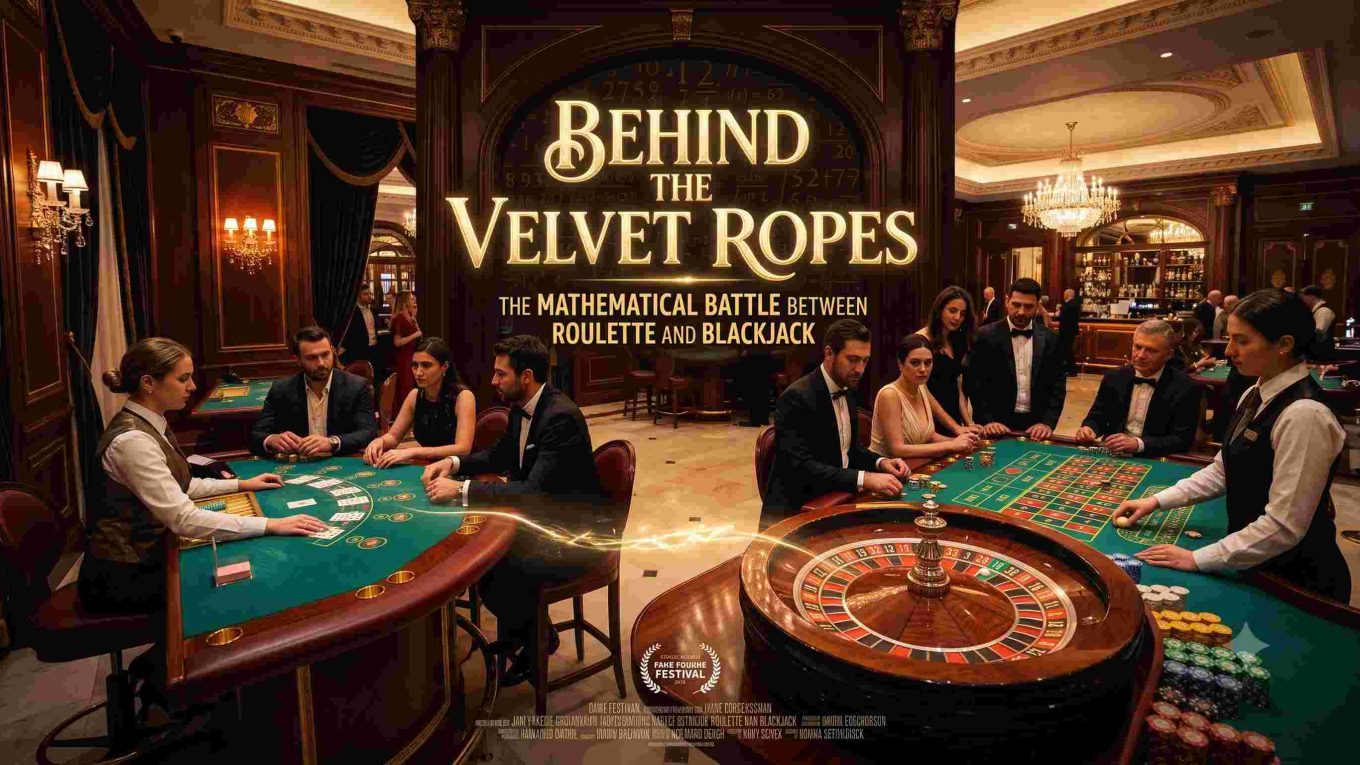
Behind the Velvet Ropes: The Mathematical Battle Between roulette vs blackjack odds
By Suyesh Gusain (B.Sc. Physics Hons., NISM Certified Research Analyst & Equity Derivatives)
Disclaimer: This article is strictly for educational and entertainment purposes. Casino games are mathematically engineered with a permanent house advantage; no strategy can guarantee long-term profit or eliminate financial risk.
Imagine walking into a massive, glittering hall. The air smells faintly of expensive perfume and fresh carpet, the lights are dimmed to hide the passage of time, and a rhythmic, hypnotic clack-clack-clack echoes from a spinning wooden wheel. To the casual eye, a casino is a magical playground of luck. But beneath the surface veneer (outer appearance), it is actually a cold, calculating machine governed entirely by strict probability and mathematics.
To truly understand how this world works, we have to look at how two of its most famous games—Roulette and Blackjack—handle risk, player decisions, and the house advantage.
Game 1: Roulette – The Pure Trap of Blind Chance
Let’s start with Roulette, the ultimate game of passive hope. Imagine standing at a long green felt table. A small white ball is spun around a bowl containing numbered pockets from 1 to 36, plus a zero (or a zero and a double zero). You place a chip on Red, crossing your fingers that luck is on your side.
In this game, you exercise zero control. Once the ball leaves the dealer’s hand, your fate is entirely in the hands of physics and probability. Why does the casino love this game? Because the math is permanently rigged in their favor through a concept called the house edge (the mathematical advantage that ensures the casino makes a profit over time).
How the Math Works Against You:
- In a standard American roulette wheel, there are 38 pockets total: numbers 1 through 36, a
0, and a00(double zero). - If you bet $1 on a single correct number, the true mathematical odds of winning are 1 in 38. However, the casino only pays you out as if the odds were 1 in 35.
- Those extra two pockets (
0and00) are the casino’s profit margin, creating a built-in house edge of 5.26%.
Imagine dropping a coin into a transparent funnel; no matter how you spin it inside, gravity pulls it toward the center hole. In Roulette, gravity is the house edge—slowly eroding (wearing away gradually) your money the longer you play, regardless of your winning streaks.
Game 2: Blackjack – Where Strategy Meets the Matrix
Now, step over to the Blackjack table. The atmosphere changes. Instead of silent prayers over a spinning wheel, players are whispering, calculating, and making split-second choices: Hit (take another card), Stand (keep current cards), or Double Down.
Unlike Roulette, Blackjack is a game of asymmetric information (a situation where one party has more or better information than the other) and player choice. Every single decision you make alters the mathematical outcome.
The Role of Skill and Strategy:
- Every card dealt from the shoe (the box holding multiple decks of cards) changes the ratio of high cards (tens and aces) to low cards remaining.
- If you play purely with a “gut feeling,” the casino still maintains a house edge of about 1% to 2%.
- However, if you memorize and execute Basic Strategy—a mathematically calculated chart telling you the exact statistically optimal move for every possible hand combination—you can shrink the house edge down to less than 0.5%.
Why Smart Players Get Caught:
Because Blackjack allows skill, sharp players sometimes attempt advantage play (methods used by skilled players to gain a mathematical edge over the casino)—most famously, card counting. By keeping a mental tally of high versus low cards that have appeared, a player can figure out when the deck favors them, raising their bets only during those moments.
Imagine a game of chess where you can read your opponent’s breathing patterns. Casinos know this. This is why pit bosses (floor managers who oversee table games) and overhead security cameras constantly watch blackjack tables. If a player’s betting patterns suddenly match a card-counting rhythm, the casino will politely—or forcefully—ban them.
Summary: The Ultimate Contrast
| Feature | Roulette | Blackjack |
| Core Nature | Pure chance (luck-based) | Strategy and probability (skill-influenced) |
| Player Control | None once the ball spins | High (choices alter outcomes) |
| House Edge | High and unchangeable (~5.26%) | Low, but can be minimized via rigid strategy (~0.5%) |
| Casino View | Steady, predictable revenue stream | Monitored closely to stop advantage players |
Ultimately, looking behind the casino curtain reveals a sobering truth: while Roulette takes your money through unyielding geometry, Blackjack takes it through psychological exhaustion and minor mathematical errors.
Author Bio
Suyesh Gusain is an analytical researcher and digital publisher specializing in algorithmic systems, data verification, and digital media ethics. Holding degrees in Physics (B.Sc. Hons) and Mass Communication (M.A.), Suyesh bridges the gap between rigorous mathematical analysis and accessible consumer education. His work centers on decoding complex algorithmic architectures, statistical probability, and digital integrity for modern audiences.
Please share your thoughts on this article in the comments below. If you found it helpful, make sure to share it with others and follow Wisdom Ganga on social media for more updates!
Frequently Asked Questions (FAQ)
Is blackjack better odds than roulette?
Yes, blackjack offers significantly better mathematical odds than roulette, provided you play with proper strategy. While American roulette carries a fixed house edge of 5.26% and European roulette sits at 2.70%, a standard blackjack game played with optimal Basic Strategy can reduce the house edge to under 0.5%. In blackjack, your decisions directly influence the outcome, whereas roulette is entirely governed by blind chance.
What is the house edge in American roulette?
The house edge in American roulette is 5.26%. This advantage is created by the inclusion of both a single zero (0) and a double zero (00) on a 38-pocket wheel. When you bet on a single number, the true odds are 1 in 38, but the casino pays out at a rate of 35 to 1. Those two extra pockets account for the casino’s long-term mathematical profit margin.
Can card counting completely eliminate the house edge in blackjack?
No, card counting does not eliminate the house edge entirely, but it can shift the player’s expectation from negative to a slight positive edge (typically 0.5% to 1.5%) during specific high-count deck concentrations. However, card counting requires rigorous mental tracking, precise bet sizing variations, and immense discipline while operating under constant surveillance by casino pit bosses.
Why do casinos have a house edge in every game?
Casinos operate as for-profit businesses. The house edge is the mathematical percentage of every bet that the casino statistically expects to retain over the long run. Because of the law of large numbers, individual players may experience short-term winning streaks, but time and probability ensure that the casino secures a steady, predictable revenue stream across millions of wagers.