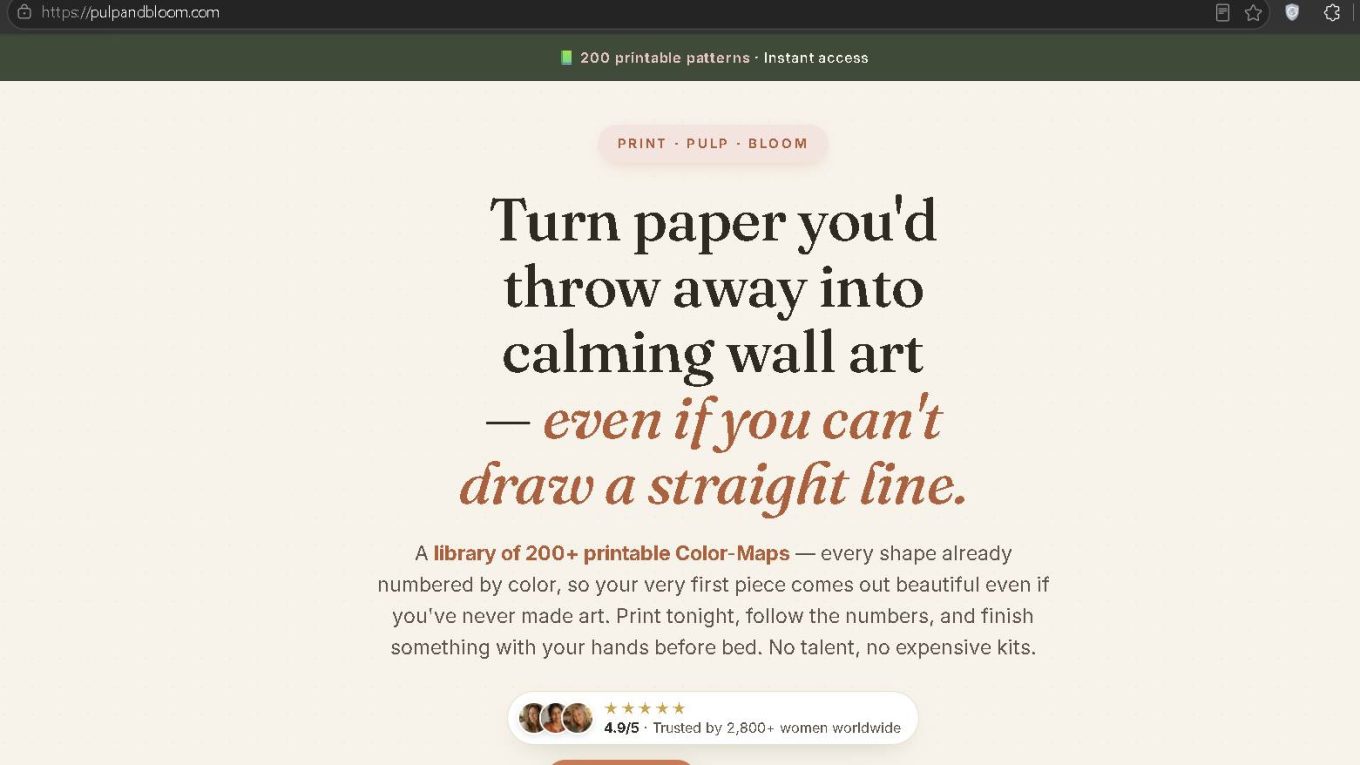
Pulp & Bloom Review: Is Pulpandbloom Legit or a Funnel Scam?
Pulp & Bloom (Pulpandbloom) has recently emerged across social media advertising feeds, marketing printable paper-crafting templates that promise to transform household scrap paper into fine art. Touting an effortless entry into home crafting and even instant side-hustle monetization, the site relies on aggressive direct-response copywriting to drive fast impulse buys.
An in-depth investigation into Pulpandbloom reveals that it operates as a classic single-product digital sales funnel, complete with cloned infrastructure, fabricated social proof, and unverified commercial claims.
What Is Pulp & Bloom?
Pulp & Bloom presents itself as a creative crafting brand offering a proprietary “Print · Pulp · Bloom” system. The platform targets hobbyists, beginners, and craft enthusiasts with a core offer centered around a downloadable library of “Color-Maps.”
The pitch claims that users need zero artistic background or expensive equipment: you simply print a numbered layout, repurpose everyday waste paper into pulp, match the numbers to colors, and finish a display-ready wall piece in an evening.
What Is Pulpandbloom Actually Selling?
Despite the polished editorial aesthetic, Pulp & Bloom is not shipping physical art kits, specialized frames, or craft materials. The checkout delivers non-tangible digital PDF files:
- Color-Map PDF Bundles: 200+ numbered outline templates designed to guide where paper pulp is placed. These are typically mass-generated vector graphics or automated line conversions.
- Instructional Guides: Basic text and PDF manuals outlining paper preparation and household blending steps.
- Commercialization Upsells: Bonus add-ons like a “First $500 Playbook,” pitching the idea that buyers can flip completed craft pieces on platforms like Etsy for $30 to $60 each.
Because distribution costs for PDFs are virtually zero, digital direct-response operators use these bundles as high-margin lead magnets to pull buyers into aggressive checkout upsell chains.
Key Red Flags Identified on Pulpandbloom
| Verification Check | Findings on Pulpandbloom | Risk Level |
| Domain Age | Registered recently; operating for barely a month | Critical |
| Social Proof Claims | Claims “4.9/5 · Trusted by 2,800+ women worldwide” | High (Fabricated) |
| Funnel Integrity | Subdomain leaks leftover text from “The Evening Stitch” | High (Cloned Template) |
| Business Identity | No verifiable corporate registration, founder, or address | Critical |
| Refund Policy | Instant digital downloads exempt from dispute resolution | High |
1. Fabricated Social Proof on a Brand-New Domain
The hero section prominently features a 5-star rating graphic claiming over 2,800+ global customers. Domain WHOIS and registry records confirm the site has been active for only weeks. Accumulating thousands of verified purchases, completions, and uniform five-star reviews within this timeframe is statistically unfeasible and a hallmark of automated funnel scripts.
2. Cloned Infrastructure and Template Remnants
Direct-response operations frequently recycle identical codebases across completely different niches. On associated sales endpoints (such as getmykit.pulpandbloom.com), unedited placeholder elements remain visible. Portions of the site retain metadata and testimonials lifted directly from The Evening Stitch—an identical, older sales funnel that peddled “500-pattern embroidery libraries” using the exact same page layout and countdown mechanics.
3. Deceptive “Side-Hustle” Monetization Hooks
The sales page leverages financial pressure points by promoting a “First $500 Playbook,” suggesting that beginners can immediately generate online income by selling pulp art. Packaging low-effort digital PDFs alongside exaggerated promises of passive craft income is a well-documented direct-response tactic to justify checkout value.
4. Shared High-Risk Server Infrastructure
Hosting records show Pulpandbloom sits on shared server clusters alongside numerous low-trust digital storefronts, ephemeral landing pages, and disposable e-commerce sites.
5. Lack of Corporate Accountability
Legitimate crafting and publishing brands provide clear company identification:
- A verifiable parent company name or LLC registration.
- A physical business address searchable via official trade registries.
- Dedicated direct customer service channels.
Pulp & Bloom omits corporate ownership data, operating purely behind privacy-shielded domain registrars and generic web submission forms.
The Single-Product Funnel Blueprint: How It Compares
Pulp & Bloom is not an isolated platform; it adheres to the single-product funnel formula observed on sites like DavidCruises.com and TryLonnis.com:
- One Primary Product: Instead of a real store architecture with diverse categories and inventory management, the entire domain exists exclusively to move users through a single checkout path.
- Artificial Scarcity: Countdown timers, limited “discount access” banners, and fake inventory meters compel rapid checkout before the visitor can evaluate the offer objectively.
- Non-Refundable Delivery: Because banks and payment processors handle digital delivery disputes strictly, recovering funds via chargebacks for downloadable PDFs is notoriously difficult once the download link fires.
Verdict: Is Pulpandbloom Legit or a Scam?
Pulp & Bloom is a high-risk, low-transparency digital sales funnel.
While buyers may receive an automated email containing PDF templates after checkout, the platform relies on fabricated customer numbers, recycled site templates, deceptive income claims, and opaque ownership. Consumers looking for paper-crafting patterns can find comparable—and often superior—free printable templates, tutorials, and community guides across established open crafting portals and verified public forums without exposing their payment details to disposable domains.
Author Bio
Suyesh Gusain — Scam‑review analyst exposing online funnel sites and protecting consumers from deceptive single‑product scams.
Every safe click counts. If this post helped, a coffee gesture fuels more scam‑busting investigations.

Call to Action
Please share this article to spread awareness. Follow us on Facebook, Twitter, and Instagram for more scam alerts. If you doubt the legitimacy of any website or investment plan, DM us on social media — we’ll help you verify.
store, search our updated online shopping scam directory to see if the website has already been flagged for fraud.
Frequently Asked Questions About Pulp & Bloom
Key facts on product delivery, refund policies, and side-hustle claims for Pulpandbloom.