The Anatomy of a Holiday Trap: Why Merryheels Exemplifies the Seasonal Impulses / Social Media Funnel Storefront Scam
If an eye-catching pair of illuminated winter footwear labeled Merryheels recently took over your social feed, you are looking directly at a textbook Seasonal Impulses / Social Media Funnel Storefront Scam. These slick pop-up sites appear overnight on Instagram and TikTok right before festive spending spikes, weaponizing polished short-form video clips to convert casual scrollers into impulsive buyers before anyone has time to investigate the seller’s background.
Behind the viral sheen, operations like this are structured from the ground up for rapid capital extraction. Rather than functioning as genuine retail brands, they deploy high-pressure urgency cues, synthetic social proof, and automated lead-generation scripts to pocket credit card payments and wholesale order margins.
Before submitting payment details or initiating an online transaction, examining the underlying architecture of these seasonal operations reveals the real financial risks involved.
To understand why storefronts like this surface every autumn and winter, it helps to examine how contemporary e-commerce exploitation operates at scale. The Seasonal Impulses / Social Media Funnel Storefront Scam relies on three distinct pillars:
[ Algorithmic Video Hook ] ➔ [ Automated DM / Bio Funnel ] ➔ [ Ephemeral Shopify Front ] ➔ [ Dispute Eviction ]
  (Viral Reel / TikTok)        (Bot comments: "Sent link!")     (Urgency triggers / Fake sales)    (Domain goes dark)
- Aesthetic Exploitation of Micro-Moments: Scammers track consumer psychological triggers tied to holidays, parties, and novelty gifts. Instead of marketing standard items year-round, they isolate viral visual hooks—such as fiber-optic heels, faux-fur outerwear, or customized seasonal crafts—that provoke immediate emotional delight and quick checkout decisions.
- Comment-to-DM Scraping Funnels: Direct sponsored advertising often faces strict algorithmic moderation and user review warnings. To bypass ad platform blacklists, operators post organic video clips and deploy automated bots that instruct users to leave simple engagement cues (e.g., “Comment ‘GLOW’ to get the 50% discount code!”). The automated script immediately fires a tracking link directly into the buyer’s private inbox, bypassing public scrutiny and comment thread warnings.
- The Ephemeral Lifespan: A storefront structured around seasonal impulse buying does not seek multi-year customer retention. Its entire business model relies on running paid traffic for roughly 30 to 60 days, accumulating payments, and disappearing before consumer credit card chargebacks and bank dispute thresholds trigger merchant processor terminations.
Suspicious Link or Courier SMS?
Verify URLs, APKs, or parcel alerts against our threat database before clicking.
Case Study: How Merryheels Puts the Playbook into Practice
Examining the setup behind Merryheels provides a direct window into how these operations disguise wholesale dropshipping fronts as exclusive luxury footwear brands.
What the Merryheels Claims and Offers
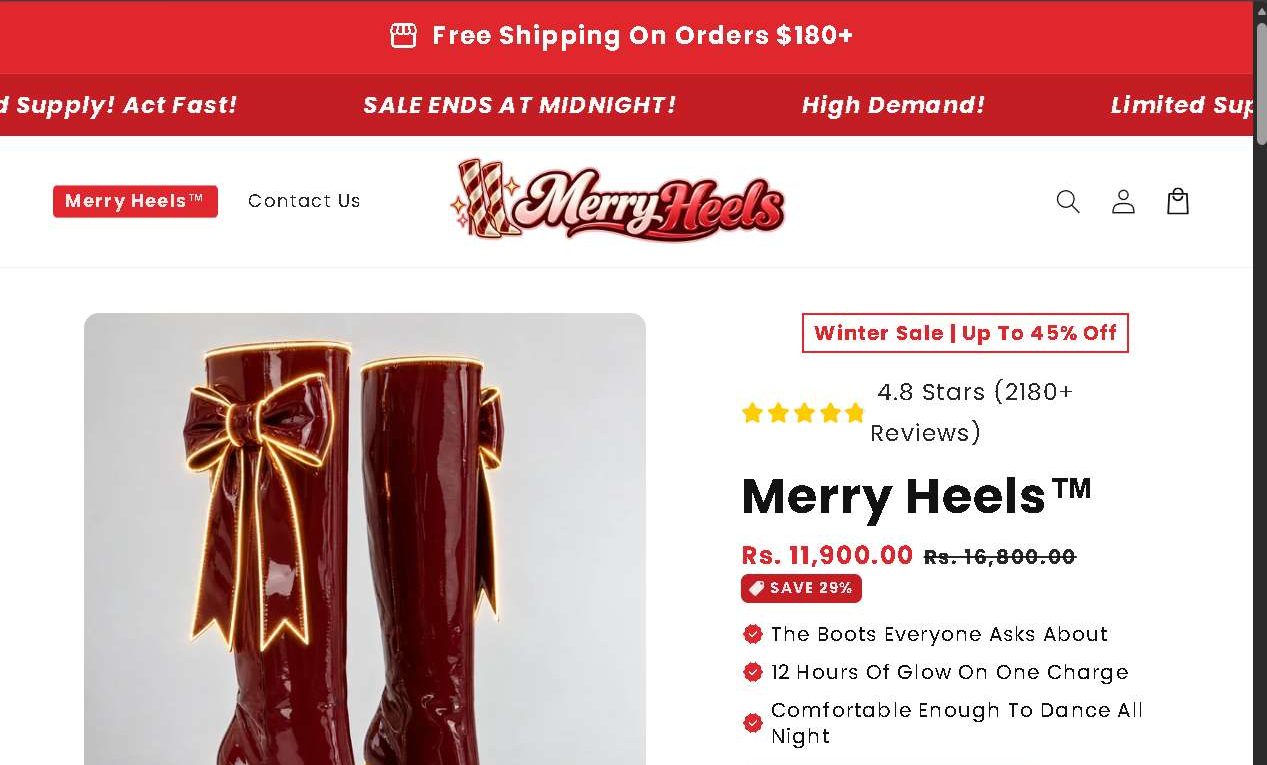
The promotional pitch centers on patent leather, knee-high holiday boots complete with high-visibility illuminated rear ribbons (“12 Hours Of Glow On One Charge”). The marketing copy positions the product as an exclusive, proprietary design (“The Boots Everyone Asks About”) built for holiday parties and festive events.
To make the purchase feel accessible, the storefront sets an inflated reference price of Rs. 16,800.00 (or roughly $180+ USD), crossed out to present an apparent bargain price of Rs. 11,900.00 alongside a standard promo banner promising “Free Shipping On Orders $180+”.
How the Merryheels Operational Mechanics Actually Function
Behind the clean visual theme, the underlying machinery relies on turnkey dropshipping software linked to wholesale manufacturing clearinghouses:
- Stolen Creative Assets: High-production promo clips are often repurposed without attribution from independent footwear designers, viral TikTok costume creators, or niche theatrical shoemakers.
- Turnkey Cloud Templates: The shop runs on a standard templated architecture populated with automated multi-currency geolocation plug-ins. Visitors are served dynamic localized currency, even when background shipping disclosures remain in US dollars.
- The Sourcing Void: When an order is placed, the operator does not dispatch inventory from a local fulfillment center. Instead, the transaction either triggers a back-end order for an unbranded, low-grade plastic replica from an overseas clearinghouse—or no product is dispatched at all, leaving the buyer holding an inactive international tracking number.
5 Critical Red Flags Found on Merryheels
Evaluating the operational footprint of this platform reveals several classic markers shared by deceptive pop-up merchants:
| Red Flag Indicator | What the Storefront Displays | The Underlying Reality |
| 1. Manufactured Urgency Clichés | “SALE ENDS AT MIDNIGHT!” and “Only 7 units left at this price.” | Hard-coded countdown timers reset automatically on every page refresh to pressure buyers into skipping basic due diligence. |
| 2. Statistically Impossible Social Proof | “4.8 Stars (2,180+ Reviews)” embedded directly beside the primary title. | The domain is newly registered with zero historical footprint on trusted consumer boards like Trustpilot or Sitejabber; review counts are hard-coded text strings. |
| 3. Currency and Shipping Inconsistencies | Header promises “Free Shipping On Orders $180+”, while pricing displays in Indian Rupees (Rs. 11,900.00). | Common consequence of generic e-commerce geolocation scripts layered over unedited default site banners. |
| 4. Lack of Corporate Entity Identity | Generic “Contact Us” web form with no registered company number, business address, or verified support hotline. | Shell entities avoid providing verifiable corporate registration details to prevent legal liability and direct consumer protection claims. |
| 5. Artificial Anchor Pricing | Heavy pseudo-markdowns (e.g., Rs. 16,800.00 slashed to Rs. 11,900.00). | Phantom price anchoring designed to trigger fear of missing out (FOMO) before shoppers run reverse image searches. |
Universal E-Commerce Protection Checklist
-
1
Break the In-App Browser Funnel
Never check out inside Instagram or TikTok web-views. Copy the link and open a standalone browser to remove referral tracking tokens and inspect the real root domain.
-
2
Run a 60-Second Background Check
Look up the domain age via WHOIS (avoid sites under 6 months old) and reverse-search product imagery on Google Lens to verify whether cheap wholesale duplicates exist.
-
3
Verify Corporate Entity Details
Check the website footer for a registered legal company name, verifiable physical address on Google Maps, and dedicated phone support—not just an anonymous web form.
-
4
Demand Insulated Payment Options
Refuse direct bank deposits, UPI QR codes, crypto, or debit transfers. Use zero-liability credit cards or protected checkout channels like PayPal Goods & Services.
-
1
Stop Waiting for Merchant Email Replies
Do not waste dispute windows negotiating with automated helpdesks or generic tracking updates. Deceptive pop-up storefronts stall purposely to exhaust chargeback timelines.
-
2
Initiate a Bank Chargeback Within 24-48 Hours
Call the phone number printed on the back of your card. Request an immediate dispute categorized under Merchant Fraud, Goods Not Delivered, or Misrepresentation.
-
3
Freeze Billing and Replace Card Credentials
Instruct your bank’s fraud desk to block future merchant authorizations under that descriptor and re-issue a fresh card number to prevent hidden recurring subscription debits.
-
4
Preserve Order & Ad Evidence
Save full-page screenshots of the product page, transaction debit receipts, and tracking communications to upload directly into your card issuer’s dispute portal.
Frequently Asked Questions (FAQ)
1. Is Merryheels a scam?
The site displays key operational hallmarks of a Seasonal Impulses / Social Media Funnel Storefront Scam, including synthetic review tallies, artificial countdown timers, and an absence of verifiable corporate registration. Ordering from such platforms carries a severe risk of non-delivery or receiving substandard knockoffs.
2. Is Merryheels legit?
There is no evidence establishing this platform as a legitimate retail enterprise or trademarked footwear manufacturer. Legitimate apparel companies maintain verifiable corporate filings, reachable phone customer service, physical mailing addresses, and independent feedback on platforms like Trustpilot or the Better Business Bureau.
These setups launch during major shopping windows using viral product videos on Instagram, Facebook, and TikTok. Operators rely on urgency banners and automated private messaging funnels to drive sales before closing down the website when customer complaints and bank disputes escalate.
4. What should I do if I ordered from an unverified footwear storefront?
Contact your card-issuing bank immediately to file a chargeback under merchant fraud or goods not delivered. Provide screenshots of the order page and correspondence to support your dispute claim.
5. Can I trust reviews displayed directly on holiday pop-up sites?
No. On-site reviews on unverified standalone storefronts are frequently populated via bulk-import review plugins or hard-coded directly into the template without third-party purchase verification. Always consult independent consumer review aggregators.
Dropshipping storefronts frequently use automatic IP-based currency conversion plugins. While body text and item prices adapt to your detected region, static elements like header banners often remain stuck in default US dollar amounts.
When goods are dispatched, buyers typically receive a low-cost imitation made from cheap synthetic textiles that does not match the high-production video advertisements. Returning items often requires paying steep international return shipping fees to overseas addresses.
Perform a WHOIS domain age lookup to confirm when the site was created, conduct reverse image searches on advertised product photos to locate original manufacturers, inspect footer menus for verified corporate identity records, and avoid vendors that do not support protected payment channels.
Every safe click counts. If this post helped, a coffee gesture fuels more scam‑busting investigations.

For more shady sites exposed, check our Shopping Scam Directory — your quick guide to staying safe online.
Help Us Spread Awareness
Please share this article to spread awareness. Follow us on social media for more scam alerts.