
Is LawDrafted Legit? Inside the AI Legal Network Behind LawDrafted.com & Copycat Directories
Consumer Advisory & Editorial Disclaimer: This investigation provides technical domain analysis, consumer protection research, and digital threat intelligence. It is published strictly for educational and informational purposes and does not constitute formal legal advice. If you require legal representation, always verify practitioners directly through your official state or national Bar association.
If you arrived at LawDrafted.com while researching a personal injury statute, contract dispute, or court deadline, you are likely asking a critical question: is LawDrafted legit?
The short answer is no. LawDrafted is not a law firm, a licensed legal advisory service, or an accredited legal resource. It is part of an emerging class of programmatic, Made-For-Advertising (MFA) content hubs built using automated artificial intelligence to capture search engine traffic across high-value legal search terms.
While LawDrafted presents itself with the clean typography and authoritative tone of a professional legal portal, our forensic analysis reveals several critical red flags:
- Anonymous Editorial Operations: The site operates without verifiable licensed attorney bylines or State Bar association license numbers.
- Jurisdictional Hallucinations: Articles frequently blur state, federal, and municipal statutory distinctions, presenting generic summaries as actionable legal rules.
- Monetization Over Accuracy: The underlying platform is architected primarily to harvest high-cost-per-click (CPC) display ad revenue and capture unvetted consumer leads.
Before relying on advice from LawDrafted—or entering personal case details into an online intake form—here is a look under the hood at how LawDrafted.com functions, the risks it creates for real legal claims, and how to tell the difference between an AI content ring and accredited legal counsel.
Suspicious Link or Courier SMS?
Verify URLs, APKs, or parcel alerts against our threat database before clicking.
Explosion Legal Blogs and Attorney Directories
A quiet explosion of programmatic legal blogs and “attorney directories” has flooded search results over recent months. If you have searched for local statutes, personal injury compensation guidelines, or sought a qualified attorney, you have likely encountered domains such as lawdrafted.com, legaloverview.com, bestlawyersinunitedstates.com, legalsynopsis.com, lawhighlights.com, laweditorial.com, and lawsdaily.com.
To the casual reader, these sites project an aura of authority: crisp scales-of-justice logos, professional corporate palettes, and comprehensive breakdowns of complex litigation.
Behind the facade lies a coordinated ecosystem of Made-For-Advertising (MFA) content farms, unvetted lead brokering rings, and automated AI text generation.
Here is what our digital forensics investigation uncovered about these platforms, how their networks function, and why relying on them puts your legal rights and personal privacy at severe risk.
Why Law Is Being Flooded with “AI Slop”
The proliferation of these domains is not accidental; it is driven by ad auction economics.
Legal search queries—specifically surrounding personal injury, mass torts, medical malpractice, DUI defense, and commercial litigation—command some of the highest Cost-Per-Click (CPC) figures in the global digital advertising industry. A single click from a user seeking a “mesothelioma attorney” or a “truck accident lawyer in Texas” can command between $75 and $300+ on ad networks like Google AdSense or programmatic header-bidding platforms.
Rather than running legitimate law firms, network operators build dozens of interconnected satellite sites. By programmatically generating hundreds of thousands of legal explainers using large language models, they capture organic search volume across long-tail legal queries, aiming to:
- Harvest lucrative display ad revenue.
- Intercept and resell consumer legal intake inquiries to marketing clearinghouses.
- Pass artificial search engine ranking signals (PBN link equity) to offshore affiliates.
Site-by-Site Analysis
While these platforms operate under different domain names, an architectural review reveals near-identical footprints, shared hosting ranges, and common operational playbooks:
| Domain | Surface Function | Technical & Operational Red Flags |
|---|---|---|
| Bestlawyersinunitedstates | National Attorney Directory | Typosquatting & Brand Dilution: Mimics established industry benchmarks (such as the peer-reviewed Best Lawyers directory). Profiles are scraped wholesale from public registries without verification; contact forms act as unencrypted middleman lead funnels. |
| Lawdrafted | Statutory & Contract Explainers | Programmatic AI Generation: High-volume output covering disparate legal topics without jurisdictional specificity. Articles lack mandatory State Bar advertising disclaimers and cite no verifiable court dockets. |
| legaloverview | General Legal Guides & FAQs | Thin Editorial Infrastructure: Managed behind WHOIS privacy proxies. Lacks physical address disclosures; heavy distribution of out-of-context legal definitions designed strictly for search volume capture. |
| legalsynopsis | Case Summaries & Legal Concepts | No Named Legal Counsel: Uses pseudonymous bylines (e.g., “Editorial Team”, “Staff Writer”). No State Bar license numbers or physical jurisdiction disclosures provided. |
| lawhighlights | Topical Legal News | Content Farm Topology: Interspersed with superficial blog posts and affiliate links. Minimal original reporting, relying instead on automated rewrites of secondary news feeds. |
| lawsdaily.com | Daily Legal Updates | MFA Architecture: Aggressive ad unit density, including interstitials and sticky video units. High bounce-rate optimization with little substantive legal analysis. |
| laweditorial | Legal Opinions & Editorials | Syndication Loop: Cross-links to other ring domains (lawdrafted, legalsynopsis) to artificially pass link authority across the network. |
| legallyexplained | Plain-English Legal Guides | Jurisdictional Blurring: Fails to distinguish between federal, state, and municipal statutory differences, risking dangerous misunderstandings for lay readers. |
When investigating independent publications, you expect distinct web architecture, unique design languages, and distinct brand identities.
However, inspecting the front ends of LawDrafted, LawEditorial, LawsDaily, LawHighlights, LegalOverview, and LegalSynopsis reveals an undeniable signature: they are built from the exact same mass-deployed website template.
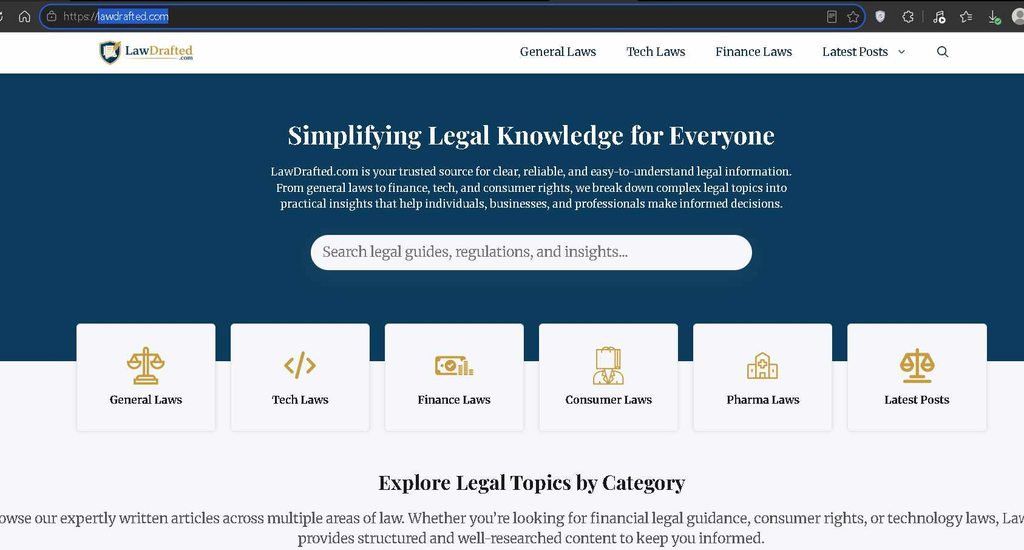

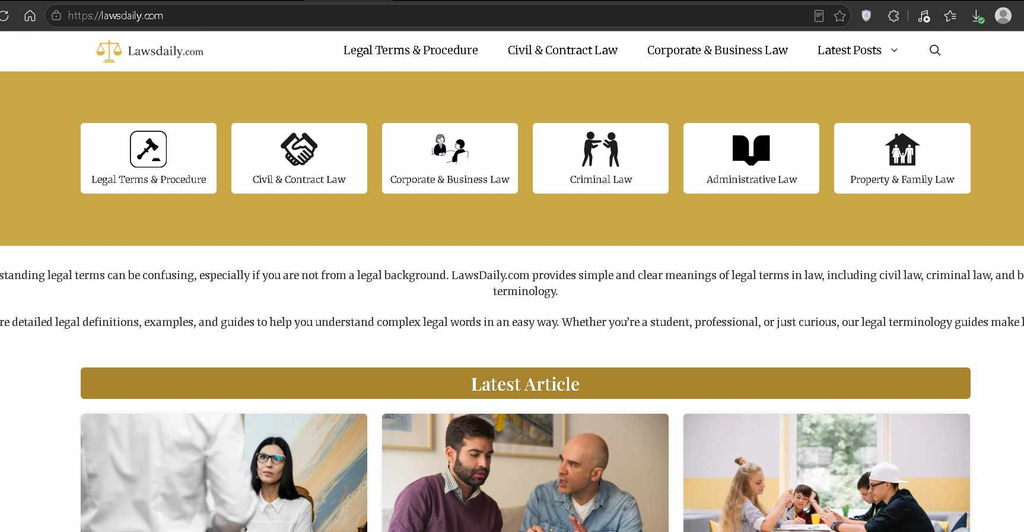
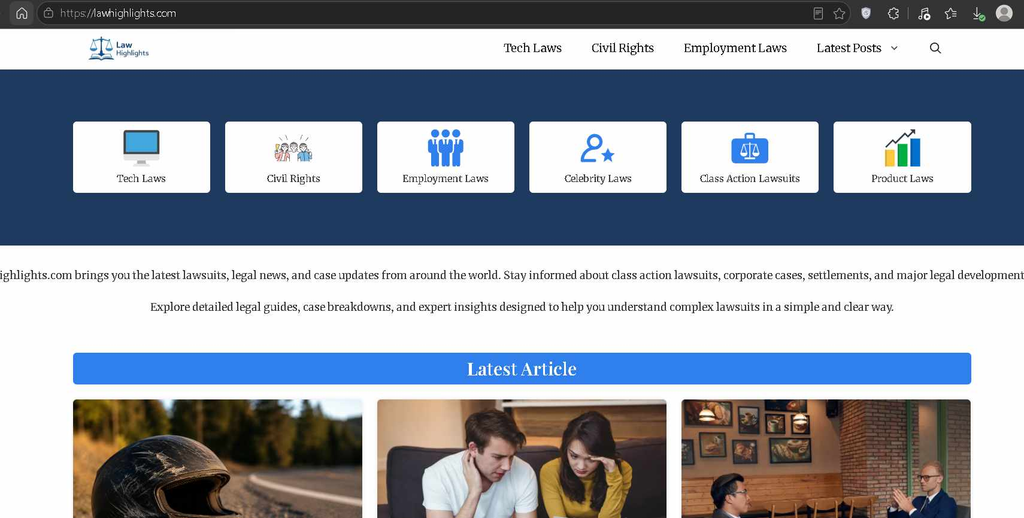
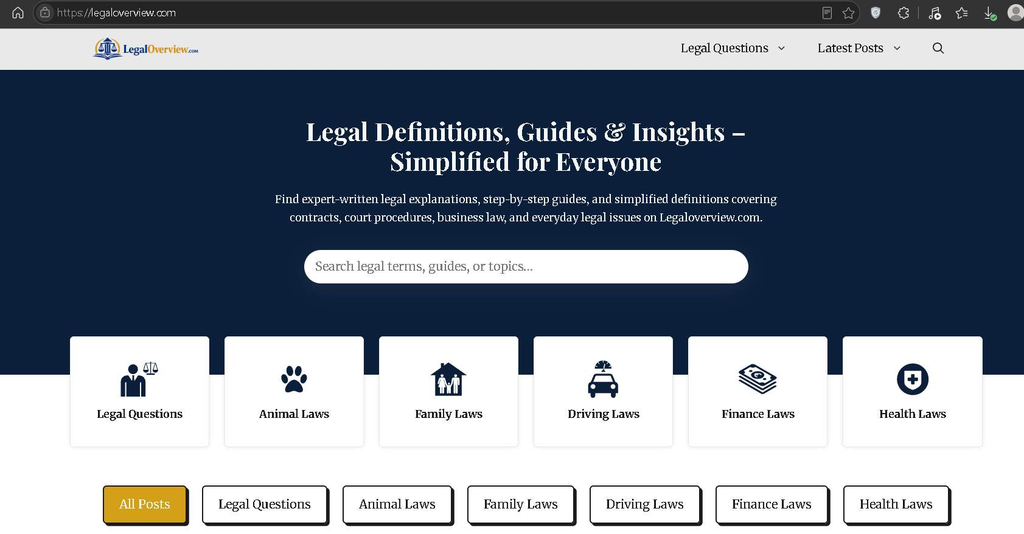
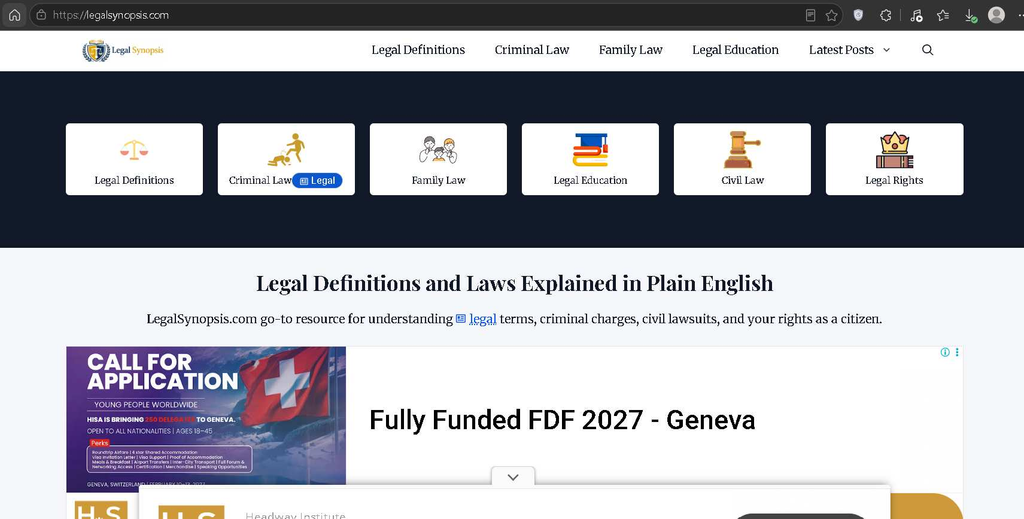
As seen above, each site deploys:
- The Exact Same 6-Box Category Matrix: Identical card elevation, border-radius, and generic line-art iconography .
- Mirrored Header Geometry: Identical top navigation layouts, search icon alignment, and drop-down menu hierarchies .
- Cloned Hero Copy Patterns: The same central search pill design paired with sweeping generic taglines (“Simplifying Legal Knowledge for Everyone”, “Legal Definitions, Guides & Insights – Simplified for Everyone”) .
The Red Flags: How to Spot an AI Legal Farm in 10 Seconds
If you land on any website claiming to offer legal information or directory services, scan for these critical indicators before trusting their advice or submitting information:
Legitimate legal articles are written or explicitly reviewed by an attorney whose name, bar number, and jurisdiction are transparently disclosed. Spam networks feature:
- Bylines like “By Admin”, “Legal Staff”, or generic names with AI-generated headshots.
- Biographies claiming decades of experience without specifying which state or federal courts the author is admitted to practice before.
B. Missing Mandatory Bar Disclaimers
Legal ethics rules in almost all jurisdictions require law firms and attorney referral services to display explicit notices (such as “Attorney Advertising: Prior results do not guarantee a similar outcome”, naming the specific sponsoring attorney licensed in that state). Unregulated content networks uniformly omit these required disclosures.
C. Jurisdictional Incoherence & “Statutory Hallucinations”
AI models regularly confuse jurisdictions. A single article might cite a Florida statute of limitations while quoting California discovery standards and referencing New York civil rules—without clarifying that civil law is strictly jurisdictional. In extreme cases, models hallucinate case citations or fabricate non-existent statutory subsections entirely.
D. Generic Contact Forms Lacking Encryption & Privilege Warnings
When you consult a real lawyer, your communication is often shielded by preliminary attorney-client privilege. Content farms feature open-ended forms stating “Get a Free Case Review Today!” that lack confidentiality safeguards, Terms of Service disclosures, or privacy guarantees.
Email: ApexLegalSolutionsMumbai@gmail.com
The Direct and Indirect Dangers to Consumers
Relying on these automated networks carries real consequences:
- Procedural Default & Forfeited Claims: Missing a statute of limitations by even a single day permanently bars your claim in civil or tort law. Following advice that cites an incorrect deadline can cost you your legal remedy.
- Aggressive Telemarketing Loops: When you submit your phone number and email into an unregulated aggregator, your personal profile is often sold instantly via automated lead-generation auctions. Users report receiving dozens of high-pressure calls from non-attorney referral mills within minutes.
- Data Harvesting of Sensitive Evidence: Submitting details about an ongoing dispute, accident, or corporate matter into an unvetted WordPress site risks public exposure or data leaks—without any professional duty of confidentiality protecting you.
How to Find Legitimate, Verified Legal Representation
Never rely on anonymous aggregator blogs or unverified directory claims. When verifying legal counsel or researching statutory law, rely solely on established, regulated resources:
Where to Find Licensed Legal Counsel & Verified Statutes
Avoid predatory content farms and unverified legal directories. Use these accredited, peer-reviewed, and state-sanctioned resources to verify attorney credentials and statutory law:
1. Official State Bar Directories Primary Verification
Every US state operates an official, publicly searchable registry of licensed attorneys (e.g., calbar.ca.gov in California, nycourts.gov in New York, or texasbar.com in Texas).
2. Accredited Peer-Reviewed Directories 3 Vetted Sources
- Martindale-Hubbell / Lawyers.com
The longstanding industry benchmark for confidential, peer-reviewed attorney competence and ethical ratings.
- Best Lawyers (
bestlawyers.com)The genuine, trademarked peer-review publication. Be alert to deceptive, pay-to-play copycat variants.
- Justia & Avvo
Established legal portals requiring attorney identity verification that cross-reference active state bar license numbers.
3. Bar Association Lawyer Referral Services (LRS) Non-Profit
Most local county and state bar associations operate non-profit lawyer referral services (LRS). These programs match clients with practitioners who have satisfied mandatory malpractice insurance requirements and formal ethical screening standards.
4. Primary Statutory Sources Official .gov / .edu
When reviewing statutes and court procedure directly, avoid ad-heavy summary blogs and consult authoritative academic or government repositories:
Summary Checklist
Legal Research: What to Do vs. What to Avoid
| What to Do | What to Avoid |
|---|---|
Credential Check
Check the author’s official State Bar license number. | High Risk
Trusting articles written by “Staff”, “Editorial”, or anonymous authors. |
Jurisdiction Verification
Verify court cases and statutes on official .gov or university databases. | High Risk
Taking action based on generic guides that don’t distinguish state jurisdictions. |
Direct Communication
Contact law firms directly through verified phone numbers. | High Risk
Entering sensitive dispute details into generic “Free Legal Advice” web forms. |
Every safe click counts. If this post helped, a coffee gesture fuels more scam‑busting investigations.

Frequently Asked Questions (FAQ)
Q. Is LawDrafted legit or a scam?
A. LawDrafted is not a verified law firm, licensed legal consultancy, or court-recognized resource. It operates as an automated content site built to capture high-value legal search traffic and generate programmatic advertising revenue. While it does not deliver direct malware, relying on its unverified advice poses significant risks because its articles lack licensed attorney oversight and often confuse state and federal statutory jurisdictions.
Q. Who owns LawDrafted.com and its affiliated websites?
A. The ownership of LawDrafted.com is masked behind commercial WHOIS privacy proxy services, listing no verified corporate entity, physical headquarters, or responsible managing attorney. Technical domain footprints link LawDrafted to a wider network of automated legal sites—including LegalOverview, LegalSynopsis, and LawsDaily—that share similar hosting blocks and programmatic content structures.
Q. Can information from LawDrafted be used in legal proceedings?
A. No. Content published on LawDrafted holds no evidentiary weight, precedential value, or legal authority in any court. Citing secondary or AI-generated legal blogs rather than official statutory codes, administrative regulations, or published case law can result in severe procedural errors or court sanctions.
Q. Are the writers on LawDrafted licensed attorneys?
A. No. Articles on LawDrafted are published under generic administrative handles or unverified contributor personas. None of the articles include State Bar Association license numbers, verifiable legal credentials, or mandatory state-level attorney advertising disclaimers.
Q. What are the dangers of following legal advice on LawDrafted?
A. The primary danger is relying on “statutory hallucinations”—inaccurate statutes of limitations, fabricated legal precedents, or conflated state laws (such as applying California civil procedure to a Texas personal injury claim). Missing a statutory filing deadline or following flawed procedural steps can permanently bar you from seeking legal relief.
Q. How does LawDrafted compare to legitimate legal resources?
A. Unlike official repositories such as the Legal Information Institute (Cornell Law) or established directories like Justia, Martindale-Hubbell, and genuine State Bar portals, LawDrafted does not vet its content through licensed attorneys or link directly to primary court dockets.
Q: Is bestlawyersinunitedstates.com affiliated with the official Best Lawyers organization?
A: No. The recognized, peer-reviewed legal publication is Best Lawyers, accessible at bestlawyers.com. Domains with slight naming variations are third-party websites trading on brand recognition without official peer-review credentials.
Q: What happens if I submit my information to a “Free Consultation” form on these sites?
A;Your information is typically routed to third-party lead aggregators or marketing clearinghouses, resulting in unsolicited sales calls from various firms or intake agencies. Your submission is not shielded by attorney-client privilege.
Q: Is bestlawyersinunitedstates.com a legitimate attorney directory?
A: While the website may operate without serving malware, it is not an official, peer-reviewed directory. The site mimics the branding of established industry institutions like the official Best Lawyers (bestlawyers.com). Most profiles are scraped from public registries without the attorneys’ knowledge or consent, and the intake forms operate as third-party lead funnels rather than direct channels to legal counsel. Always verify attorney credentials through official state bar associations instead.
Q: Who runs websites like legaloverview.com, legalsynopsis.com, and lawhighlights.com?
A: These sites conceal their operational ownership behind domain privacy proxies (such as Privacy Protect or WHOIS Privacy Corp) and list virtual office mail drops rather than physical headquarters. Technical network footprinting shows these domains often share hosting IP clusters, analytics IDs, and ad monetization tags, indicating they are part of a centralized Private Blog Network (PBN) designed for search engine arbitrage.
Q: Is it safe to submit my case details into “Free Consultation” forms on sites like lawsdaily.com or laweditorial.com?
A: Submitting your contact details and legal dispute information on these sites is risky. Because these platforms are not legitimate law firms, your communications are not protected by attorney-client privilege. Instead, your personal phone number, email, and case summary are packaged as sales leads and auctioned to third-party telemarketing mills or mass tort referral brokerages.
Q: How do I tell if a legal directory online is real or an AI-generated scraper site?
A: Legitimate legal portals (such as Martindale-Hubbell, Justia, and Avvo) provide direct links to an attorney’s active State Bar registration number, display explicit attorney advertising disclaimers, and list verifiable office locations. AI aggregator sites typically feature anonymous “Editorial Staff” bylines, generic stock imagery, no bar licensure disclosures, and forms that route through unencrypted marketing aggregators.
A: Most of these networks evade UPL enforcement by burying vague “informational purposes only” disclaimers in their site footers, claiming they offer educational commentary rather than legal representation. However, when these networks publish hallucinated statutory advice or funnel unsuspecting consumers through deceptive attorney referral schemes, state bar ethics boards and consumer protection regulators frequently investigate them for deceptive trade practices.
Vaibhav Vinay Singh
Vaibhav Vinay Singh is a digital researcher, content strategist, and co-director at Wisdomganga. He investigates online fraud ecosystems, digital consumer risks, and financial market transparency. Read more of his investigative work on his author profile.
Help Us Spread Awareness
Please share this article to spread awareness. Follow us on social media for more scam alerts.