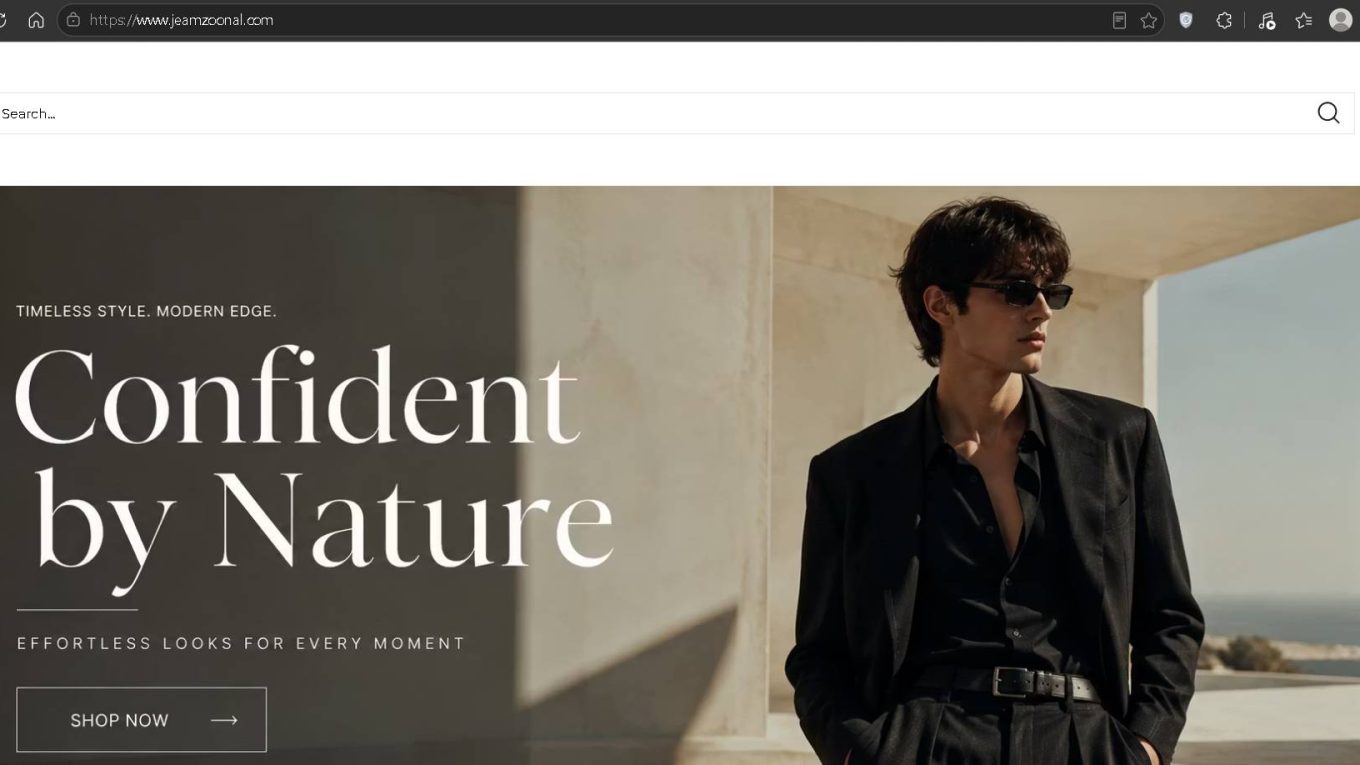
Jeamzoonal Review: Is It a Scam or Legit Shopping Site?
Jeamzoonal presents itself as a sleek, contemporary direct-to-consumer menswear brand offering premium streetwear, structured outerwear, and tailored two-piece sets. The website targets digital shoppers across the United States, the United Kingdom, Canada, and Australia through targeted social media campaigns displaying deep promotional discounts of 50% to 70% off retail prices.
Polished catalog photography and an uncluttered layout create the appearance of an established boutique label. However, an exhaustive forensic analysis confirms that Jeamzoonal is an unsafe, high-risk synthetic storefront. Consumers should not enter payment details or attempt transactions on this domain under any circumstances.
In reality, the website operates as an untraceable drop-shipping shell designed to collect funds while insulating its operators from merchant accountability. The platform lacks verifiable corporate backing, relies on fabricated business registrations, and conceals its operational infrastructure behind privacy proxies.
This technical audit breaks down the underlying digital footprint of Jeamzoonal, dissecting its server architecture, ownership records, payment routing mechanisms, and supply chain claims to equip consumers and financial institutions with actionable risk intelligence.
What Is Jeamzoonal Doing?
Jeamzoonal deploys a commercial acquisition strategy engineered to exploit algorithm-driven discovery feeds on platforms like Meta and TikTok. The operators purchase algorithmic ad placements that direct mobile traffic straight into isolated product landers.
These landing pages bypass corporate disclosures and funnel visitors directly to streamlined checkout interfaces. Browser sessions are monitored through client-side tracking scripts that record cart additions and checkout abandonment, creating urgency via simulated low-stock counters and countdown timers.
To project merchant credibility, the site utilizes hosted e-commerce architecture that mirrors legitimate retail workflows. It includes standard shopping cart behaviors, dynamic localized currency switches, automated order confirmation templates, and embedded security icons.
Behind this surface, the site functions without authentic merchant inventory or authorized distributor agreements. It captures customer billing data and routes transactions through third-party payment aggregators. This setup conceals the merchant of record and allows the operators to extract capital while remaining outside Western regulatory frameworks.
What Jeamzoonal Selling?
The storefront advertises an extensive catalog of men’s apparel. Featured items include faux leather utility jackets, textured Mandarin-collar shirts, pleated wide-leg trousers, and casual two-piece lounge sets.
Rather than manufacturing original designs, the site populates its catalog by scraping product imagery and digital assets from legitimate fast-fashion brands, Asian wholesale marketplaces, and independent design labels.
The advertised prices run contrary to basic manufacturing and international freight economics. Complex garments like fully lined faux-leather jackets and two-piece tailored outerwear sets are listed between $40 and $70 USD.
True production costs, quality fabric sourcing, ethical labor overhead, and expedited cross-border air logistics make these price points unviable for a genuine independent merchant. To produce and ship these items profitably at these prices, operators either substitute ultra-cheap synthetic materials or collect payments without fulfilling shipments.
How the Scam Works
The operational blueprint of Jeamzoonal follows a predictable, four-stage fraudulent conversion lifecycle:
- Ad Click to Cart Checkout: Target consumers encounter sponsored video ads showcasing premium fabric textures and tailored fits. Clicking the ad bypasses the homepage and routes shoppers directly to discounted product bundles. The checkout system pushes buyers toward rapid card payment using artificial scarcity notices.
- Payment Diversion and Merchant Obfuscation: When a customer enters their credit card or banking details, the transaction does not settle into a standard corporate merchant account tied to a verified business entity. Instead, the funds pass through offshore intermediaries or shell merchant accounts. This layer conceals the identity of the beneficiary and frustrates initial chargeback routing.
- The Post-Purchase Blackout: Following payment processing, the buyer receives an automated confirmation email containing a generic order number. Weeks later, the customer receives either no tracking updates or a tracking code linked to an untraceable, third-party logistics platform. In typical scenarios, the package either never arrives or arrives after substantial delays containing an unbranded, low-grade polyester item that bears no resemblance to the advertised product.
- Financial Fallout and Identity Exposure: When consumers request refunds, automated helpdesk addresses generate delaying responses or cease communication entirely. Meanwhile, the consumer’s personally identifiable information—including full legal names, billing addresses, phone numbers, and payment details—remains stored on an unverified offshore server, exposing the buyer to credential resale or secondary phishing attempts.
Critical Red Flags
The technical discrepancies observed during our investigation of Jeamzoonal contrast sharply with legitimate commercial standards:
| Signal / Feature | Jeamzoonal.com Status | Legitimate Retail Standard |
| Domain Registration Age | Registered August 24, 2026 (Under 30 days active) | Multi-year registered history with documented renewals |
| Corporate Identity | Listed as “DWERGH UNHFGSD INC” (Synthetic keyboard-mash entity) | Verified, active business registration searchable in official corporate registries |
| Physical Nexus | Bogus street address in Aspen, Colorado; zero physical presence | Verified corporate headquarters, warehouse facility, or registered agent |
| Asset Authenticity | Scraped, uncredited images sourced from external catalogs | Proprietary photography, copyrighted visual assets, and original branding |
| Legal Boilerplate | Copied, generic templates missing governing legal jurisdictions | Tailored Terms of Service citing specific consumer protection statutes |
| Customer Service | Web submission form and non-responsive support address | Multi-channel support including phone, live agent chat, and physical return centers |
- WHOIS Obfuscation: The domain utilizes complete privacy redaction services to hide registrant identity, with registrar records pointing directly to infrastructure based in mainland China.
- Absence of Corporate Nexus: Public corporate record searches across the Colorado Secretary of State database reveal no active or historical filings for the listed parent company entity.
- Stolen Catalog Assets: Reverse image queries reveal that promotional jacket photography corresponds to pre-existing listings across disparate overseas wholesale sites and independent menswear brands.
Risk Parameters & Technical Profile
- Domain Registration Age & Registrar: Registered on August 24, 2026, through an offshore registrar with full ICANN WHOIS proxy masking.
- SSL Certificate Details: Uses an automated, Domain-Validated (DV) Let’s Encrypt certificate. This proves basic transmission encryption but provides zero vetting of the underlying legal business entity.
- Server Location & Hosting Infrastructure: Hosted on shared cloud infrastructure with routing nodes configured to disguise the true server location and origin host.
- Payment Gateway Security & Surcharge Traps: Employs basic web checkout forms without independent multi-factor authentication protocols, exposing cardholders to unauthorized merchant category charges.
- Consumer Legal Recourse Level: Extremely low. Because the operators maintain no corporate presence within US, UK, Canadian, or Australian jurisdictions, regulatory agencies have zero subpoena power over the site’s managers.
These parameters represent a critical risk to consumer financial security. Transacting with an unvetted offshore entity strips away standard merchant dispute mediation, turning routine purchasing into an open-ended exposure risk for credit card compromise and identity misuse.
Conclusion
Jeamzoonal exhibits all the structural markers of an ephemeral, high-risk synthetic e-commerce storefront. From its newly minted domain status and scraped catalog images to its fabricated corporate identity and evasive ownership infrastructure, every data point indicates a store created to extract short-term consumer capital without delivering legitimate retail value.
Engaging with this platform exposes personal banking credentials, wastes consumer funds, and compromises private identity data.
If you have already submitted payment information on Jeamzoonal, treat your card as compromised. Contact your card issuer immediately to report the transaction as fraudulent and request a card replacement.
For debit transactions, request emergency protections under Federal Reserve Regulation E in the United States or relevant national banking codes. For credit card transactions, file a formal dispute under the Fair Credit Billing Act in the US, Section 75 of the Consumer Credit Act in the UK, or equivalent chargeback provisions in Canada and Australia. Monitor your bank statements closely for unauthorized recurring micro-charges over the coming billing cycles.
“A visually polished website is never proof of an authentic business; verified corporate registration, authentic merchant histories, and clear physical accountability are the only true benchmarks of online safety.”
Every safe click counts. If this post helped, a coffee gesture fuels more scam‑busting investigations.

Call to Action
Please share this article to spread awareness. Follow us on Facebook, Twitter, and Instagram for more scam alerts. If you doubt the legitimacy of any website or investment plan, DM us on social media — we’ll help you verify.
“Scammers evolve daily. Subscribe to our scam‑alert list and stay one step ahead.”
FAQs Section
Q: Is Jeamzoonal a legit website or a scam?
A: Jeamzoonal is an untrustworthy, high-risk synthetic storefront exhibiting multiple hallmarks of a scam. Registered just a few weeks ago with hidden ownership records, it uses a fictitious corporate entity name (“DWERGH UNHFGSD INC”), provides a bogus address in Aspen, Colorado, and lacks any verifiable business history or merchant accountability. It is not a legitimate retail business.
Q: What do customer reviews and complaints say about Jeamzoonal?
A: Legitimate third-party review platforms like Trustpilot or SiteJabber show virtually no established transaction history for Jeamzoonal due to how recently the domain was created. Independent cybersecurity and scam-detection tools flag it as a “Suspicious Shop” with a 4/100 trust score, citing copied website templates, lack of corporate backing, and standard fake-store operational markers.
Q: How do I get a refund if I bought something from this Jeamzoonal scam?
A: Do not expect a direct refund from their customer support. Contact your bank or credit card company immediately. Request a chargeback citing non-delivery or fraudulent merchant activity (e.g., under the Fair Credit Billing Act in the US, Section 75 in the UK, or your bank’s unauthorized transaction protocols). You should also request a replacement card to prevent recurring unauthorized micro-charges.
Q: What are the main warning signs that Jeamzoonal is a fake store?
A: The biggest red flags include an extremely young domain registration (August 24, 2026), a nonsensical legal entity name on its “About Us” page, an untraceable physical address, catalog images lifted from external fashion labels, and unrealistic 50% to 70% discounts on tailored jackets and outerwear that are economically impossible for genuine retailers to sustain.
Q: Are the men’s jackets advertised on Jeamzoonal real or fake?
A: The listings do not represent genuine, proprietary inventory. The high-end photos featured on the site are scraped from third-party catalogs and Asian wholesale platforms. Orders typically result in either non-delivery or the shipment of low-quality synthetic knockoffs that bear little resemblance to the tailored fits and materials shown in the promotional photography.