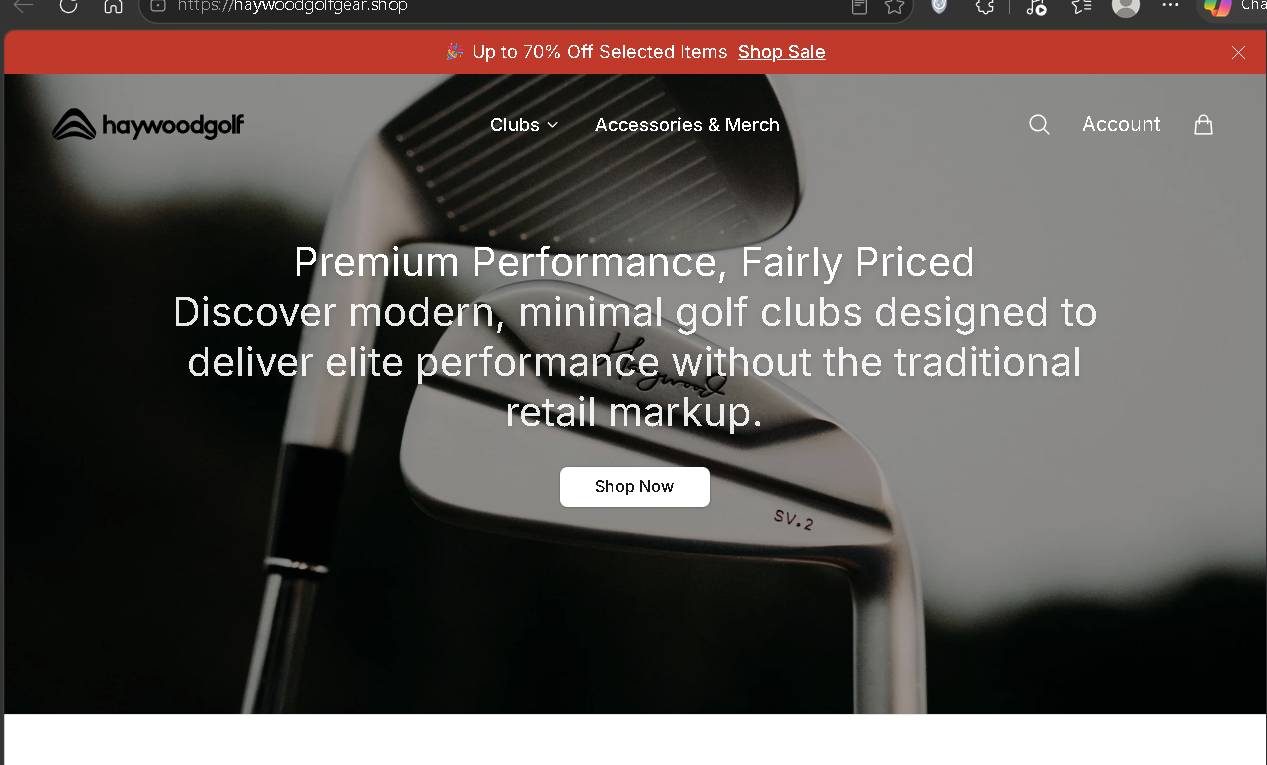
Anatomy of a Modern Retail Clone: Exposing the Haywoodgolfgear.shop Threat
If you recently stumbled upon Haywoodgolfgear.shop, our direct forensic verdict confirms that this domain is an illegitimate impersonator/scam website designed to harvest financial data and siphon funds. Golfers hunting for equipment clearances are increasingly being targeted by spoofed digital storefronts that exploit direct-to-consumer brand equity to trap impulse buyers.
Understanding the mechanics behind these deceptive platforms is crucial for protecting your digital identity and capital. This investigative report breaks down the operational blueprint of copycat storefronts, inspects the infrastructure of Haywoodgolfgear.shop, details its deceptive lures, exposes five critical operational vulnerabilities, and provides actionable remediation if your financial details have been compromised.
Deconstructing the Illegitimate Impersonator: Architecture and Fundamentals
An illegitimate impersonator/scam website is a weaponized clone created by copying visual assets, stylesheets, copy blocks, and trademarks from a verified brand and hosting them on an unrelated domain. Unlike basic phishing pages that attempt only to steal login credentials, modern retail impersonators operate complete, transactional e-commerce engines designed to intercept credit card data, extract checkout payments, or execute identity theft.
The Attack Lifecycle
- Asset Scraping: Automated scrapers crawl a target brand’s legitimate catalog, downloading high-resolution hero assets, product photography, specifications, and layout templates.
- Disposable Infrastructure: Operators register cheap top-level domains (such as
.shop,.top, or.xyz) via privacy-shielded registrars and deploy the scraped interface on low-cost hosting clusters. - Traffic Hijacking: Threat actors run paid social campaigns, automated forum links, and algorithmic search ads targeting branded transactional queries like golf club clearance, cheap forged irons, or discount golf gear.
- Checkout Exfiltration: The victim enters sensitive payment information. The site either extracts money directly via untraceable payment gateways or captures credit card details through unencrypted web forms for secondary fraud.
Case Study: The Inner Workings of Haywoodgolfgear.shop
The emergence of Haywoodgolfgear.shop provides a textbook example of direct-to-consumer impersonation in the golf hardware market. Vancouver-based Haywood Golf built a loyal customer following on a transparent value proposition: precision-engineered forged irons, wedges, and putters sold directly to golfers via its primary hub, haywoodgolf.com, cutting out traditional retail markups.
The threat actors behind Haywoodgolfgear.shop exploit this direct-to-consumer pricing model to engineer a convincing trap:
[Threat Actor Operations]
         │
         ▼
[Mirror Official Brand Identity (Haywood Golf)]
         │
         ▼
[Deploy Cloned Storefront on Disposable Domain: Haywoodgolfgear.shop]
         │
         ▼
[Funnel Traffic: Social Media Ads, Misleading Search Keywords]
         │
         ▼
[Bait Target: 70% Fire-Sale Pricing on Forged Equipment]
         │
         ▼
[Capture Credit Card Details / Route Non-Refundable Merchant Transactions]
         │
         ▼
[Result: Zero Fulfillment, Data Leakage, or Drop-shipped Counterfeits]
The Deceptive Pipeline
- Visual Duplication: The clone clones Haywood’s minimalist aesthetic, typography, and original marketing copy (“Premium Performance, Fairly Priced”).
- The Phantom Cart: Products can be customized—shaft flex, lofts, lies—giving buyers the false impression of a custom club-building platform.
- Payment Routing: Once an order is placed, the transaction routes through unauthorized payment merchant processors, off-shore peer accounts, or unvetted aggregators that offer zero consumer protection.
- The Aftermath: Victims experience one of two outcomes: total delivery failure (complete silence followed by domain abandonment) or the receipt of worthless generic junk via untracked drop-shipping, leaving the buyer without recourse.
What the Site Claims vs. What It Delivers
| Feature | The Site’s Marketing Claim | Observed Reality |
| Identity | Authorized direct sales outlet for Haywood Golf | Unaffiliated clone site operating on an unverified server |
| Pricing | Storewide clearance discounts of up to 70% | High-risk lure engineered to trigger impulsive purchases |
| Product Origin | Precision forged heads with premium aftermarket shafts | Phantom inventory; zero factory fulfillment or sub-par knockoffs |
| Support | Full customer service, returns, and satisfaction warranties | Missing phone lines; dead or unmonitored contact webforms |
| Security | Secure, encrypted checkout with buyer dispute protection | Payment exfiltration mechanisms with negligible card safety |
Suspicious Link or Courier SMS?
Verify URLs, APKs, or parcel alerts against our threat database before clicking.
Five Critical Red Flags Uncovered on Haywoodgolfgear.shop
1. Off-Brand TLD Registration
Authentic sporting manufacturers anchor their global trade on long-standing .com domains. Disposable scam operations lean heavily on alternate TLDs like .shop because they are cheap to register in bulk and simple to burn once blacklisted by security agencies and web browsers.
2. Implausible Clearance Pricing
Forged golf equipment relies on specialized tooling, carbon steel, and premium shaft components with narrow production margins. A blanket “Up to 70% Off Selected Items” promo on current-generation clubs defies manufacturing economics. Legitimate golf equipment manufacturers do not slash 70% off core sets.
3. Missing Corporate Registry & Transparent Contact Channels
A forensic pass over the site’s footer reveals an absence of essential corporate disclosures:
- No verifiable registered corporate entity.
- No physical warehouse address or verifiable headquarters.
- No direct telephone line for order verification.All inquiries are funneled through generic webforms or anonymous email domains.
4. Shanzhai Inventory Duplication Without Fit Verification
Authentic golf equipment companies offer custom length, lie, grip, and shaft tuning with dynamic inventory tracking. The clone allows users to add arbitrary sets, custom builds, and combinations into the cart without inventory caps or lead-time calculation—a clear indicator of phantom listings.
5. Suspicious Merchant Gateways and Payment Routing
While legitimate checkouts integrate audited payment processors, verified digital wallets (Apple Pay, Google Pay, Shop Pay), or authenticated merchant accounts, clone sites often direct users to unprotected card fields, unsecured third-party redirects, or untraceable foreign accounts that bypass multi-factor banking security.
Email: ApexLegalSolutionsMumbai@gmail.com
Immediate Recovery Playbook: If You Transacted on the Site
If you have already submitted card numbers or personal details on Haywoodgolfgear.shop, act immediately:
- Initiate an Emergency Card Freeze: Call your issuing bank’s fraud mitigation department immediately. Freeze or cancel the compromised card and request a replacement with a new PAN (Primary Account Number).
- File an Unauthorized Chargeback: Request a transaction dispute under fair credit billing protections, citing fraud or non-delivery from an unverified merchant.
- Monitor Financial Reports: Place a fraud alert or credit freeze on your profiles across major credit reporting agencies to prevent identity theft.
- Secure Digital Credentials: If you used an email and password combination that matches your credentials on other portals, update those accounts immediately and enable two-factor authentication (2FA).
- Report to Regulatory Authorities: File fraud complaints with the Federal Trade Commission (FTC at ReportFraud.ftc.gov), the FBI Internet Crime Complaint Center (IC3), or local consumer protection agencies.
Frequently Asked Questions
Is Haywoodgolfgear.shop scam?
Yes. Haywoodgolfgear.shop is a confirmed scam clone domain that mirrors genuine brand assets from Haywood Golf to mislead consumers into submitting financial details for phantom inventory.
Is Haywoodgolfgear.shop legit?
No, it is not legit. It has no legal affiliation, supply chain integration, or corporate ties with the real Haywood Golf brand operating at haywoodgolf.com.
What is an illegitimate impersonator scam website in e-commerce?
An illegitimate impersonator scam website is an unauthorized digital storefront that replicates an authentic merchant’s design, photography, and trademarks to steal credit card information, capture unauthorized payments, or distribute counterfeit merchandise.
Yes, but rarely via the merchant. You must file a formal chargeback claim directly with your credit card issuer or bank, citing merchant fraud and providing proof that the storefront is a rogue impersonator.
Why do illegitimate golf gear sites offer 70% discounts?
Disproportionate discounts create an artificial sense of urgency. This psychological lever distracts buyers from evaluating domain names, inspecting security badges, or verifying corporate contact details.
How do I verify genuine golf equipment websites before buying?
Always inspect the root domain, match it against the brand’s verified social media channels, cross-check their stated business address, and avoid clicking promotional sale links served through unverified social feeds.
What happens if I put my credit card details into a cloned storefront?
Your payment details can be processed by unauthorized payment processors or collected and sold on the dark web. You should cancel the compromised card immediately to avoid recurring unauthorized charges.
Where can I buy authentic Haywood golf clubs safely?
Authentic clubs, wedges, and accessories should only be purchased directly from the company’s verified primary domain, haywoodgolf.com, or via vetted, authorized fitting partners.
Every safe click counts. If this post helped, a coffee gesture fuels more scam‑busting investigations.

For more shady sites exposed, check our Shopping Scam Directory — your quick guide to staying safe online.
Help Us Spread Awareness
Please share this article to spread awareness. Follow us on social media for more scam alerts.