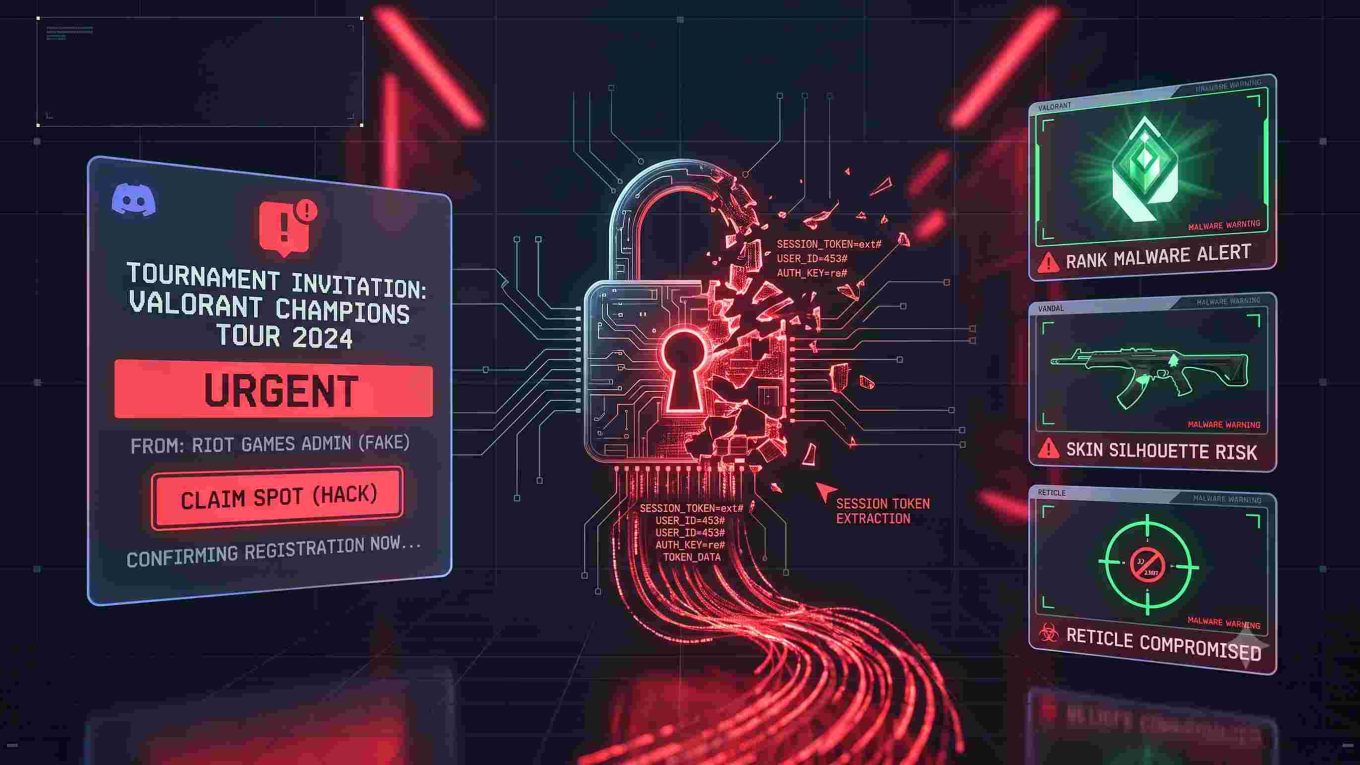
Received a “Need a 5th” Discord Tournament Message? Why It’s a Scam & How to Verify It
You are queued up in Discord, running deathmatches, warming up your crosshair on Ascent, and getting ready to stack with the squad. Suddenly, an unprompted direct message pings your headset. It is an old duo partner or an acquaintance from a mutual competitive gaming server.
The message reads like an urgent call to arms: their top fragger had an emergency, the tournament organizers are threatening a forfeit, and there is an active $1,000 prize pool on the line. All they need is for you to step up, fill the roster, and authenticate your account on the organizer’s bracket platform.
Before you click that clean-looking interface or type your login credentials, hit the brakes. You are not being recruited for an underdog championship run; you are staring straight down the barrel of one of the most prolific cyber threats targeting the tactical gaming community.
Anatomy of the “Need a 5th” Valorant Tournament Scam
The threat ecosystem surrounding the “need a 5th” Valorant tournament scam does not rely on brute-force cracking or high-level network penetration. Instead, it weaponizes pure social engineering tailored to gamer psychology: urgency, vanity, team loyalty, and competitive FOMO (Fear Of Missing Out).
Attackers understand that if you have time to cross-reference URLs, consult mutual friends, or ask questions in a Discord voice channel, their entire operation collapses. To bypass your natural skepticism, they construct an artificial crisis:
Once the victim opens the phishing portal, the attack splits into two catastrophic paths: credential harvesting via fake OAuth pop-ups, or direct endpoint infection through malicious client downloads.
The Panic Bait: Decoding the "Need a Fifth for Tournament Discord Message"
Every campaign begins with a script engineered to force immediate action. When analyzing a typical "need a fifth for tournament discord message," you will notice a structured pattern designed to suppress critical thinking:
"Yo bro, our Duelist just got a power outage right before round 1. We desperately need a fifth for tournament bracket play or we get instant DQ'd! Can you sub in for just two games? We'll split the prize pool 50/50. Just drop your Riot ID on the tournament portal so the admins verify the roster."
Why the Message Looks Completely Authentic
- Sent from Established Accounts: The DM rarely comes from a brand-new, level-0 bot profile with a default avatar. It arrives from an account on your actual friends list that was compromised hours earlier.
- Skill Flattery: The script strokes your ego—claiming your agent pool, mechanical aim, or current rank is the "perfect fit" to save their tournament run.
- Tight Match Clocks: Scammers state that the bracket locks in "4 minutes," actively discouraging you from asking clarifying questions.
If you respond with skepticism via voice comms, the account will dodge: "Can't hop in VC right now, my mic drivers are updating / our team comms are in the tournament client, just authenticate real quick!"
The Low-Effort Trap: "Friend Asking to Vote for Tournament Team Discord Scam"
If attackers notice you are hesitant to commit to playing a full multi-hour bracket, they pivot to a lower-friction variant: the "friend asking to vote for tournament team discord scam".
This social engineering bait eliminates the commitment of playing:
"Hey! I know you're busy and can't sub in, but our team is in the finals of a sponsor contest! Could you do me a massive favor and vote for our roster? Just click the link and verify with your Discord/Steam/Riot profile so the vote counts."
Because voting takes "only five seconds," users let their guard down. However, the underlying technical infrastructure is identical:
- The Phishing Portal: You are directed to a spoofed esports hub mirroring platforms like Challengermode, Faceit, or Battlefy.
- The Cloned Authentication Window: Clicking "Vote" launches a pop-up window formatted to mirror Riot’s or Steam’s legitimate login page.
- Real-Time Reverse Proxy Bypass: When you enter your username, password, and two-factor authentication (2FA) code, automated server-side tools (such as evilginx kits) capture the data in real time. The bots sign into your real account, decouple your registered email, terminate active sessions, and lock you out permanently.
The Competitive Angle: Busting the "Valorant Premier Tournament Register Link Scam"
With competitive players striving for Division promotions and VCT path-to-pro qualification, bad actors have modernized their lures using the "valorant premier tournament register link scam".
In this setup, scammers exploit the community's trust in official game updates. They send a spoofed "Premier Verification Portal" or "Custom Scrim Client" link, claiming external roster registration is required to synchronize stats or bypass anti-smurf restrictions.
The Infostealer Malware Drop
Unlike simple phishing sites that only harvest credentials, Premier-themed scams frequently deliver Infostealer Trojans (such as Lumma Stealer, RedLine, or Vidar) disguised as:
Premier_AntiCheat_Patch.zipTournamentLauncher_v3.2.exeScrimClientSetup.bat
Because Valorant players are accustomed to Riot Vanguard operating at kernel level, many players unquestioningly execute downloaded files with administrative privileges.
Once executed, these payloads do not install anti-cheat drivers. They sweep local directories, extracting active browser session cookies, decrypting stored passwords, harvesting Discord access tokens, and compromising crypto wallets. With active session tokens stolen, attackers bypass 2FA entirely without needing your password.
(For a complete architectural breakdown of the Malware-as-a-Service supply chain and Windows process hollowing methods powering these payloads, check out our technical teardown of the Need a 5th esports scam.)
Why Attackers Target Competitive Gamer Accounts
Stolen gaming accounts are not discarded; they represent high-liquidity assets traded across illicit marketplaces:
| Asset Stolen | Black-Market Street Value | Exploitation Motive |
| OG & Exclusive Skins | $150 – $800+ | Accounts featuring discontinued skins (e.g., Champions 2021 Vandal, Arcane Sheriff) cannot be re-purchased and are resold quickly. |
| High Ranks (Immortal / Radiant) | $50 – $300 | High-tier accounts are bought by smurfs, cheaters testing private scripts, or boosting services. |
| Aged Discord Accounts | High / Strategic | Hijacked profiles with older account creation dates and active Nitro subscriptions easily bypass anti-spam filters, turning your profile into a bot to infect your contacts. |
How to Verify a Suspicious Tournament Message in 30 Seconds
Before you touch any external link, run this rapid verification checklist to confirm whether your friend's account is automated:
- Demand Voice Authentication: Ask them to join a voice channel or send a 5-second voice note. Compromised accounts are run by bot farms and will always invent an excuse: "Mic broken," "In team comms already," or "No time, 2 mins left."
- Ask an In-Game Inside Question: Drop a question only your actual friend knows: "What agent did we play yesterday?" or "Who was bottom-fragging in our last competitive game?" A bot will ignore the question and repeat the urgent link.
- Verify Official Premier Boundaries: Riot Premier registration, match scheduling, bracket tracking, and roster locks occur exclusively inside the Valorant client. Riot never asks you to verify your roster on a third-party site for native Premier tournaments.
- Inspect the Address Bar: Check the root domain carefully. Real Riot authentication is hosted on
authenticate.riotgames.com. Fake portals use look-alike domains likeriot-premier-auth[.]com,bracket-vct-challenge[.]xyz, or fake subdomains. - Zero External Anti-Cheat Policy: Official organizers never mandate downloadable
.exeor.zipanti-cheat files for casual scrims alongside Vanguard. If a site demands you run software, close the tab.
Emergency Incident Response: What to Do If You Clicked
If you realize you interacted with a phishing link or executed an unknown file, act immediately:
- Isolate Your System: Disconnect your PC from the internet instantly (unplug Ethernet or disable Wi-Fi) to halt remote data exfiltration.
- Scan for Malicious Payloads: Boot into Safe Mode and run complete offline scans using dedicated malware detection tools like Malwarebytes or HitmanPro.
- Revoke Active Sessions from an Alternate Device: Using a separate, secure phone or laptop, log into your Discord and email accounts. Navigate to settings, revoke all "Authorized Apps," and select "Log Out of All Devices" to terminate hijacked session tokens.
- File an Urgent Riot Support Ticket: Visit
support.riotgames.com, select "Recover My Account," and provide proof of ownership: original account creation dates, linked transaction IDs from VP purchases, and initial skin unlocks.
Treat sudden tournament pings with the same tactical vigilance you use on the server: clear your angles, verify your intel, and never trade account security for the illusion of an easy bracket win.
Frequently Asked Questions (FAQ)
1. Can a Discord tournament link steal my Riot account if I have 2FA enabled?
Yes. Scammers use real-time reverse-proxy phishing kits (like evilginx). When you type your two-factor code into their spoofed Riot login pop-up, the proxy relays that code directly to the real Riot servers, captures the resulting session cookie, and logs into your account instantly. Once inside, automated scripts swap your linked email address before the session expires.
2. What should I do if my Discord is sending tournament messages automatically?
Your Discord account token has been compromised. Immediately open Discord on a mobile device or clean browser, navigate to User Settings > Devices, and click "Log Out All Known Devices." Change your password right away, as updating your password automatically invalidates old authentication tokens. Finally, inspect User Settings > Authorized Apps and remove any unauthorized integrations.
3. Why do tournament organizers claim I need a custom anti-cheat client?
Any community organizer claiming you need to install a custom .exe, .bat, or .zip anti-cheat alongside Vanguard is lying. Scammers use this excuse because Valorant players are accustomed to kernel-level anti-cheat software. In reality, that file is an infostealer (such as Lumma or RedLine) designed to extract your browser passwords, crypto wallets, and session cookies.