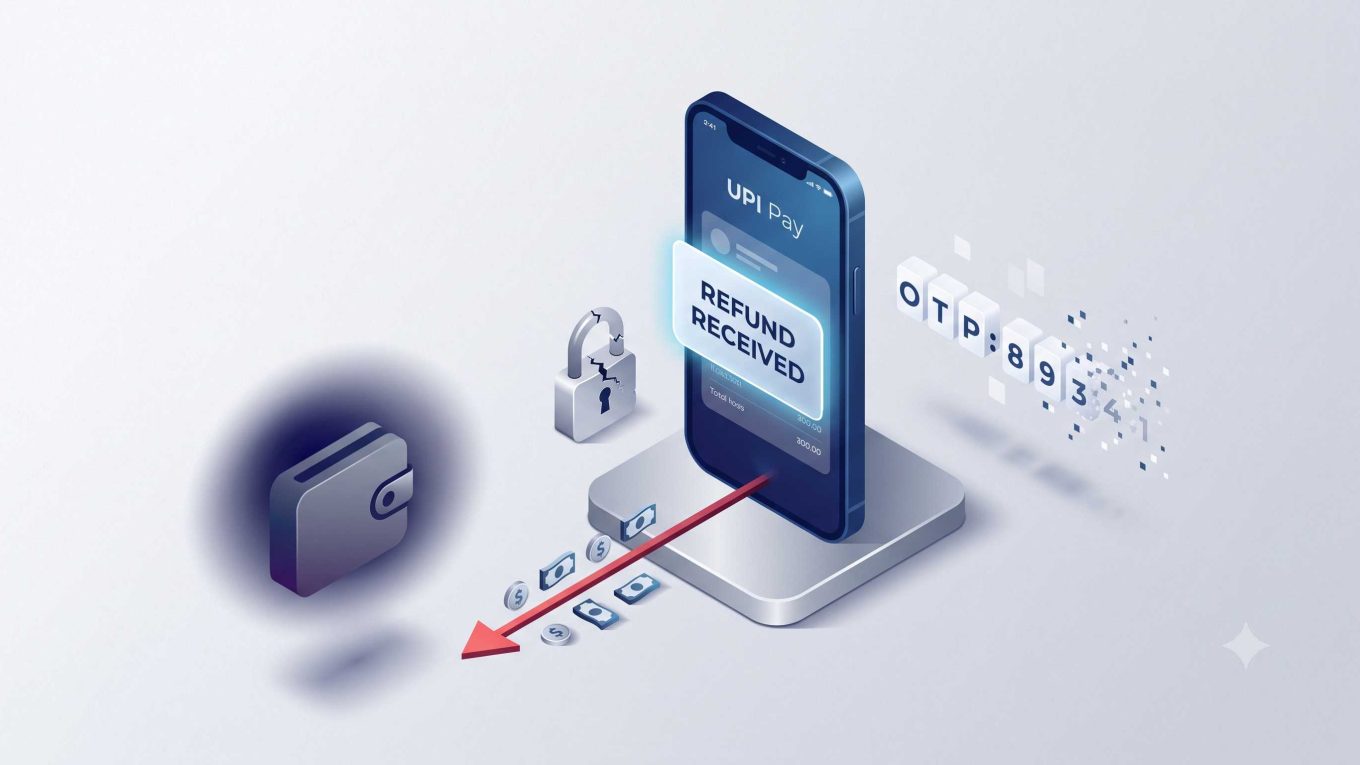
Cashback Scam: How Fake “Refund Processing” Messages Drain Your Bank Account
“We’re processing your ₹2,500 cashback. To receive it, please share the OTP sent to your phone.” It sounds like the final, routine step of getting money you’re actually owed — which is exactly why the cashback scam is one of the most financially damaging fake reward scams. Unlike scams that ask you to pay a fee, this one convinces you to hand over the very credentials that let scammers pay themselves, straight from your account.
This is a spoke in our larger guide on fake reward scams, where we cover all 10 disguises scammers use. Here, we break down exactly how the cashback/refund angle works, why it’s uniquely dangerous compared to fee-based scams, and how to protect yourself from it.
What Is a Cashback Scam?
A cashback scam is a message or call — often referencing a real past purchase, bill payment, or transaction — claiming that a refund, cashback, or reward is being processed for you. To “receive” the money, you’re asked to share an OTP, install a screen-sharing app, or click a link to a fake payment page.
What sets this angle apart from most other fake reward scams is that it doesn’t ask you to pay anything. Instead, it manipulates you into authorizing an outgoing transaction while making it feel like an incoming one — often by disguising a payment request as a “collect request” that looks identical to a refund on UPI apps.
How the Scam Typically Unfolds
Step 1 — The Refund Trigger The scammer references something plausible — a recent order, a failed transaction, a bill overpayment — often guessed or gathered from data leaks, making the claim feel specific and credible.
Step 2 — The Call or Message You’re contacted, sometimes by someone posing as “customer support,” saying a refund or cashback is ready but requires your cooperation to complete.
Step 3 — The OTP or App Request You’re asked to share an OTP sent to your phone “to verify your identity for the refund,” or asked to install a remote screen-sharing app “so our team can process it for you.”
Step 4 — The Disguised Debit In UPI-based versions, you’re sent a payment request disguised to look like you’re “accepting money,” but approving it with your UPI PIN actually authorizes a debit from your account, not a credit.
Step 5 — The Immediate Drain Once the OTP, screen-sharing access, or UPI PIN is used, funds are withdrawn immediately, often across multiple small transactions to avoid triggering fraud alerts before the victim realizes what happened.
A Realistic Example Script
Here’s what a typical cashback scam message or call script looks like (details altered to avoid resembling any real company):
“Sir/Ma’am, this is regarding your recent order with [Brand]. Due to a system error, you are eligible for a cashback of ₹2,450. To credit this amount, please share the OTP you will receive shortly, or accept the payment request sent to your UPI ID.”
Notice how the script frames the interaction entirely around receiving money, while the actual mechanics — sharing an OTP, accepting a “request” — are the exact steps used to authorize a debit.
Red Flags Specific to Cashback Scams
- You’re asked to share an OTP to “receive” money. No legitimate refund or cashback ever requires you to share an OTP — OTPs exist specifically to authorize outgoing actions, not incoming credits.
- You’re asked to install a screen-sharing app like AnyDesk or TeamViewer to “help process” a refund — a method almost exclusively used in scams, never in genuine refund processes.
- A “payment request” is sent instead of a direct credit. On UPI, receiving money never requires you to enter your PIN; only sending or approving a payment does.
- The caller has partial, plausible-sounding details about a real transaction, which feels convincing but doesn’t confirm they’re actually from the company.
- There’s urgency to act “before the refund window closes.“
What To Do If You Receive This Message or Call
- Never share an OTP with anyone, for any reason — no legitimate refund, cashback, or verification process requires it.
- Never install a screen-sharing app at the request of someone claiming to process a refund or reward.
- Check any “payment request” carefully — on UPI, only entering a PIN to approve an outgoing payment moves money; a real credit never asks for your PIN.
- Verify independently by contacting the brand’s official customer care number, not any number provided by the caller or message.
- If you’ve already shared an OTP, granted app access, or approved a request, contact your bank immediately to freeze the account, and report it to the National Cyber Crime helpline (1930) or via cybercrime.gov.in.
The Bottom Line
Cashback scams are especially dangerous because they don’t ask you to pay — they convince you to unknowingly authorize your own account being drained. The moment anyone asks for an OTP, screen-sharing access, or a UPI PIN to “give” you money, treat it as an immediate red flag. For a full breakdown of the other disguises this scam takes — from lucky draws to delivery traps — read our complete guide to fake reward scams.
FAQs of Cashback Scams
1. Can sharing an OTP really let someone take money instead of giving it to me?
Yes. OTPs are designed to authorize actions, including outgoing payments — sharing one with a scammer, even for a supposed “refund,” effectively lets them approve a transaction on your behalf.
2. How do UPI “collect request” scams disguise a debit as a credit?
The scammer sends a payment request that, when approved with your UPI PIN, actually authorizes money to leave your account — but the notification and framing are designed to look like you’re accepting an incoming payment.
3. Why would a scammer ask me to install a screen-sharing app for a refund?
Screen-sharing apps like AnyDesk or TeamViewer give the scammer real-time access to your device, allowing them to view banking apps, capture OTPs, or initiate transactions directly — a method never used in genuine refund processes.
4. Is it normal for a company to call about a cashback or refund I’m owed?
Genuine refunds are usually credited automatically or communicated through official app notifications, not through unsolicited calls asking you to share an OTP or approve a payment request to “receive” the money.
5. What should I do if I’ve already shared an OTP or approved a UPI request for a fake cashback?
Contact your bank immediately to freeze the account and report unauthorized transactions, then file a complaint with India’s National Cyber Crime helpline at 1930 or via cybercrime.gov.in.
Call to Action
Please share this article to spread awareness. Follow us on Facebook, Twitter, and Instagram for more scam alerts. If you doubt the legitimacy of any website or investment plan, DM us on social media — we’ll help you verify.
“Scammers evolve daily. Subscribe to our scam‑alert list and stay one step ahead.”