The “Baby of the Year” Illusion: How Pay-to-Win Voting and Digital Footprint Risks Exploit Parental Pride
Quick Takeaways for Concerned Parents:
- Is it an outright scam? Technically, no. The competition is run legally by a commercial fundraiser, an actual grand prize is awarded, and a portion goes to charity.
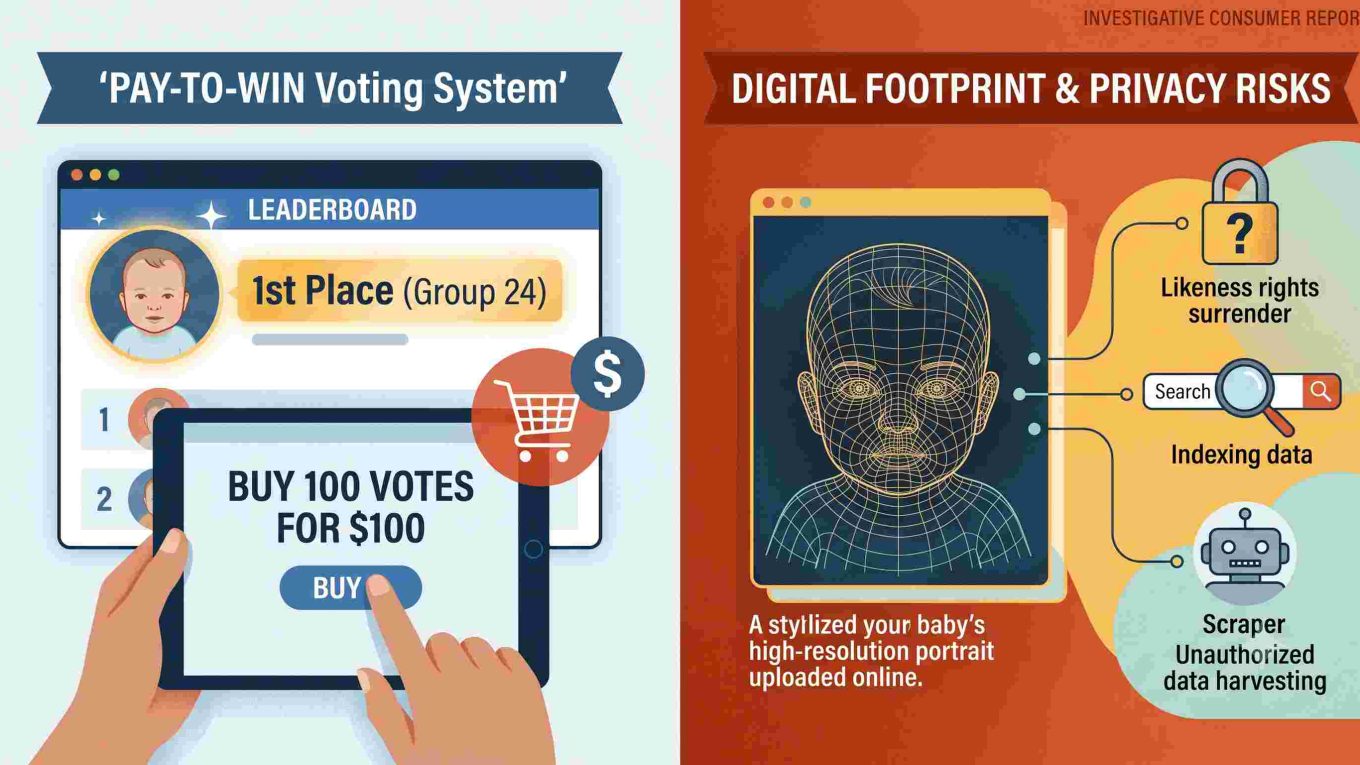
- Why the backlash? It is fundamentally a pay-to-win popularity contest. While one daily vote is free, unlimited additional votes can be bought for roughly $1 each under the guise of donations. The baby with the best-funded network wins.
- The hidden trap: Contestants are placed into hundreds of small, isolated “micro-groups.” A notification saying your child is in “1st Place” usually means first out of 50 children, not first in the country.
- The biggest concern: Broad copyright surrenders, public search engine indexing of infants’ faces and full names, and substantial for-profit administrative fee cuts before money reaches the partner charity.
Every parent looks at their child and sees someone extraordinary. It is an instinct rooted in love, protective pride, and joy. Marketers and commercial operators understand this dynamic intimately—and in recent years, few campaigns have monetized parental emotion as aggressively as the viral “Baby of the Year” competition.
Promoted across Instagram, Facebook, and TikTok feeds, the pitch is instantly compelling: a $25,000 cash prize, a featured spread in a national publication or ad campaign, and association with high-profile celebrity ambassadors and well-known children’s charities.
Within hours of entering, family group chats buzz with excitement. Grandparents, aunts, and coworkers are mobilized to cast their daily votes. But as the competition progresses into deeper elimination rounds, excitement frequently turns into frustration and unease.
Is “Baby of the Year” a criminal scam? Or is it a sophisticated, legal enterprise built on dark design patterns and commercial fundraising loopholes? To protect both your wallet and your child’s digital footprint, here is an investigative breakdown of how the contest actually operates.
1. Legitimacy Check: Criminal Fraud vs. Predatory Marketing
To evaluate the competition accurately, one must first separate illegal schemes from predatory business models.
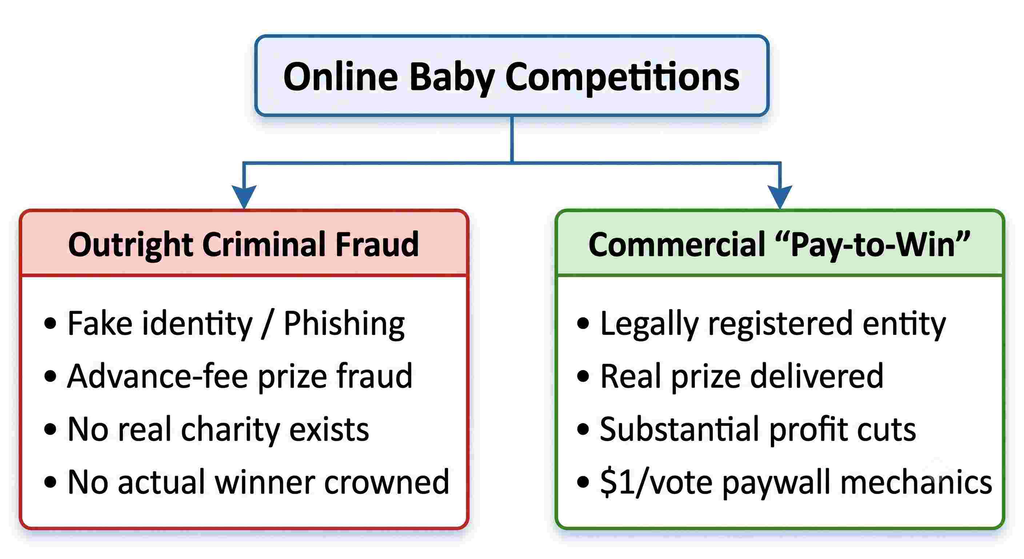
An outright scam involves fictitious operators, stolen credit card processing, or fake modeling scouts asking for money via wire transfer with no prize ever awarded.
“Baby of the Year” (typically organized by Colossal Management, LLC, which operates similar contests like Maxim Cover Girl and Face of Horror) does not fall into this criminal category:
- It is registered as a commercial fundraiser/for-profit entity.
- A grand prize winner is officially crowned and paid.
- A share of the proceeds is distributed to legitimate 501(c)(3) charities (such as Baby2Baby, often handled through an intermediary non-profit like DTCare).
However, legal does not mean transparent or fair. While organizers avoid breaking the law by detailing their rules in lengthy Terms of Service, the operational mechanics are deliberately structured around psychological levers that induce families to spend thousands of dollars.
2. Deconstructing the Mechanics: The “Pay-to-Win” Machine
At the core of the controversy is a three-part machine designed to keep parents invested emotionally and financially.
The Illusion of the Free Vote
Contests allow one free vote per verified account every 24 hours. This serves a critical dual purpose for the organizers:
- It builds massive, recurring organic web traffic.
- It recruits every participating parent as an unpaid marketer who drives hundreds of new visitors to the platform daily.
The $1-a-Vote Engine and the “Charity Shield”
Free votes rarely decide the outcome. Entrants quickly discover that supporters can buy unlimited additional votes (typically $1 per vote, sold in blocks of $10, $25, $50, or $100+).
By framing these purchases as “charitable donations” to a designated partner non-profit, the contest erects an effective emotional shield:
- Parents do not feel like they are buying victory; they feel like they are “supporting a good cause.”
- Friends and relatives who might normally decline to vote in a commercial contest feel a moral obligation to contribute when the solicitation is framed as a charity donation.
The mathematical reality is stark: a baby whose family spends $2,000 on purchased votes will easily defeat a baby relying on dozens of friends casting free daily votes. It is an auction disguised as a talent search.
The Micro-Group Deception
The most deceptive psychological tactic involves tournament segmentation.
When you enter, your child is not placed on a single, transparent nationwide leaderboard alongside 50,000 other babies. Instead, organizers quietly partition contestants into hundreds of arbitrary micro-groups of 40 to 60 children.
Total Entrants: ~50,000+ Infants Nationwide
  ├── Group 1  (50 Babies) ──► Parent sees: "Your baby is #1!"
  ├── Group 2  (50 Babies) ──► Parent sees: "Your baby is #1!"
  ├── Group 3  (50 Babies) ──► Parent sees: "Your baby is #1!"
  └── Group N  ... (Hundreds of parallel groups running simultaneously)
When a parent receives an automated email or dashboard alert saying, “Congratulations! Your baby is in 1st Place!”, it creates an enormous rush of pride and urgency. What the alert omits in bold text is that the baby is merely first in Group 24, with hundreds of other “first-place” babies sitting in parallel groups across the system.
As the competition progresses through successive cut rounds (Top 20, Top 10, Top 5, Group Finals, Quarterfinals, Semifinals), the groups merge, the competition intensifies, and maintaining a high position requires progressively larger financial outlays.
3. The Financial Reality: Follow the Money
Where does the money go when someone spends $100 on “charity votes”?
If you donate $100 directly to a charity like Baby2Baby via their official website, roughly 85% to 95% of those funds go straight to program services supporting families in need, with the remainder covering standard payment processing and overhead.
When votes are purchased through commercial contest platforms, the fine-print disclosures tell a very different story:
- The For-Profit Operator’s Cut: Commercial co-venturers and operators routinely retain a significant percentage (often between 30% and 40%, plus operational and credit card processing fees) to cover production costs, advertising budgets, executive margins, and profits.
- The Intermediary Layer: Funds often pass through intermediary grant-making non-profits before reaching the designated beneficiary charity.
- The Math: Millions of dollars are spent across all participants to award a single $25,000 prize.
If your primary goal is philanthropy, routing donations through a commercial voting competition is one of the least efficient ways to help children in need.
4. The Critical Blind Spot: Child Privacy and Digital Footprints
Beyond the financial mechanics lies a more enduring concern that many parents overlook in the excitement of competition: data privacy and child safety.
| Risk Factor | How the Contest Operates | The Long-Term Impact |
| Search Engine Indexing | Full names, ages, locations, and high-res photos are published on public, indexed URLs. | A permanent, searchable digital footprint created before the child can even speak. |
| Broad Likeness Rights | Terms of Service often include broad, irrevocable, royalty-free licenses to use photos. | The organizers retain legal rights to reuse your child’s image in future marketing. |
| Data Harvesting & Scraping | Publicly accessible photo portals with zero access controls. | Web scrapers, identity brokers, and automated bots easily harvest face portraits and metadata. |
| Facial Recognition & AI | Clear, multi-angle baby portraits available without paywalls. | Public image databases provide fuel for unregulated third-party AI image datasets. |
When parents enter these contests, they are often unknowingly surrendering their child’s likeness rights to commercial marketing entities, while broadcasting identifying details to any anonymous web visitor.
5. Legitimate Contests vs. Pay-to-Win Competitions
How does “Baby of the Year” compare to genuine, time-tested brand searches? Evaluating contests against the industry standard—such as the annual Gerber Baby Photo Search—highlights the structural contrast:
| Feature | Commercial “Pay-to-Win” Contests | Traditional Brand Searches (e.g., Gerber) |
| Cost to Enter | Free initial entry, but requires paid votes to win | 100% Free |
| Voting Mechanism | $1 per vote; unlimited paid voting allowed | Zero paid votes; selected by an internal panel of judges |
| Selection Criteria | Whichever family spends/solicits the most capital | Expressiveness, brand fit, visual appeal |
| Transparency | Contestants hidden in partitioned micro-groups | Public, uniform entry process with clearly stated odds |
| Likeness Usage | Extensive licensing surrendered upon submission | Narrowly defined usage rights tied strictly to campaign parameters |
| Primary Revenue Driver | Selling votes under the banner of charity | Brand loyalty, positive PR, and consumer trust |
6. What Should You Do If You Have Already Entered?
If your child is currently enrolled in a pay-to-win competition, you do not need to panic—but you should make informed, strategic decisions.
- Let the Rankings Drop Without Guilt: Recognize that an elimination does not reflect your child’s beauty or value. It simply means you chose not to participate in an artificial bidding war.
- Do Not Guilt-Trip Your Network: Avoid pressuring family members or friends to buy votes. If they wish to support children in need, encourage them to donate directly to a local shelter or non-profit organization.
- Request Photo and Account Deletion: Review the contest’s privacy policy and email the administrative support desk with a formal request to remove your child’s profile, name, and images from their indexed servers.
- Talk Openly About the Mechanics: When friends or relatives share their own contest links, gently explain how the micro-group and $1-a-vote systems work. Spreading awareness stops predatory marketing models from thriving on social platforms.
The Bottom Line
Every baby is worthy of celebration. But genuine appreciation does not come with a $1 checkout cart, an arbitrary ranking inside “Group 47,” or a contractual surrender of your child’s likeness.
When a competition turns infant appreciation into a monetized leaderboard, the children are not the real contestants. The parents are the targets, and their social circles are the revenue stream. Step away from the leaderboards, keep your money in your pocket, and protect your child’s digital privacy.
Suyesh Gusain is a scam‑site analyst and consumer‑safety content creator with a degree in Mass Communication. He specializes in exposing fraudulent e‑commerce clones and writing SEO‑optimized scam‑review articles that help readers shop safely online.
Every safe click counts. If this post helped, a coffee gesture fuels more scam‑busting investigations.

Call to Action
Please share this article to spread awareness. Follow us on Facebook, Twitter, and Instagram for more scam alerts. If you doubt the legitimacy of any website or investment plan, DM us on social media — we’ll help you verify.
“Scammers evolve daily. Subscribe to our scam‑alert list and stay one step ahead.”
Frequently Asked Questions About the “Baby of the Year” Contest
Is the Baby of the Year contest legit or a scam?
Technically, it is not an illegal scam. The competition is run legally by Colossal Management as a commercial fundraiser, an actual grand prize is awarded, and a portion of the proceeds is donated to charity (such as Baby2Baby via DTCare).
However, many consumer watchdogs and parents criticize it as an emotional “pay-to-win” scheme because advancing to the final rounds virtually requires spending substantial sums of money on purchased votes.
Do you have to pay to win Baby of the Year?
In theory, no—each registered voter gets one free vote every 24 hours. In practice, yes. Because supporters can buy unlimited additional votes at approximately $1 per vote under the guise of charitable donations, babies whose families spend hundreds or thousands of dollars consistently outrank those relying purely on free daily votes.
What does “1st place in group” mean on Baby of the Year?
Being in “1st place” does not mean your baby is leading the entire nationwide contest. Organizers quietly divide thousands of entrants into hundreds of parallel “micro-groups” (typically 40 to 60 babies each). Seeing your child in 1st place simply means they lead their specific, arbitrary sub-group before the next elimination cut.
How much money actually goes to charity in the Baby of the Year contest?
While paid votes are branded as donations to a partner charity, standard commercial fundraising disclosures show that a significant portion—often 30% to 40% or more, alongside payment processing and operational overhead—is retained by the for-profit organizers. Donating directly to the charity via their official website ensures far more of your money directly benefits children.
Is it safe to enter the Baby of the Year contest?
Entering carries real digital privacy risks. Participating requires uploading high-resolution photos, full names, ages, and approximate locations to public, search-engine-indexed pages. Furthermore, the contest’s Terms of Service frequently grant the organizers broad, royalty-free licensing rights to use your child’s photos for future marketing without additional consent or compensation.
How does Baby of the Year compare to the Gerber Baby Photo Search?
The Gerber Baby Photo Search is 100% free to enter, does not allow anyone to buy votes, and selects its winner through an internal panel of judges based on expressiveness and visual brand fit. In contrast, Baby of the Year allows unlimited purchased votes and determines winners primarily by how much money is spent by an entrant’s network.
How do I delete my baby’s profile and photos from Baby of the Year?
You must contact the contest operator’s support desk directly via the contact email provided in their website footer or Privacy Policy. Explicitly request the permanent deletion of your account, profile data, and all submitted photos from their active servers and public search indexing.