Aliked.net Review: Is It a Scam or a Legitimate Paid Gig?
Consumers in the US, UK, Canada, and Australia are encountering aggressive social media advertisements for Aliked.net. This platform projects an enticing commercial illusion: users can allegedly earn $30 per hour simply by talking to strangers.
The pitch claims these conversations are recorded, stripped of identifying details, and licensed to artificial intelligence companies. This modern gig-economy twist specifically targets individuals seeking effortless remote income. However, behind this compelling narrative lies a highly suspicious data-harvesting operation.
Aliked.net is completely unsafe, and users should strictly avoid submitting personal contact information, voice data, or banking details to the platform.
The core operational reality of Aliked.net is that it functions as an untraceable phishing trap rather than a legitimate data broker. The site relies on a synthetic employment model to collect biometric and financial data from unsuspecting individuals under the guise of setting up payroll.
This technical audit deconstructs the underlying architecture of Aliked.net, examining its domain registration anonymity, the absence of a verifiable corporate entity, and the predatory mechanics it uses to exploit the current hype surrounding artificial intelligence.
What Is Aliked.net Doing?
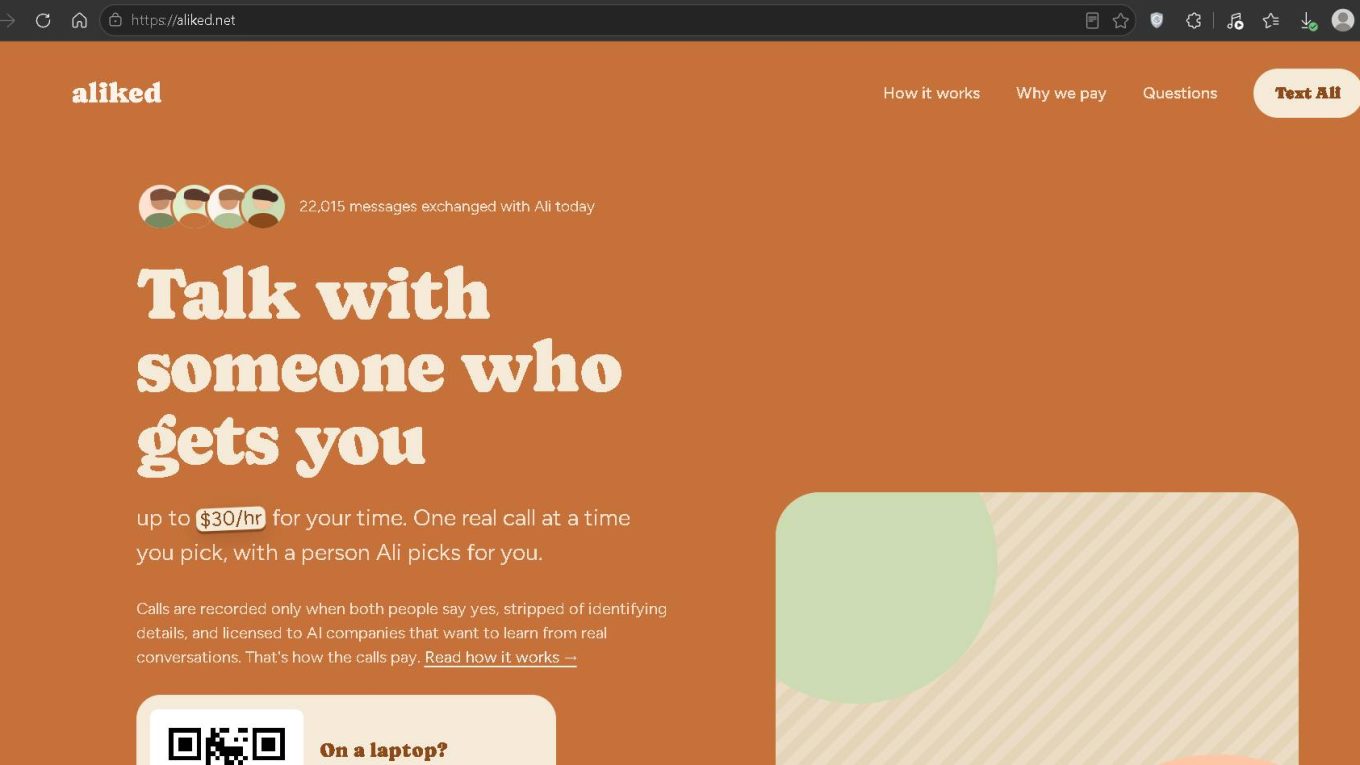
Aliked.net exploits public interest in artificial intelligence and remote side hustles by brokering a fake service. The platform lures traffic through algorithm-gaming social media advertisements that promise high-paying, low-effort work. Once clicked, users are directed to a functionally hollow landing page that mimics a legitimate tech startup, complete with reassuring privacy claims. It instructs users to text “Ali” to begin matching with partners for paid conversations.
Technically, the site functions as a sophisticated data-capture funnel. Instead of a standard e-commerce flow, the “onboarding” process involves surrendering a phone number to an unverified third-party server. By forcing users to initiate contact via SMS, the operators capture verified telecommunications data and establish a direct communication line that easily bypasses browser security warnings. The site utilizes a free automated SSL certificate to project a false sense of security, which merely encrypts the connection to a predatory endpoint, safely transiting your data straight to anonymous operators.
What Is This Site Exploiting?
Unlike a retail scam pushing discounted designer goods, Aliked.net exploits the promise of a freelance employment opportunity. The platform claims to broker your voice data to AI companies, passing $30 per hour down to the user. This pricing model is economically unfeasible and fundamentally misrepresents how AI model training operates.
Legitimate technology laboratories do not crowdsource highly paid, unverified phone calls from random internet users. Professional data labeling and conversational AI training tasks are heavily scrutinized, require strict non-disclosure agreements, and pay a fraction of this advertised rate.
To manufacture credibility, the platform relies on deceptive visual assets. The website features generic, faceless avatars and claims “22,015 messages” were exchanged today—a static, hardcoded metric designed to create artificial social proof. By masking its true nature behind trendy AI buzzwords, Aliked.net creates a synthetic front for large-scale data harvesting, aiming to acquire biometric voice data and payment details to sell to malicious actors.
How the Scam Works
The victim lifecycle on Aliked.net follows an exploitation model designed entirely to extract personal and financial data:
- Ad Click to Onboarding: The lifecycle begins via a sponsored ad. Instead of adding an item to a cart, the user “registers” by providing their phone number or scanning a QR code, immediately compromising their mobile identity.
- The Payroll Diversion: Once SMS communication begins, automated chatbots extract further identity metrics. The user is prompted to provide banking information or credit card details under the guise of setting up a “direct deposit” account for their wages.
- The Post-Registration Blackout: After surrendering payment credentials and recording initial voice samples, the platform initiates a blackout. The promised compensation never materializes. Users receive automated delay messages, or the SMS channel goes entirely dead.
- The Financial Fallout: The ultimate consequence is severe credential compromise. Victim phone numbers are added to active phishing lists. Bank account details provided for deposits are exploited for unauthorized ACH withdrawals, and recorded voice data can be weaponized for AI voice-cloning scams targeting the victim’s family.
Critical Red Flags
This technical analysis reveals a severe concentration of critical red flags, categorizing Aliked.net as a maximum-risk operation.
| Signal / Feature | Aliked.net Status | Legitimate Gig Platform Standard |
| Domain Registration | Registered August 31, 2026. | Years of established domain history. |
| WHOIS Identity | Fully redacted via ICANN proxy. | Transparent corporate ownership. |
| Physical Nexus | Zero physical addresses listed. | Verifiable corporate headquarters. |
| Legal Documentation | Missing legitimate Privacy Policy. | Comprehensive data processing agreements. |
| Business Model | $30/hr for unverified voice data. | Strict KYC identity checks and tax forms. |
- WHOIS Anonymity: The domain was registered on August 31, 2026. The operators hide behind a Denver proxy service to obscure their actual identities and geographic location.
- Absence of Physical Nexus: There is no corporate entity tied to this website. Companies handling payroll and sensitive biometric data must legally display registered business addresses.
- Missing Legal Boilerplate: The site lacks the legal infrastructure required to operate as a data broker, blatantly violating international data protection regulations.
Risk Parameters & Technical Profile
The infrastructure of Aliked.net presents a critical threat matrix for any user interacting with its systems.
- Domain Registration & Registrar: Registered on August 31, 2026, via Name.com. This extreme domain youth strongly indicates a short-term, burn-and-churn scam operation.
- SSL Certificate: The site utilizes a free Let’s Encrypt SSL certificate. This requires zero business vetting, allowing scammers to project false security to bypass basic browser blocks.
- Server Location: The domain resolves through Vercel DNS routing, effectively masking the origin server’s true geographical location and hosting provider.
- Payment Gateway Security: Operating a reverse-payment scam, the site acts as a credential harvesting gateway. Providing routing numbers poses immediate, high-severity risks of direct debit fraud.
- Consumer Legal Recourse: Legal recourse is exceptionally low. With anonymous operators and no physical jurisdiction, victims have virtually no centralized authority to petition for asset recovery.
Conclusion
Aliked.net is a definitive scam and a sophisticated data-harvesting front. The combination of an extremely young domain, complete ICANN registry anonymity, an economically impossible compensation model, and the total absence of a verifiable corporate nexus confirms its malicious nature.
Engaging with this platform puts your biometric identity, personal telecommunications data, and banking credentials at immediate risk. The site does not exist to pay consumers for their time; it exists to extract sensitive information under the guise of an artificial intelligence gig-economy platform, positioning victims for severe financial exploitation.
If you provided financial details to Aliked.net, take immediate defensive action. Contact your bank to flag the interaction and block ACH transfers related to unknown entities. If you provided debit card information, freeze the compromised cards and request replacements. Place a fraud alert on your credit profiles with major bureaus to intercept attempts at synthetic identity creation, and remain hyper-vigilant against targeted phishing text messages or voice-cloning calls.
“In the digital economy, anonymity is the ultimate red flag; if a platform demands your biometric or financial data but refuses to verify its corporate identity, it is not a business opportunity—it is a trap.”
Author Bio
Suyesh Gusain: With 8+ years auditing digital architecture and advising global consumer protection groups, he actively dismantles emerging financial scams targeting retail demographics.
FAQ Section
Q: Is Aliked.net a scam or a legit platform?
A: Evidence indicates Aliked.net is a scam. The site was just registered on August 31, 2026. The owners completely hide their identity using a WHOIS privacy protection service. It functions as a data-harvesting trap rather than a legitimate employment platform.
Q: Are there any real reviews for the Aliked “talk to someone who gets you” service?
A: No credible, independent reviews exist for this service. The domain is extremely young, which indicates a high-risk operation. Independent cybersecurity scanners flag the site as highly suspicious due to its low traffic, recent creation date, and hidden origins.
Q: Does Aliked.net really pay 30 dollars an hour?
A: No. The $30 per hour claim is an economically unfeasible lure. Legitimate artificial intelligence companies do not crowdsource unverified phone calls at this rate. The site uses this impossible promise to trick you into surrendering your banking details and voice data.
Q: Is the Aliked website safe for personal data?
A: Absolutely not. The platform is a massive privacy risk. The site operates entirely anonymously and hides behind a proxy service in Denver. Submitting your phone number or recording your voice exposes you to identity theft, active phishing networks, and AI voice-cloning scams.
Q: How does the Aliked net AI voice recording gig scam work?
A: The scam starts with social media ads promoting easy money. Once you text the provided number, automated bots extract your personal information. They prompt you to hand over your verified phone number, payment data, and voice biometrics under the guise of setting up an account, but the promised compensation never arrives.
Every safe click counts. If this post helped, a coffee gesture fuels more scam‑busting investigations.

Call to Action
Please share this article to spread awareness. Follow us on Facebook, Twitter, and Instagram for more scam alerts. If you doubt the legitimacy of any website or investment plan, DM us on social media — we’ll help you verify.
“Scammers evolve daily. Subscribe to our scam‑alert list and stay one step ahead.”