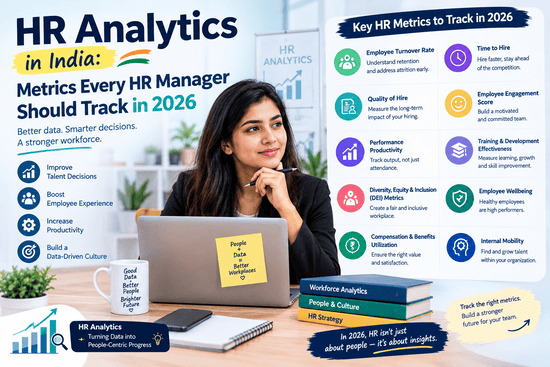
HR Analytics in India: Metrics Every HR Manager Should Track in 2026
Human Resources has evolved far beyond hiring employees and processing payroll. Today’s HR leaders are expected to make data-driven decisions that improve employee performance, reduce attrition, optimize hiring costs, and contribute directly to business growth.
This shift has given rise to HR Analytics, one of the most important trends shaping the future of Human Resource Management in India.
Whether you work in a startup, IT company, manufacturing organization, or growing SME, relying solely on intuition is no longer enough. Modern HR teams must leverage workforce data to identify patterns, solve problems, and measure the effectiveness of HR initiatives.
As someone who has worked in recruitment and HR operations, I’ve noticed that organizations that actively track HR metrics tend to make better hiring decisions, retain employees longer, and build stronger workplace cultures.
In this guide, we’ll explore what HR Analytics is, why it matters, and the essential metrics every HR manager in India should track in 2026.
What is HR Analytics?
HR Analytics, also known as People Analytics or Workforce Analytics, refers to the process of collecting, analyzing, and interpreting employee-related data to improve HR and business outcomes.
Instead of making decisions based on assumptions, HR professionals use data to answer questions such as:
- Why are employees leaving?
- Which hiring channels generate the best talent?
- How long does recruitment take?
- What factors affect employee engagement?
- Which departments experience higher attrition?
The goal is simple: transform workforce data into actionable business insights.
Why HR Analytics Is Becoming Essential in India
Indian organizations are facing several workforce challenges:
- Rising employee attrition
- Skill shortages
- Hybrid work management
- Increasing recruitment costs
- Employee engagement concerns
- Talent retention challenges
HR analytics helps organizations:
✅ Reduce turnover
✅ Improve hiring quality
✅ Increase workforce productivity
✅ Optimize HR budgets
✅ Strengthen employee experience
✅ Support strategic decision-making
In competitive industries such as IT, BFSI, healthcare, e-commerce, and manufacturing, data-driven HR practices are quickly becoming a necessity rather than a luxury.
The Four Types of HR Analytics
Before discussing metrics, it’s important to understand the different categories of HR analytics.
1. Descriptive Analytics
Answers:
What happened?
Examples:
- Monthly attrition rate
- Number of new hires
- Training hours completed
2. Diagnostic Analytics
Answers:
Why did it happen?
Examples:
- Reasons behind employee turnover
- Causes of absenteeism
- Performance decline investigation
3. Predictive Analytics
Answers:
What could happen next?
Examples:
- Predicting employee resignations
- Forecasting talent requirements
- Identifying retention risks
4. Prescriptive Analytics
Answers:
What should be done?
Examples:
- Retention strategies
- Workforce planning decisions
- Hiring recommendations
Top HR Metrics Every HR Manager Should Track
1. Employee Turnover Rate
Employee turnover measures how many employees leave the organization within a given period.
Formula
(Number of Employees Who Left ÷ Average Number of Employees) × 100
Why It Matters
High turnover can indicate:
- Poor management
- Low engagement
- Compensation issues
- Limited growth opportunities
HR Insight
If turnover spikes within the first six months of employment, onboarding processes may need improvement.
2. Employee Retention Rate
Retention rate measures the percentage of employees who stay with the company.
Formula
(Number of Employees Remaining ÷ Total Employees at Start) × 100
Why It Matters
Strong retention typically indicates:
- Employee satisfaction
- Effective leadership
- Positive workplace culture
High retention often leads to lower recruitment costs and improved organizational stability.
3. Time to Hire
This metric measures the time taken to fill a vacancy after it is approved.
Formula
Date Position Filled - Date Vacancy Opened
Why It Matters
Long hiring periods can:
- Affect productivity
- Delay project timelines
- Increase recruitment costs
Personal Observation
In competitive hiring markets, reducing time-to-hire by even a week can significantly improve candidate acceptance rates.
4. Cost Per Hire
This metric calculates the average recruitment cost for each new employee.
Formula
Total Recruitment Costs ÷ Number of Hires
Costs Include
- Job advertisements
- Recruitment software
- Agency fees
- Recruiter salaries
- Assessment tools
Why It Matters
Understanding hiring costs helps HR teams allocate recruitment budgets effectively.
5. Quality of Hire
Quality of hire evaluates the effectiveness of recruitment efforts.
Factors Considered
- Performance ratings
- Retention rates
- Manager feedback
- Productivity levels
Why It Matters
Fast hiring is useless if the employee is not the right fit.
A quality hire often delivers long-term business value.
6. Offer Acceptance Rate
This metric tracks how many candidates accept job offers.
Formula
Accepted Offers ÷ Total Offers Extended × 100
Why It Matters
A low acceptance rate may indicate:
- Non-competitive salaries
- Long hiring processes
- Poor candidate experience
7. Absenteeism Rate
Absenteeism measures employee absence frequency.
Formula
Lost Workdays ÷ Available Workdays × 100
Why It Matters
Excessive absenteeism may signal:
- Burnout
- Workplace dissatisfaction
- Health concerns
- Management challenges
8. Employee Engagement Score
Engaged employees are generally more productive and committed to organizational goals.
How to Measure
Through surveys assessing:
- Job satisfaction
- Leadership trust
- Work environment
- Career growth opportunities
Why It Matters
Engagement often correlates directly with retention and productivity.
9. Employee Productivity Metrics
Productivity measurement differs by industry.
Examples include:
Sales Teams
- Revenue generated
- Deals closed
Customer Support
- Tickets resolved
- Customer satisfaction scores
Manufacturing
- Units produced
- Production efficiency
Why It Matters
Understanding productivity helps optimize workforce performance.
10. Training Effectiveness
Organizations invest heavily in employee development.
Track:
- Training completion rates
- Skill improvement
- Post-training performance
- Retention impact
Why It Matters
Training should lead to measurable improvements, not simply completion certificates.
11. Internal Promotion Rate
This metric tracks positions filled internally.
Formula
Internal Promotions ÷ Total Open Positions × 100
Why It Matters
High promotion rates often reflect:
- Effective succession planning
- Employee development
- Strong retention strategies
12. Revenue Per Employee
One of the most important business-oriented HR metrics.
Formula
Total Revenue ÷ Number of Employees
Why It Matters
This metric provides insights into workforce efficiency and organizational productivity.
13. Employee Net Promoter Score (eNPS)
eNPS measures employee willingness to recommend the organization as a workplace.
Survey Question
On a scale of 0 to 10, how likely are you to recommend this company as a workplace?
Why It Matters
Strong eNPS scores often indicate a healthy workplace culture.
14. Diversity and Inclusion Metrics
Modern organizations increasingly monitor diversity data.
Metrics may include:
- Gender diversity
- Leadership diversity
- Hiring diversity
- Pay equity indicators
Why It Matters
Diverse workplaces often benefit from broader perspectives and innovation.
15. Early Attrition Rate
Early attrition refers to employees leaving shortly after joining.
Typical Measurement
Employees leaving within:
- 3 months
- 6 months
- First year
Why It Matters
Early exits often reveal:
- Hiring mismatches
- Poor onboarding
- Unrealistic expectations
HR Analytics Tools Popular in India
Many organizations use HR technology solutions to track workforce data.
Popular HRMS platforms include:
- greytHR
- Keka
- Darwinbox
- Zoho People
- PeopleStrong
- SAP SuccessFactors
- Oracle HCM
These systems help HR teams generate dashboards and workforce reports automatically.
How HR Managers Can Build an HR Analytics Strategy
Step 1: Define Business Objectives
Identify critical business goals such as:
- Reducing turnover
- Improving hiring quality
- Increasing engagement
Step 2: Select Relevant Metrics
Avoid tracking data simply because it is available.
Focus on metrics that influence business decisions.
Step 3: Ensure Data Accuracy
Poor-quality data leads to poor decisions.
Regular audits improve reporting accuracy.
Step 4: Create Dashboards
Visual dashboards help stakeholders understand trends quickly.
Useful dashboard components include:
- Attrition trends
- Hiring performance
- Diversity metrics
- Engagement surveys
Step 5: Take Action
Data alone creates little value.
The real benefit comes from acting on insights.
Common HR Analytics Mistakes
Many organizations collect data but fail to generate meaningful insights.
Avoid these mistakes:
❌ Measuring too many metrics
❌ Ignoring employee feedback
❌ Focusing only on recruitment data
❌ Using inaccurate data
❌ Not sharing insights with leadership
❌ Tracking metrics without action plans
Remember: analytics should drive decisions, not just reports.
The Future of HR Analytics in India
The future of HR analytics is increasingly connected with:
Artificial Intelligence
AI can identify:
- Employee attrition risks
- Hiring patterns
- Workforce trends
Predictive Workforce Planning
Organizations can forecast future talent requirements more accurately.
Real-Time Dashboards
HR leaders can make faster, more informed decisions.
Personalized Employee Experiences
Analytics helps create customized development, learning, and engagement programs.
As digital transformation accelerates across India, data-driven HR will become a key competitive advantage.
Frequently Asked Questions (FAQs)
What is HR Analytics?
HR Analytics is the process of analyzing workforce data to improve business and HR outcomes.
Why is HR Analytics important?
It helps organizations make informed decisions regarding hiring, retention, employee engagement, and workforce planning.
What is the most important HR metric?
Employee turnover rate is often considered one of the most critical HR metrics because it directly affects costs, productivity, and retention.
Can small businesses use HR Analytics?
Yes. Even small organizations can track basic metrics such as turnover, absenteeism, hiring costs, and retention rates.
Which HR software is best for HR Analytics in India?
Popular options include greytHR, Keka, Darwinbox, Zoho People, and PeopleStrong.
Final Thoughts
HR Analytics is no longer reserved for large corporations. In today’s competitive job market, even small and mid-sized businesses can benefit from workforce data.
The most successful HR leaders are those who combine human understanding with data-driven decision-making. By tracking metrics such as turnover, retention, hiring efficiency, engagement, and productivity, HR professionals can move beyond administrative responsibilities and become strategic business partners.
From my experience in HR and talent acquisition, the organizations that consistently monitor and act on workforce metrics are often the ones that build stronger cultures, retain top talent, and achieve sustainable growth.
In 2026 and beyond, HR Analytics will not simply be an HR function. It will be a business necessity.
Sweta Rawat is an HR professional with over 2.5 years of experience and an MBA in Human Resources. She writes on modern HR practices, employee engagement, and workplace culture, blending professional expertise with creative insight.