Mefij.shop Review: Silent Transmitters, Phony Deals, and the Ham Radio Clearance Trap
Amateur radio enthusiasts searching the web for scarce transceivers, antenna tuners, and RF amplifiers are increasingly stumbling upon Mefij.shop, a deceitful web portal running a calculated Typosquatting & Brand Impersonation Scam. By hijacking the iconic red logo and brand heritage of MFJ Enterprises, the storefront presents itself as a dedicated clearance outlet for discontinued amateur radio gear.
However, buying precision radio hardware online requires looking past familiar brand banners. In mid-2024, MFJ Enterprises officially ceased on-site manufacturing at its historic Starkville, Mississippi facility, creating widespread global shortages for brand-new tuners and components. Fraud syndicates are actively exploiting this scarcity by spinning up clone storefronts loaded with phantom inventory to capture unverified credit card checkouts.
This investigative teardown exposes how Mefij.shop operates, explains the architecture behind typosquatting clone stores, details five critical red flags, and provides an actionable recovery plan to safeguard your banking credentials.
The Mechanics of a Typosquatting Brand Clone
A typosquatting brand clone is an unauthorized e-commerce portal built to exploit misspelled search queries, phonetic slip-ups, and the trust associated with legacy manufacturers. Rather than launching a legitimate distribution business, bad actors register disposable domains that closely resemble an established company’s official name.
In genuine amateur radio distribution:
- Authorized Dealer Networks: Licensed suppliers (such as DX Engineering, Ham Radio Outlet, or Gigaparts) maintain certified logistics warehouses, direct manufacturer accounts, and transparent return facilities.
- Component-Driven Cost Floors: Precision RF equipment—including manual antenna tuners, roller inductors, dummy loads, and linear amplifiers—requires substantial copper, aluminum, and calibration labor, maintaining firm secondary market valuations.
In a fraudulent clone funnel:
- The Domain Squat: The scammer secures a cheap, disposable top-level domain (such as
.shop) and inserts a phonetic character—turningmfjintomefij. - The Catalog Scrape: Automated scraping scripts harvest high-resolution product photography, technical schematics, and model numbers directly from the manufacturer’s historic product archive.
- Phantom Stock Generation: The operators display hundreds of discontinued, out-of-production units as “in stock” and apply artificial 60% to 75% liquidation discounts to create buying urgency.
- The Non-Delivery Void: Once a buyer enters their payment details, the merchant either captures the card data for unauthorized charges or mails cheap trinkets with bogus tracking numbers to defeat bank chargeback windows.
E-Commerce Protection Checklist
-
1
Break the In-App Browser Funnel
Never check out inside Instagram or TikTok web-views. Copy the link and open a standalone browser to remove referral tracking tokens and inspect the real root domain.
-
2
Run a 60-Second Background Check
Look up the domain age via WHOIS (avoid sites under 6 months old) and reverse-search product imagery on Google Lens to verify whether cheap wholesale duplicates exist.
-
3
Verify Corporate Entity Details
Check the website footer for a registered legal company name, verifiable physical address on Google Maps, and dedicated phone support—not just an anonymous web form.
-
4
Demand Insulated Payment Options
Refuse direct bank deposits, UPI QR codes, crypto, or debit transfers. Use zero-liability credit cards or protected checkout channels like PayPal Goods & Services.
-
1
Stop Waiting for Merchant Email Replies
Do not waste dispute windows negotiating with automated helpdesks or generic tracking updates. Deceptive pop-up storefronts stall purposely to exhaust chargeback timelines.
-
2
Initiate a Bank Chargeback Within 24-48 Hours
Call the phone number printed on the back of your card. Request an immediate dispute categorized under Merchant Fraud, Goods Not Delivered, or Misrepresentation.
-
3
Freeze Billing and Replace Card Credentials
Instruct your bank’s fraud desk to block future merchant authorizations under that descriptor and re-issue a fresh card number to prevent hidden recurring subscription debits.
-
4
Preserve Order & Ad Evidence
Save full-page screenshots of the product page, transaction debit receipts, and tracking communications to upload directly into your card issuer’s dispute portal.
Case Study: Deconstructing the Mefij.shop Operation
Examining Mefij.shop illustrates how deceptive clone portals target niche hobbyist communities.
           [ Historic Brand Heritage Scraped ]
             (MFJ Enterprises / Starkville, MS)
                           │
         (Logo, Tuner Specs & Catalog Scraped)
                           ▼
   ┌────────────────────────────────────────────────────────┐
   │              Scam Portal: mefij.shop                   │
   │  ┌─────────────────────────┐  ┌─────────────────────┐  │
   │  │ Hijacked Visual Identity│  │ Bait Tactics        │  │
   │  │ • Stolen Red MFJ Logo   │  │ • Phonetic Typo URL │  │
   │  │ • "Master the Airwaves" │  │ • 60%–75% Markdowns │  │
   │  │ • Familiar Menu Trees   │  │ • Phantom Inventory│  │
   │  └─────────────────────────┘  └─────────────────────┘  │
   └────────────────────────────────────────────────────────┘
                           │
             (Search Queries / Deal Forums)
                           │
                           ▼
               [ Shopper Enters Checkout ]
                           │
       ┌───────────────────┴───────────────────┐
       ▼                                       ▼
 [ Credit Card Skimming Risk ]         [ The Fulfillment Void ]
 • Card credentials captured           • Total non-delivery
 • Risk of secondary transactions      • Junk trinket tracking scam
Digital Infrastructure and The Visual Mimic
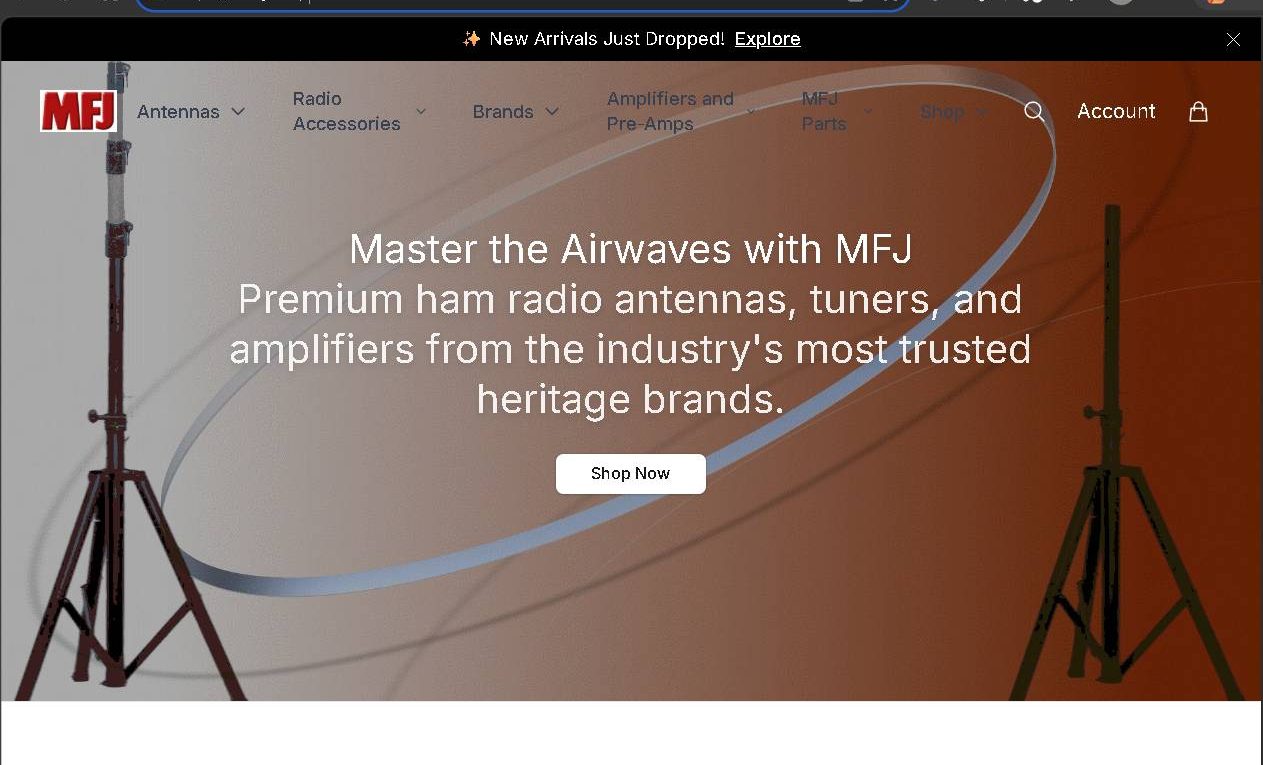
The storefront opens with an aesthetic designed to immediately reassure radio operators. The upper left corner displays the authentic, registered red-and-white MFJ logo. The hero banner displays ham radio antenna masts and a bold slogan: “Master the Airwaves with MFJ: Premium ham radio antennas, tuners, and amplifiers from the industry’s most trusted heritage brands.”
The navigation categorizes equipment cleanly into standard amateur radio groupings: Antennas, Radio Accessories, Brands, Amplifiers and Pre-Amps, MFJ Parts, and Shop. Yet behind this orderly navigation, the platform operates without legitimate warehouse links, functioning purely as a payment collection trap.
Suspicious Link or Courier SMS?
Verify URLs, APKs, or parcel alerts against our threat database before clicking.
What Mefij.shop Claims and Offers
- Extensive Phantom Inventory: Lists hundreds of factory-fresh MFJ manual tuners (such as the MFJ-949E and MFJ-993B IntelliTuner), antenna analyzers (MFJ-259D / MFJ-269D), and Ameritron linear amplifiers that are out of production and largely unavailable in new-in-box condition elsewhere.
- Steep Liquidation Discounts: Advertises heavy RF electronics at fraction-of-manufacturing rates, with high-end tuners normally trading for $250 to $400 offered for $69 to $89.
- Streamlined Cart & Account Flow: Includes functional user account registrations, shopping carts, and top announcement bars promoting “✨ New Arrivals Just Dropped! Explore” to mimic an active modern distributor.
- Broad Payment Interfaces: Prompts buyers into entering direct payment card credentials without providing trusted escrow-style buyer protections.
5 Critical Red Flags on Mefij.shop
1. Phonetic Typosquatting Domain Pattern
The official, historical web address for MFJ Enterprises is mfjenterprises.com. The clone domain Mefij.shop inserts an extra letter (“e”) into the acronym and deploys an inexpensive, disposable .shop top-level extension. Inserting extra letters to mirror an existing brand is a classic typosquatting technique designed to deceive hurried shoppers who glance casually at the browser address bar.
2. Phantom Inventory on Discontinued Factory Hardware
Following the closure of MFJ’s primary manufacturing facility in Starkville, Mississippi, verified retail distributors exhausted their remaining new-in-box inventory. A recently launched, obscure .shop storefront claiming to possess unlimited, brand-new stock across discontinued product lines is offering phantom items that do not exist.
3. Absurdly Low Prices on Copper- and Component-Heavy RF Gear
Linear RF amplifiers, roller inductors, and antenna tuners contain substantial amounts of copper wire, precision air-variable capacitors, toroidal cores, and heavy chassis steel. Because scrap metal, component sourcing, and domestic assembly dictate hard manufacturing costs, selling these items brand new for $60 to $80 is economically unfeasible. Deep, sitewide markdowns across specialized electronics are clear indicators of non-delivery fraud.
4. Absence of Corporate Identity and Physical Verification
The site lists no verifiable corporate headquarters address, business registration number, tax identification details, or customer service telephone lines. Genuine amateur radio distributors provide technical support desks staffed by licensed amateur operators. Mefij.shop routes all communication through disposable web forms and anonymous webmail, while its WHOIS ownership records are fully masked behind privacy proxies.
5. High Risk of Payment Skimming and Tracking Deception
Cloned hobby storefronts operate on two primary fraud vectors:
- Direct Financial Skimming: Capturing the cardholder’s 16-digit card number, CVV code, and expiration date to execute secondary fraudulent charges.
- Bait-and-Switch Delivery: Shipping a small, cheap item (such as an unbranded plastic keychain or foam sticker) via untraceable postal packets. The scammer uses the real tracking number from that delivery to claim “proof of fulfillment” against banking chargeback requests.
Action Plan: Practical Steps for Consumer Recovery & Protection
If you visited Mefij.shop or completed a transaction on the portal, take these immediate steps to safeguard your funds:
- File an Immediate Credit Card Chargeback: Contact the fraud department of your card-issuing bank right away. State clearly that you made a purchase on an unauthorized counterfeit clone website, report merchant fraud, and request a formal chargeback for non-delivery.
- Cancel and Replace the Compromised Card: Because the checkout form collected your card number, CVV, and expiration date directly, treat the card as compromised. Have your bank deactivate the number immediately and issue a replacement card with fresh credentials.
- Document and Archive Transaction Records: Save digital copies of your order confirmation receipt, transaction line items on your banking statement, screenshots of the product listings, and the exact website URL. This documentation provides vital evidence if your bank opens a merchant dispute.
- Beware of False Package Tracking Numbers: If the merchant provides a tracking code pointing to obscure third-party courier portals (e.g., 17Track, Track718), treat it with skepticism. Scammers use fabricated logistics networks to create false tracking scans and delay bank disputes.
- Buy Ham Gear Exclusively Through Verified Channels: When searching for MFJ or Ameritron equipment, purchase exclusively through established, authorized distributors (like DX Engineering or Ham Radio Outlet) or vetted amateur swap meets (such as QRZ Swaps or QTH.com) using protected payment methods like PayPal Goods and Services.
- Report the Scam Domain: File formal reports with the Federal Trade Commission (ReportFraud.ftc.gov), the FBI’s Internet Crime Complaint Center (IC3.gov), and Google Safe Browsing to help take down the clone infrastructure.
Frequently Asked Questions
Is Mefij.shop scam?
Yes, Mefij.shop is a fraudulent clone website. It steals the logos, trademarks, and catalog listings of MFJ Enterprises to harvest credit card data and collect payments without fulfilling orders.
Is Mefij.shop legit?
No, Mefij.shop is not a legit or authorized distributor. The legitimate manufacturer portal is mfjenterprises.com, and the genuine company has warned consumers about phishing sites mimicking its brand.
Why is the domain named “mefij” instead of “mfj”?
The operators use typosquatting—inserting the letter “e” between “m” and “f”—to intercept shoppers who misspell the brand name or glance quickly at a search link.
Where does the equipment on Mefij.shop come from?
The site does not have real stock. It uses scraped product descriptions and images from historic MFJ catalogs, listing discontinued tuners and amplifiers that it cannot source or deliver.
Can I get my money back if I purchased from Mefij.shop?
Yes, if you paid using a credit card, you can dispute the charge with your bank by requesting a fraud-related chargeback for merchant non-delivery. Debit card purchases carry narrower recovery windows, making fast contact with your bank critical.
Why does Mefij.shop show an HTTPS padlock icon?
The padlock symbol only verifies that data sent between your browser and the web server is encrypted via SSL. It does not verify the merchant’s business integrity, legal licensing, or ability to ship hardware.
What should I do if Mefij.shop sends a cheap plastic trinket instead of my tuner?
Photograph the package, the postal label, and the contents immediately. Present the photographs to your bank as evidence of a bait-and-switch transaction to support your chargeback claim.
How can I spot fake amateur radio websites?
Watch for lookalike domain names with unusual spelling or .shop extensions, discontinued equipment advertised at 60%+ markdowns, absent physical corporate addresses, and missing customer service phone numbers.
Every safe click counts. If this post helped, a coffee gesture fuels more scam‑busting investigations.

For more shady sites exposed, check our Shopping Scam Directory — your quick guide to staying safe online.
Help Us Spread Awareness
Please share this article to spread awareness. Follow us on social media for more scam alerts.