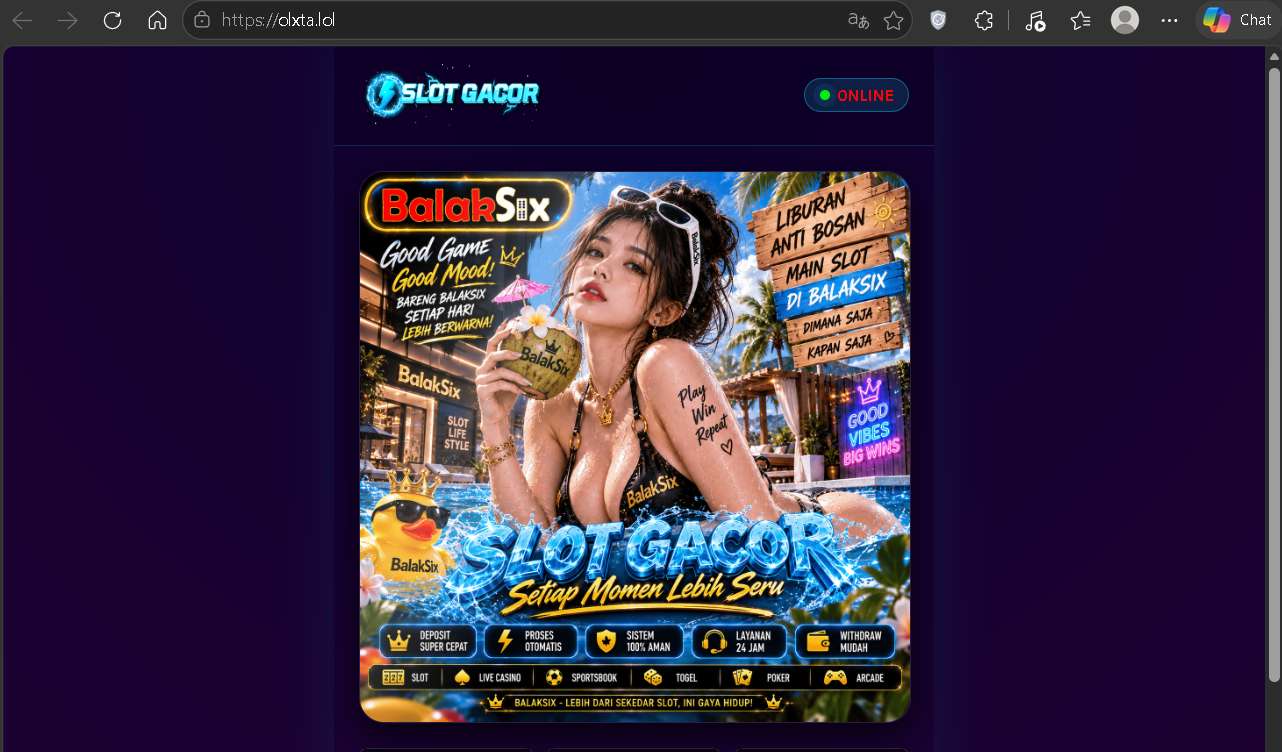
Inside Olxta.lol: Dissecting an Unregulated, Black-Market “Judi Online” (Judol) Scam
Digital fraud networks are increasingly deploying disposable web addresses like Olxta.lol to lure internet users into an unregulated, black-market “Judi Online” (Judol) scam. Operating under aggressive marketing banners and promises of instant riches, portals operating on cheap top-level domains are rarely benign gaming destinations. Instead, they function as high-risk traps engineered to capture your bank balance, siphon identity data, and bypass consumer fraud protections.
Understanding how these platforms manipulate unsuspecting gamblers requires a hard look at their underlying mechanics. When you encounter a domain like Olxta.lol, you are not stepping into a digital equivalent of a regulated brick-and-mortar casino where independent gaming commissions audit every spin.
You are entering an illicit cybercrime infrastructure built from the ground up to funnel capital out of retail bank accounts into untraceable payment networks. Here is an investigative breakdown of how these unregulated syndicates work, using Olxta.lol as a prime case study.
Suspicious Link or Courier SMS?
Verify URLs, APKs, or parcel alerts against our threat database before clicking.
Anatomy of the Secondary Threat: What Is an Unregulated, Black-Market “Judi Online” Scam?
To evaluate Olxta.lol accurately, one must first demystify the multi-billion-dollar shadow economy known across Southeast Asia and global internet safety communities as the judi online (“judol”) black market.
At its foundation, an unregulated judol operation is an illegal online gambling network that circumvents national banking protocols, anti-money laundering (AML) controls, consumer gaming authorities, and data privacy legislation. While legitimate iGaming entities obtain licenses from recognized statutory bodies—such as the Malta Gaming Authority (MGA), the UK Gambling Commission (UKGC), or the Isle of Man Gambling Supervision Commission—unregulated syndicates operate completely in the shadows.
These illicit syndicates share three foundational pillars:
- Uncertified Random Number Generators (RNG): Fair platforms subject their software code to third-party audits by independent testing labs like eCOGRA, BMM Testlabs, or iTech Labs. In black-market judol setups, the game algorithms run on proprietary or pirated backend scripts where operators can manually calibrate payouts, RTP (Return to Player) percentages, and house edges at will.
- Layered Financial Funnels: Because legitimate merchant accounts and standard payment gateways (like Visa, Mastercard, or authorized automated clearing houses) block illegal gambling merchants, judol operators channel player funds through shell company bank accounts, automated QRIS gateways, prepaid virtual wallets (e-wallets), and compromised “money mule” retail checking accounts.
- Cyber Evasion Infrastructure: Authorities continuously block and blacklist illicit gambling domains. To survive, operators run massive domain-mirroring syndicates. They purchase hundreds of low-cost TLDs (such as
.lol,.top,.xyz, or.vip) and redirect traffic invisibly as soon as regulatory bodies issue takedown notices.
Player Safety Blueprint: Prevention Rules & Actionable Solutions
Protect your digital assets before interacting with unverified gambling mirrors, or follow the mitigation sequence if you have already shared data.
Never pay secondary “clearance taxes,” “unlock fees,” or “verification deposits.” Unregulated syndicates use these requests to extract extra funds before blocking your account.
Uninstall any browser-downloaded package immediately. Reboot into Safe Mode, run an updated antivirus scan, and revoke any suspicious SMS or Accessibility permissions.
Reset passwords on any email accounts, crypto wallets, or payment platforms that shared login credentials with the mirror site. Turn on app-based 2FA (e.g., Google Authenticator).
If you deposited using debit or credit rails, call your issuing bank’s dispute desk immediately to file a chargeback under merchant fraud or failure of service delivery.
Report and block WhatsApp or Telegram spam numbers. Ignore third-party “fund recovery agents” claiming they can hack back your balance for an upfront retainer.
Case Study: Olxta.lol Under the Microscope
When navigating directly to Olxta.lol, visitors encounter a digital storefront operating under the visual brand name BalakSix, prominently decorated with the buzzword phrase “Slot Gacor”.
The phrase “Slot Gacor” translates culturally to a machine or digital reel that is supposedly “leaking” or exceptionally “easy to hit jackpots on.” The site pairs hyper-saturated graphics, tropical beach vacation imagery, and suggestive model photography with high-energy claims designed to trigger impulse decision-making.
What the Platform Publicly Claims and Offers
Like many white-label offshoots targeting the Indonesian-speaking digital sphere, Olxta.lol markets a comprehensive suite of betting choices:
- Digital Slots (Slot Gacor): Presented as algorithmically loose machines delivering rapid wins.
- Live Casino Suites: Featuring classic table games like baccarat, roulette, and blackjack, often streaming bootlegged feeds.
- Sportsbook & Togel (Lotteries): Fixed-odds wagering across international sports markets alongside traditional Southeast Asian lottery pools.
- Peer-to-Peer Poker and Mini Arcades: Fast-paced digital games designed to attract micro-stakes bettors.
- Operational Promises: The user interface explicitly advertises “Deposit Super Cepat” (super-fast deposits), automated processing, 24/7 customer service, and guaranteed “Withdraw Mudah” (effortless withdrawals).
The Technical Reality: How Olxta.lol Actually Works
Behind the slick interface lies a standard white-label script engineered to facilitate capital extraction rather than fair entertainment.
- The Entry & Data Extraction Phase: The registration funnel requires a user’s mobile number, national bank account number (or e-wallet ID), and full legal name. Even prior to depositing cash, the user has handed critical Personally Identifiable Information (PII) to an unverified entity.
- The “Honey-Trap” Dopamine Loop: Upon deposit via peer-to-peer bank transfer or digital wallet, the user is fed manipulated gaming loops. New users often experience rapid, small “wins” on early spins. This psychological priming is intentional: it builds false confidence and persuades the victim to increase their initial deposit size.
- The Withdrawal Blackout: The true nature of Olxta.lol emerges during cash-out requests. Once a user triggers a significant withdrawal, the platform imposes artificial friction:
- Excessive Turnover Hurdles: Players are told their turnover ratio is inadequate, forcing them back onto rigged reels until their account balance evaporates.
- Advance-Fee Extortion: Support agents claim the account is flagged for “suspicious activity” or “tax validation,” demanding an additional 10% to 30% cash deposit before funds can clear.
- Hard Freezes: If the user refuses to deposit more money, access to the portal is abruptly terminated, the account is locked, and live chat agents cease communication.
5 Major Red Flags Uncovered on Olxta.lol
+-----------------------------------------------------------------------------------+
|                           OLXTA.LOL RED FLAG AUDIT                                |
+------------------------------------+----------------------------------------------+
| Factor                             | Threat Assessment                            |
+------------------------------------+----------------------------------------------+
| 1. Disposable Domain Choice (.lol) | Critical evasion tactic for cycling mirrors  |
| 2. Total Lack of Gaming Licenses   | Zero regulatory compliance or player safety  |
| 3. Unverifiable Corporate Entity   | Anonymous WHOIS, untraceable shell ownership |
| 4. Unregulated Payment Routing     | Relies on private mule accounts & P2P wallets|
| 5. Advance-Fee Withdrawal Barriers | Classic hallmark of predatory financial scams|
+------------------------------------+----------------------------------------------+
1. The Use of a Disposable, High-Churn Top-Level Domain (.lol)
Legitimate financial service providers, licensed gaming platforms, and authorized iGaming enterprises do not build long-term brands on novelty top-level domains like .lol. Fraud rings specifically acquire cheap TLDs in bulk because they expect each domain to be flagged, blacklisted, or seized within weeks by internet service providers and cybersecurity filters.
2. Complete Absence of Accredited Regulatory Licensing
A certified gaming venue will always link to an active, verifiable licensing register (such as Curacao eGaming, PAGCOR, or European gaming boards) complete with a public registration license number. Olxta.lol displays zero authentic statutory licensing certificates. There is no external authority monitoring the code fairness, payout ratios, or reserve liquidity of the platform.
3. Masked Ownership and Shell Operator Footprint
A standard WHOIS infrastructure audit reveals hidden ownership credentials, privacy-redacted administrative profiles, and hosting infrastructure designed to obscure physical location. When an operation refuses to list its parent corporation, physical business address, or data protection officer, you have no legal recourse when your funds are compromised.
4. Direct P2P and Mule-Account Banking Rail Usage
When initiating deposits on these networks, users are rarely redirected to authorized commercial merchant processors. Instead, they are instructed to transfer funds directly to individual personal names on local banking networks or secondary digital wallets. These recipient accounts are almost always “mule accounts”—stolen or bought identities used by money-laundering networks to obfuscate transaction trails.
5. Predatory Withdrawal Conditions & Advance-Fee Demands
No legitimate, licensed gaming portal requires players to pay separate “activation fees,” “anti-fraud clearance deposits,” or “unlocking taxes” to release their existing account balances. Such demands are textbook markers of advance-fee financial fraud.
Consumer Protection: What to Do If You Interacted with Olxta.lol
If you have already entered personal details or deposited capital onto Olxta.lol, take the following risk mitigation steps immediately:
- Halt All Further Transactions: Never send additional funds to “unlock” an existing balance. Any subsequent deposit will also be stolen.
- Protect Your Banking Credentials: If you supplied your primary checking account number or used shared passwords, immediately contact your bank’s fraud monitoring division. Request a freeze on unauthorized outbound direct debits and change your online banking login credentials immediately.
- Monitor Identity Footprints: Scammers routinely bundle unverified casino registration logs into identity theft packets sold across unindexed dark web markets and private messaging channels. Consider setting up a credit monitoring freeze or fraud alerts with major credit reporting agencies if you submitted sensitive financial details.
- File Official Cybercrime Reports: Submit the domain and payment transaction hashes/receipts to your country’s national cybersecurity agency or financial crime reporting portal (such as the FBI’s IC3, the UK’s Action Fraud, or Indonesia’s Aduan Konten / CekRekening.id initiative).
Frequently Asked Questions (FAQ)
1. Is Olxta.lol a scam?
Yes. Olxta.lol displays the definitive hallmarks of an unlicensed, predatory black-market gambling trap. It utilizes disposable infrastructure, lacks authentic gaming licenses, uses manipulated game algorithms, and creates deliberate withdrawal friction that prevents players from retrieving deposited funds.
2. Is Olxta.lol legit?
No. Olxta.lol is not a legitimate online casino or licensed gaming platform. It operates completely outside standard financial regulations, lacks recognized auditing certifications, and obscures its operational ownership to evade law enforcement and consumer protection authorities.
3. How does the unregulated, black-market “Judi Online” (Judol) scam manipulate game results?
Because these websites do not use software audited by accredited labs (like eCOGRA or iTech Labs), operators utilize rigged backend scripts. They can artificially boost winning hit frequencies during a player’s initial sessions to build false confidence, only to throttle payout odds to zero once larger wagers are made.
4. Why does Olxta.lol use a .lol domain name?
The operators register cheap, disposable domains like .lol because internet service providers and regulatory bodies frequently block these sites. When one domain is seized or added to a spam blacklist, the syndicate redirects traffic to an identical mirror clone under a new, disposable URL.
5. Can I recover money lost to an illegal online slot scam like Olxta.lol?
Direct fund recovery from unlicensed platforms is extremely difficult because transactions are routed through third-party money mule accounts, untraceable e-wallets, or decentralized crypto networks. You should report the transaction to your financial institution’s fraud unit immediately, but beware of secondary “recovery scammers” who promise guaranteed refunds for an upfront fee.
6. What are the identity theft risks associated with registering on Olxta.lol?
Registering on unverified slot sites exposes your phone number, email, and personal banking identifiers. Illicit networks routinely package and sell these contact lists across private messaging channels, exposing victims to targeted phishing attacks, credential stuffing, and unauthorized identity misuse.
7. What does the term “Slot Gacor” mean on sites like Olxta.lol?
“Slot Gacor” is an Indonesian slang phrase used by black-market operators to describe a slot machine that is supposedly “leaking winnings” or guaranteed to pay out easily. In practice, it is a psychological marketing hook used by illicit operators to entice users to deposit real funds into rigged games.
8. How can I differentiate between a legal iGaming platform and an unregulated black-market site?
Legitimate platforms operate in jurisdictions where online betting is strictly licensed and regulated. They clearly display interactive validation seals from recognized regulatory authorities (such as MGA, UKGC, or state gaming control boards), process payments through recognized commercial merchant gateways, and subject their software to public, third-party fair play audits. Unregulated sites operate anonymously, use novelty or disposable domains, rely on peer-to-peer mule transfers, and carry no verified oversight.
Every safe click counts. If this post helped, a coffee gesture fuels more scam‑busting investigations.

Help Us Spread Awareness
Please share this article to spread awareness. Follow us on social media for more scam alerts.