Greencash-Lending Review: Is Greencash-lending.com Legit or a Loan Scam?
When borrowers face sudden emergencies, searching for Greencash-lending often directs them toward a high-risk, unverified loan portal / lead-generation trap designed to extract deeply personal records rather than provide direct funding. In an era where online cash advances promise instant relief, understanding the line between authentic financial institutions and speculative data funnels is vital for consumer identity protection.
Submitting confidential banking information, identity documents, and employment histories to unvetted credit websites introduces substantial financial vulnerability. Examining the mechanics behind these ephemeral credit platforms reveals how data-harvesting funnels capture high-value consumer files while offering zero lending liability or verifiable regulatory oversight.
Anatomy of Unverified Loan Portals: How Data Brokering Replaces Underwriting
A high-risk, unverified loan portal / lead-generation engine does not operate as a direct credit provider or chartered financial institution. Instead of lending its own capital, the entity functions as an unregulated digital clearinghouse that monetizes applicant desperation:
- Information Arbitrage: Rather than evaluating creditworthiness through compliant bureau underwriting, these portals collect comprehensive personal files (Social Security numbers, national identity credentials, active bank routing strings, and employer phone records) to compile high-value lead packets.
- Secondary Market Brokering: Once an application form is completed, the site distributes that consumer dossier across shadow networks of payday lenders, aggressive debt consolidation agencies, telemarketing boiler rooms, and offshore marketing aggregators.
- Absence of Truth in Lending Compliance: Regulated financial lenders must explicitly publish transparent Annual Percentage Rates (APR), default terms, origination charges, and statutory disclosures mandated under the Truth in Lending Act (TILA). Lead funnels omit these frameworks because they assume zero lending risk.
- Advance-Fee Phishing Vectors: Unregulated portals frequently serve as feeder mechanisms for advance-fee credit schemes. Unsuspecting applicants receive phone calls or text messages declaring that their loan has been approved, contingent upon a prerequisite “insurance deposit,” “clearing fee,” or “wire verification transfer.”
Suspicious Link or Courier SMS?
Verify URLs, APKs, or parcel alerts against our threat database before clicking.
Case Study: Investigating Greencash-Lending (greencash-lending.com)
The website greencash-lending.com illustrates the exact architectural pattern of an ephemeral credit lead-harvesting funnel targeting borrowers in immediate financial distress.
What the Platform Claims and Offers
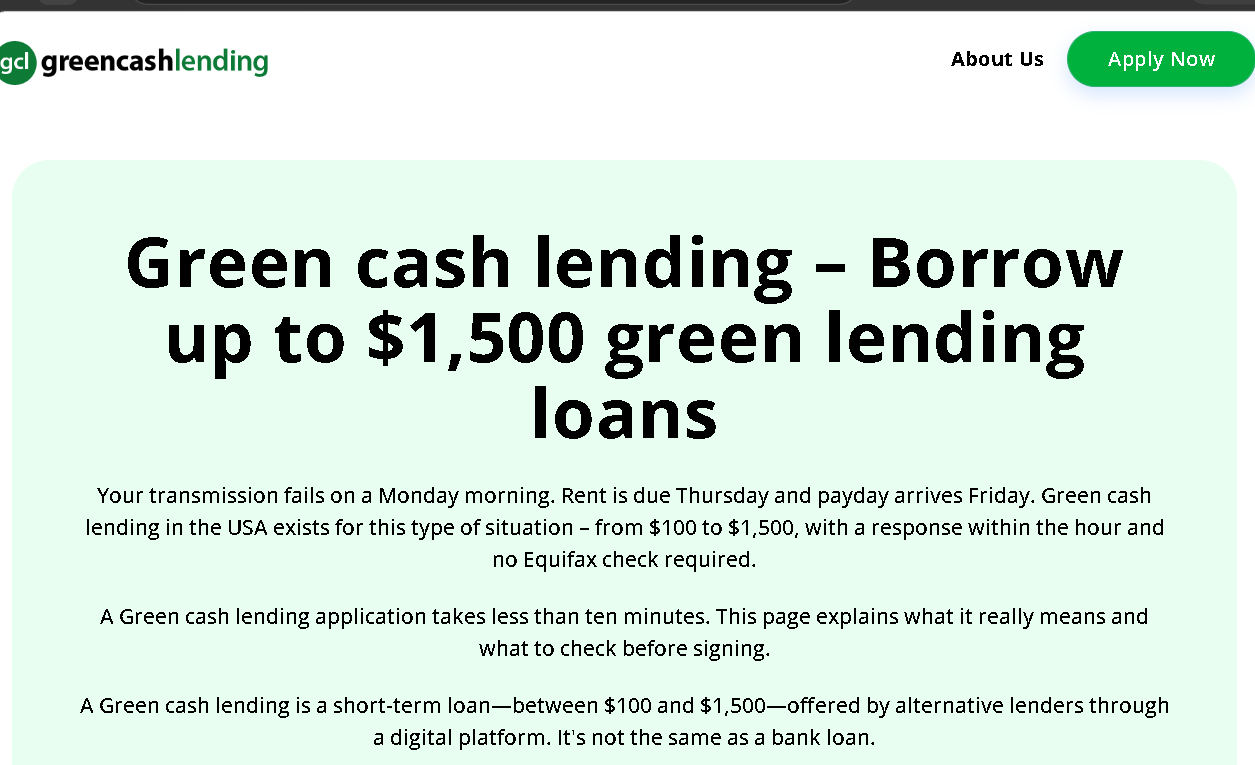
Greencash-lending presents itself as a streamlined emergency cash solution tailored for US consumers encountering shortfalls, citing sudden car repairs or impending rent deadlines. The platform advertises short-term advances ranging from $100 up to $1,500 with promises of application turnaround “within the hour” and explicitly claims “no Equifax check required”. The visual presentation centers around a straightforward “Apply Now” funnel designed to persuade visitors to complete a comprehensive financial application in under ten minutes.
Email: ApexLegalSolutionsMumbai@gmail.com
The Operational Reality: How the Site Works
Behind the simple interface, Greencash-lending displays the structural mechanics of an unregulated lead gateway:
- Intake of Sensitive Consumer Identifiers: The platform functions as a front-end form that systematically gathers identity markers, residential history, banking coordinates, and income metrics.
- Third-Party Arbitrage Routing: The portal does not underwrite the debt on its own balance sheet. The platform explicitly notes that funds are offered by “alternative lenders through a digital platform” rather than an established direct bank.
- Monetization via Lead Distribution: Applicants rarely receive a clear, binding loan offer directly from the web domain. Instead, the collected records are sold down lead pipelines to high-interest alternative lenders, triggering waves of unsolicited communications across email, phone, and text channels.
- Complete Legal Disconnection: If an affiliated third party deploys predatory terms, aggressive debt collections, or high daily interest rates, the portal bears no legal accountability because it operates merely as an unverified matching intermediary.
Every safe click counts. If this post helped, a coffee gesture fuels more scam‑busting investigations.

5 Critical Red Flags Uncovered on Greencash-Lending
1. Brand-New Domain Profile with Concealed Ownership
Domain registration audits reveal that greencash-lending.com was activated on September 30, 2026. Legitimate banking organizations spend years establishing operational integrity and public licensing, whereas this platform appeared overnight with all WHOIS registrant details masked behind proxy shields.
2. Lack of Required Statutory Lending Disclosures
State and federal consumer credit protection statutes require any platform soliciting consumer loans in the United States to publish licensing details, representative APR examples, maximum loan terms, physical headquarters addresses, and explicit TILA disclosures. Greencash-lending provides high-level text summaries while omitting transparent corporate licensing numbers and jurisdictional filings.
Direct online lenders and secure fintech institutions process banking data over dedicated, hardened servers governed by strict SOC 2, ISO 27001, and PCI-DSS compliance frameworks. Greencash-lending is hosted on shared budget web servers (Bluehost / Newfold Digital) alongside thousands of unrelated commercial websites, an infrastructure standard that falls short of data security requirements for managing financial records.
4. “No Credit Check” Bait Tactics
Promising loans up to $1,500 with “no Equifax check required” is an established marketing tactic used to pull in credit-compromised applicants. Direct institutions always verify credit capacity; claims of skipping basic underwriting checks often mask data-gathering portals or lenders charging high effective APRs.
5. Absence of Verified Physical Operations or Direct Support
The platform lacks an identifiable commercial address, direct corporate registration numbers, or inbound telephone support desks staffed by licensed loan officers. Users have no verified recourse, legal entity name, or physical office to hold accountable once their data is submitted.
Consumer Protection: Steps to Take if You Submitted Your Data
If you completed an online form on an unverified platform like Greencash-lending, protect your personal identity and financial accounts immediately:
- Place a Credit Freeze with Major Bureaus: Contact Equifax, Experian, and TransUnion to freeze your credit files. This stops identity thieves or unauthorized lenders from taking out new credit lines in your name.
- Alert Your Financial Institution: Inform your bank that your account and routing numbers were shared on an unverified web platform. Request proactive monitoring for unauthorized Automated Clearing House (ACH) withdrawals, or consider migrating funds to a clean checking account.
- Monitor for Advance-Fee Inquiries: Completely ignore any caller, email, or message claiming you are approved for a loan but must first wire funds, purchase gift cards, or pay an upfront “processing fee.” Authentic lenders deduct fees directly from loan proceeds; they never demand advance transfers.
- Report to Regulatory Watchdogs: File identity theft and fraud advisories with the Federal Trade Commission (FTC at IdentityTheft.gov or ReportFraud.ftc.gov) and notify your state Attorney General’s consumer protection bureau.
Frequently Asked Questions
Is Greencash-lending a scam?
Greencash-lending displays severe consumer risk profiles, including a domain created in late 2026, hidden ownership, unverified licensing, and budget web hosting. Because it functions as an unverified lead portal rather than a licensed direct lender, submitting sensitive personal and banking details carries substantial identity theft and predatory lending risks.
Is Greencash-lending legit?
No verifiable evidence supports Greencash-lending as a legitimate, regulated financial lending institution. It lacks state-by-state credit licensing, published TILA disclosures, physical corporate addresses, and direct underwriting facilities.
What is a high-risk, unverified loan portal / lead-generation site?
A high-risk, unverified loan portal / lead-generation site is a website that advertises fast cash or unsecured emergency loans to gather personal, employment, and banking details. Instead of lending money directly, it sells applicant data to external broker networks, exposing users to telemarketing spam, high-interest debt, or phishing schemes.
How do unverified loan sites make money if they do not fund loans?
These portals generate revenue by selling completed consumer profiles as qualified leads. Lenders, collection services, and third-party marketers pay the site operator for each applicant packet containing verified contact, income, and banking credentials.
What should I do if a lender asks for an upfront fee before releasing funds?
Never send money to receive a loan. Demanding upfront fees for insurance, collateral, or transfer processing is an indicator of an advance-fee loan scam. Legitimate financial institutions deduct closing charges directly from the loan payout.
How can I verify if an online lender is legally registered?
Check your state’s department of financial institutions or banking regulator database to verify that the company holds an active lending or loan broker license. Furthermore, ensure the lender publishes an active NMLS (Nationwide Multistate Licensing System) identifier and compliant APR disclosures.
Why is applying for “no credit check” loans dangerous on new websites?
Websites promising guaranteed approvals without checking credit history frequently use that claim as bait to capture information from financially stressed consumers. Once captured, your details can be shared across unvetted networks or targeted with predatory terms exceeding statutory interest rate caps.
How do I stop unsolicited calls after using a loan lead generator?
Register your phone numbers on the National Do Not Call Registry, place fraud alerts on your credit files, deploy spam-call filtering applications, and never confirm personal details over inbound calls from unfamiliar lending agencies.
For more shady sites exposed, check our Shopping Scam Directory — your quick guide to staying safe online.
Help Us Spread Awareness
Please share this article to spread awareness. Follow us on social media for more scam alerts.