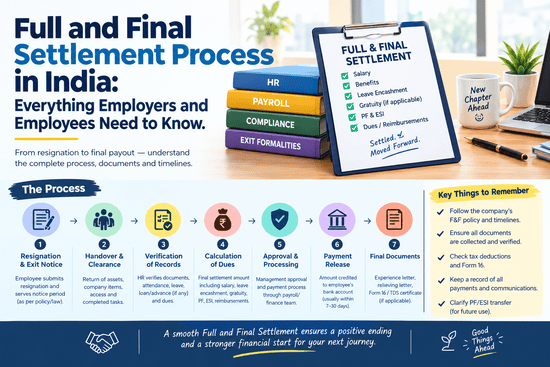
Full and Final Settlement Process in India: Everything Employers and Employees Need to Know
Employee exits are inevitable. What truly defines an organization’s professionalism, however, is not just how it welcomes employees but how it handles their departure.
Imagine this: an employee serves a company for three years, completes a smooth handover, returns all company assets, and looks forward to receiving their final dues. Weeks pass, emails go unanswered, and there’s confusion regarding salary, leave encashment, and notice pay adjustments. What should have been a positive exit experience quickly turns into frustration.
This is precisely why the Full and Final (F&F) Settlement process is one of the most critical responsibilities of HR and payroll teams.
A timely and transparent settlement process demonstrates organizational integrity, strengthens employer branding, reduces legal disputes, and leaves departing employees with a positive impression. In today’s world of Glassdoor reviews, LinkedIn networks, and employee referrals, the exit experience matters just as much as the onboarding experience.
This comprehensive guide explains the Full and Final Settlement process in India, its components, timelines, compliance requirements, and best practices for HR professionals and employers.
What is Full and Final Settlement?
Full and Final Settlement (commonly referred to as F&F Settlement) is the process through which an employer settles all financial obligations owed to an employee upon separation from the organization.
The objective is simple: ensure that both parties have cleared all pending dues before formally ending the employment relationship.
The settlement typically includes:
- Pending salary
- Leave encashment
- Gratuity (if applicable)
- Incentives and bonuses
- Reimbursement claims
- Notice period adjustments
- Recoveries and deductions
- Other contractual payments
Once processed, the employee receives a detailed settlement statement outlining all earnings, deductions, and the final amount payable.
Why Full and Final Settlement Matters
Many organizations view F&F settlement as a payroll activity. In reality, it is a crucial employee experience and compliance function.
A structured settlement process helps organizations:
Maintain Legal Compliance
Employers are expected to clear applicable dues within prescribed timelines and maintain proper records.
Protect Employer Brand
Departing employees often become future clients, referral sources, or even rehires. A smooth exit leaves a lasting positive impression.
Reduce Disputes
Transparent calculations and proper documentation significantly minimize future disagreements.
Enhance Employee Trust
Even when employees leave, timely settlements demonstrate fairness and professionalism.
From an HR perspective, I have often observed that employees may forget office perks or team outings, but they rarely forget delays in receiving their final settlement. A well-managed F&F process can transform an exit into a positive final touchpoint.
Situations Where Full and Final Settlement Applies
The F&F settlement process is initiated whenever an employment relationship comes to an end, including:
- Resignation: When an employee voluntarily chooses to leave the organization.
- Retirement: Upon completion of service tenure or attainment of retirement age.
- Termination: When employment is ended by the employer.
- Contract Completion: For employees engaged under fixed-term arrangements.
- Layoffs or Organizational Restructuring: In cases involving workforce reduction or restructuring exercises.
- Absconding Cases: Even when employees leave without notice, organizations are required to calculate payable and recoverable amounts appropriately.
Components of Full and Final Settlement
One of the most common reasons for employee disputes is a lack of understanding about what forms part of the final settlement. Let’s break down each component.
1. Unpaid Salary
This includes salary payable from the previous payroll cycle until the employee’s last working day.
For example, if payroll is processed monthly and an employee leaves on the 18th of the month, salary for the days worked during that period must be calculated and included in the settlement.
2. Leave Encashment
Many organizations allow employees to encash accumulated earned or privileged leave balances at the time of separation.
Example
Monthly Gross Salary: ₹60,000
Unused Earned Leaves: 12 Days
Per-Day Salary = ₹60,000 ÷ 30
Per-Day Salary = ₹2,000
Leave Encashment = ₹2,000 × 12
Total Leave Encashment = ₹24,000
The exact calculation methodology may vary depending on company policy.
3. Notice Period Recovery or Notice Pay
Notice period handling is one of the most important elements of F&F settlement.
Employee Serves Full Notice: No adjustments are required.
Employee Leaves Early: Organizations may recover salary equivalent to the unserved notice period.
Company Waives Notice: In some cases, employers release employees immediately and compensate them according to employment terms.
Proper documentation is essential to avoid misunderstandings.
4. Bonus and Variable Pay
Depending on company policies, employees may be eligible for:
- Performance bonuses
- Annual incentives
- Sales incentives
- Retention bonuses
- Productivity-linked rewards
The eligibility criteria should be clearly defined in employment contracts or compensation policies.
5. Gratuity
Gratuity is a long-term service benefit available to eligible employees.
Employees who complete the required period of continuous service may qualify for gratuity payments as applicable under relevant provisions.
Common Formula
Gratuity = (Last Drawn Salary × 15 × Completed Years of Service) ÷ 26
Many organizations process gratuity alongside the Full and Final Settlement process.
6. Reimbursements
Employees often have approved business expenses pending reimbursement.
These may include:
- Travel expenses
- Internet reimbursements
- Mobile reimbursements
- Client meeting expenses
- Business-related purchases
All approved claims should be settled before employee separation is formally closed.
7. Recoveries and Deductions
Not every F&F statement results in money payable to the employee alone.
Organizations may recover:
- Salary advances
- Employee loans
- Excess leave taken
- Asset damage costs
- Notice period recoveries
- Tax deductions
Transparency is critical here. Every deduction should be properly documented and communicated.
Step-by-Step Full and Final Settlement Process
A structured approach helps organizations process settlements accurately and efficiently.
Step 1: Separation Initiation
The process begins when:
- A resignation is accepted
- A retirement request is approved
- A termination decision is finalized
HR officially initiates the separation workflow.
Step 2: Exit Clearance Process
Multiple departments are involved in verifying employee obligations.
IT Department
- Laptop return
- Software access removal
- Email deactivation
Administration
- ID cards
- Access cards
- Parking permits
Finance Department
- Expense verification
- Loan reconciliation
- Advance recovery
Reporting Manager
- Project handover
- Knowledge transfer completion
- Team transition confirmation
Until all clearances are completed, settlement calculations may remain pending.
Step 3: Attendance and Leave Verification
HR validates:
- Last working day
- Attendance records
- Leave balance
- Notice period compliance
Accuracy at this stage directly affects payment calculations.
Step 4: Settlement Calculation
Payroll teams calculate:
Earnings
✅ Pending Salary
✅ Leave Encashment
✅ Bonus Payments
✅ Incentives
✅ Reimbursements
Deductions
✅ Tax Deductions
✅ Notice Recovery
✅ Loan Recovery
✅ Asset Recovery
The final payable amount is then determined.
Step 5: Review and Approval
Most organizations follow a multi-level approval process involving:
- HR
- Payroll
- Reporting Manager
- Finance Team
Approvals ensure accuracy and compliance.
Step 6: Payment Processing
Once approved, funds are transferred directly to the employee’s bank account.
The employee generally receives:
- Full and Final Settlement Statement
- Salary Slip
- Relieving Letter
- Experience Letter
- Tax-related documents (if applicable)
Common Challenges in Full and Final Settlement
Even well-structured organizations encounter challenges.
Delayed Asset Return
Employees occasionally hold company assets beyond their last working day.
Best Practice: Create a digital asset-tracking checklist during onboarding itself.
Payroll Calculation Errors
Manual calculations increase the risk of mistakes.
Best Practice: Use automated payroll and HRMS systems.
Delayed Approvals
Approvals from multiple stakeholders can slow the process.
Best Practice: Implement workflow automation tools.
Poor Communication
Employees often become anxious when they are unaware of settlement status.
Best Practice: Provide periodic updates and expected timelines.
How HR Technology Simplifies F&F Settlement
Modern HR and payroll platforms significantly streamline the settlement process.
Organizations increasingly use HRMS solutions to:
- Calculate leave encashment automatically
- Track notice periods
- Generate settlement reports
- Monitor approvals
- Maintain compliance records
- Reduce manual intervention
Automation not only improves speed but also enhances accuracy and employee confidence.
Best Practices for HR Professionals
High-performing HR teams follow several proven practices:
Standardize the Process
Create clear exit checklists and approval workflows.
Maintain Transparency
Share detailed breakup sheets explaining all calculations.
Process Settlements Promptly
The faster the settlement, the better the employee experience.
Conduct Exit Audits
Review completed settlements periodically to identify process gaps.
Leverage HRMS and Payroll Tools
Automation reduces administrative workload and minimizes errors.
Frequently Asked Questions
How long does Full and Final Settlement take in India?
The timeline varies based on company policies, clearance requirements, and payroll cycles. Many organizations aim to complete settlements within 30-45 days after the last working day.
Is leave encashment included in F&F settlement?
Yes. Eligible leave balances are generally encashed according to company policy.
Can organizations deduct notice pay from F&F settlement?
Yes, if an employee does not serve the required notice period and the employment agreement permits such recovery.
Is gratuity included in Full and Final Settlement?
Eligible employees may receive gratuity as part of their final settlement process.
What documents are provided after settlement?
Organizations commonly issue a settlement statement, relieving letter, experience letter, and final payslip.
Final Thoughts
The Full and Final Settlement process is far more than an administrative formality. It is the final reflection of an organization’s culture, professionalism, and commitment to employee experience.
Companies invest significant effort in attracting, hiring, and retaining talent. Yet the exit experience often receives less attention than it deserves. A delayed or inaccurate settlement can overshadow years of positive employment experiences, while a smooth and transparent process reinforces trust and goodwill.
For HR leaders, payroll professionals, and business owners, the goal should not simply be to “close an employee record.” The objective should be to create a respectful and seamless departure experience that safeguards compliance, strengthens employer branding, and leaves employees feeling valued even as they move on to their next opportunity.
Because in today’s interconnected professional world, how an employee leaves your organization often becomes part of the story they tell about it.
Sweta Rawat is an HR professional with over 2.5 years of experience and an MBA in Human Resources. She writes on modern HR practices, employee engagement, and workplace culture, blending professional expertise with creative insight.