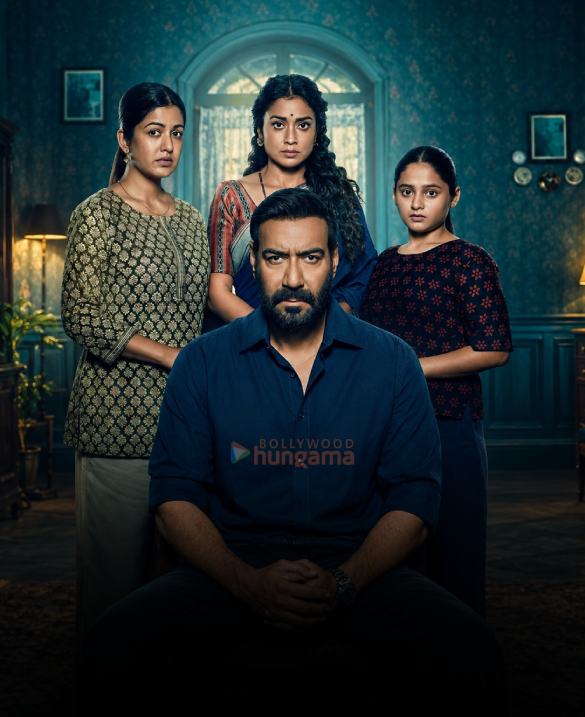
Drishyam 3: The Conclusion Review & Analysis — How Vijay Salgaonkar Weaponized Human Psychology
By Suyesh Gusain
“A common man becomes a silent beast when danger comes for his family.”
In the high-stakes universe of Drishyam, we witness an ordinary, fourth-grade-fail cable operator named Vijay Salgaonkar standing against the full might of the State. In Drishyam 3: The Conclusion, the tension escalates into a gripping standoff where an elite legal team, an IG, an SP, and seasoned investigators try to pin down an airtight murder case against one man.
Yet, Vijay goes to extraordinary lengths to shield his household. The narrative transcends conventional notions of right and wrong. As the protagonist reflects, truth shifts depending on angle and perspective—and so does the meaning of justice. From the opening frame of the original film to the climax of this finale, Vijay pursues a single, unyielding objective: to save his family.
Quick Facts: Drishyam 3: The Conclusion
The Genius of Vijay’s Strategy: Perception as a Weapon
The most compelling aspect of the entire franchise is that Vijay does not commit secondary grave crimes to mask his family’s initial act of self-defense. Instead, he weaponizes perception. He constructs narratives and orchestrates timelines strictly according to his own master plan. Right down to the final act, he stays steps ahead of everyone attempting to build a prosecution.
The twists in Drishyam 3 elevate the stakes far beyond its predecessors. Originally conceived by Jeethu Joseph, the character of Vijay is written with extraordinary narrative balance, and Ajay Devgn delivers a career-defining performance.
What stands out most is Vijay’s immense patience—the deadliest weapon a person can possess. He never allows emotional distress or tactical retreats to compromise his composure or peace of mind. Every move is calculated, cold, and patient, making it nearly impossible for police officers and seasoned prosecutors to decipher his playbook. His unwavering temperament is the decisive factor that allows a common man to outmaneuver institutional power.
The Forensic Chessboard: Why the State Keeps Failing
The Hindi adaptation, directed by Abhishek Pathak, honors the core philosophy that words create visuals, and visuals create the story. Vijay triumphs because he forces his opponents to view the facts exclusively through his narrative lens.
1. The Anatomy of an Airtight Defense
In Indian criminal jurisprudence, securing a conviction without a direct eyewitness demands an unbroken chain of circumstantial evidence. Under Section 27 of the Indian Evidence Act, any discovery made through an accused person’s disclosure must be corroborated with untampered physical custody. Vijay understands the system’s strict forensic demands better than the authorities realize. By ensuring that timelines, receipts, and biological traces leave room for reasonable doubt, he dismantles the prosecution before the case ever reaches final arguments.
2. The Police’s Fatal Mistake
Jaideep Ahlawat steps into the role of SP Crime Branch, exuding the gritty, imposing presence expected of a seasoned investigator. Yet, his character repeats the exact psychological mistake made by earlier officers: he crosses the threshold of Vijay Salgaonkar’s home and threatens his family.
The police strategy was straightforward: rattle Vijay, make him nervous, and turn his family from his greatest strength into an exploitable vulnerability. The investigators openly state that they will not underestimate him simply because he is a fourth-grade-fail. Yet, by subjecting his family to intimidation, they inadvertently hand him the ultimate motivation to fight back harder.
3. The Script and Dialogue
From a directorial standpoint, Pathak maintains sharp pacing, keeping viewers guessing as layers of deception unravel. If there is one critique, it lies in the dialogue. The script occasionally lacks those singular, unforgettable punchlines that stay with the audience long after leaving the cinema hall, relying instead on plot momentum to carry the weight.
The Catalyst for a New Chapter: Meera Deshmukh’s Arc
Strong screenwriting requires clear, organic character motivation. Following the events of Drishyam 2, Sameer’s father, Mahesh Deshmukh (Rajat Kapoor), wanted closure. What compelling force pulls him back into the legal fray to reopen the investigation?
The answer is rooted deep in human psychology. Tabu reprises her role as Meera Deshmukh—once an iron-willed IG and one of Goa’s most formidable figures. Consumed by the unresolved grief and guilt of failing to secure justice for her son, her mental health collapses, culminating in an attempt on her own life.
Witnessing this once-invincible woman driven to absolute helplessness shatters Mahesh. Her suicide attempt becomes the singular emotional catalyst powerful enough to reignite the case, setting off the climactic legal clash in Drishyam 3.
Here is the consolidated, deduplicated set of FAQs. The overlapping questions regarding the reopening trigger and the forensic/legal body-discovery hurdles have been merged into unified, high-intent entries covering both the plot motivations and legal mechanics.
Frequently Asked Questions (FAQ)
1. Why was the Sam Deshmukh case reopened in Drishyam 3 after Mahesh wanted to move on?
Following the events of Drishyam 2, Mahesh Deshmukh (Rajat Kapoor) sought closure and closure alone. However, his wife Meera Deshmukh (Tabu)—once Goa’s formidable Inspector General—succumbs to overwhelming maternal grief and guilt, resulting in a suicide attempt. Seeing his once-unshakeable wife driven to absolute helplessness shatters Mahesh, forcing him to demand a fresh, high-level inquiry led by the Crime Branch.
2. How did Vijay Salgaonkar beat the forensic evidence and the lack of a body legally?
Vijay leveraged both procedural law and forensic storage loopholes. Under Indian criminal law, establishing a murder conviction via circumstantial evidence requires an unbroken chain of custody and proof beyond reasonable doubt. Knowing confessions to police officers are inadmissible under Sections 25 and 26 of the Indian Evidence Act, Vijay focused on creating doubt around sample contamination and biological identity. By ensuring any recovered remains could never be conclusively matched to Sameer via DNA profiling, he neutralized the state’s forensic offensive before it could stand in court.
3. What was the critical psychological mistake made by the Crime Branch investigators?
The investigators treated Vijay’s family as his vulnerable failure point. By raiding his residence, subjecting his traumatized daughters to hostile pressure, and attempting raw intimidation, they backfired completely. Rather than inducing panic, their aggression activated Vijay’s cold, protective instincts, giving him the resolve and clarity needed to outmaneuver their predictable interrogation playbooks.
4. How does Vijay Salgaonkar’s background as a cable operator make his alibis believable?
Managing a local cable network and watching countless thrillers gave Vijay an intuitive grasp of timeline reconstruction, time-stamping, and cognitive bias. He recognized that detectives look for timeline discrepancies rather than spoken claims. By providing verifiable receipts, movie tickets, and carefully timed public interactions, he weaponized visual memory, leading witnesses and investigators to confirm his fabricated narrative naturally.
5. Is Vijay Salgaonkar treated as a hero or a criminal in Drishyam 3?
The story deliberately frames Vijay in a moral gray area. While he commits perjury, obstructs justice, and tampers with evidence, he never resorts to secondary violence or acts of malice. His entire campaign is an act of parental self-defense against extortion and attempted assault, compelling audiences to view him as a devoted guardian rather than a typical criminal.
6. Is Drishyam based on a true court trial, and is Drishyam 3 the definitive end?
No, Drishyam is not based on a real-life case; it is an original fictional narrative conceived by Jeethu Joseph, inspired by classic mystery tropes and Indian evidence law. Drishyam 3: The Conclusion serves as the definitive resolution to the long-standing cat-and-mouse legal feud between Vijay Salgaonkar and the Deshmukh family.