Gundhq.shop Exposed: The Fake GUND Storefront Fleecing Plush Toy Shoppers
If an online storefront named Gundhq.shop recently popped up in your feed offering premium GUND teddy bears and plushies for next to nothing, keep your card in your wallet. Whether you typed the exact URL or stumbled onto it searching for misspellings like Gund hq shop, Gundhq store, Gund-hq.shop, Gundhq.com, or Gundshop, you are not looking at a hidden clearance outlet. You are looking at a classic retail clone designed to harvest your hard-earned cash and personal information.
The bait is simple: slick social media advertisements on Facebook, Instagram, and TikTok targeting parents, collectors, and gift shoppers with rock-bottom liquidation prices. Stolen brand imagery, familiar red lettering, and countdown timers create a false sense of urgency. But behind that familiar storefront lies an anonymous, newly minted trap. Here is the complete investigative breakdown of how this fake store operates, the digital forensics that expose it, and the exact steps to protect your bank account and identity if you have already clicked “Buy Now.”
The Mechanics: How Brand Impersonation Scams Operate
Brand impersonation scams are not run by amateur lone-wolf hackers; they are churned out by organized, automated retail fraud networks. These networks operate like high-volume digital syndicates, deploying hundreds of copycat storefronts every week.
The strategy relies entirely on borrowed trust:
- Scraping Legitimate Assets: Fraud networks use automated web scrapers to mirror genuine brand websites. In this case, the perpetrators scraped the official catalog, lifestyle photography, promotional banners, product descriptions, and trademarked logos belonging to GUND—America’s oldest and most iconic soft toy manufacturer (owned by Spin Master).
- Buying Disposable Domains: Instead of building a unique brand, scammers register disposable domain names using cheap top-level extensions (like
.shop,.top,.store,.buzz, or.vip). Adding words like “HQ,” “Official,” “Outlet,” “VIP,” or “Discounts” gives the fake domain an air of administrative authenticity to casual browsers. - Purchasing Target Ads on Social Media: The fraudsters do not wait around for organic search traffic. They invest stolen capital into targeted ad campaigns across Meta and TikTok. The ads claim a “warehouse clearance,” “going-out-of-business liquidation,” or “factory overstock flash sale,” directing impulse buyers straight to the checkout page.
- Bypassing Consumer Scrutiny via Urgency: Fake countdown timers (“Sale ends in 02:14:59!”), low-stock tickers (“Only 3 left at this price!”), and simulated live purchases popping up in the corner of the screen bypass critical thinking. The shopper assumes they scored an incredible bargain before someone else snaps it up.
- The Ghost Checkout: Once you input your shipping address and payment credentials, one of two things happens: either nothing ever ships and the site ceases communication, or you receive a worthless counterfeit trinket (such as a cheap nylon cord, generic foam ring, or paper sticker) weeks later from an untraceable drop-shipping hub in East Asia. The cheap package exists solely to create a valid postal tracking number to fight payment disputes.
📧 Need Legal Assistance?
Contact the author for legal consultations, case evaluations, and professional inquiries.
Dedicated Case Study: Gundhq.shop
The Facade and Product Offering
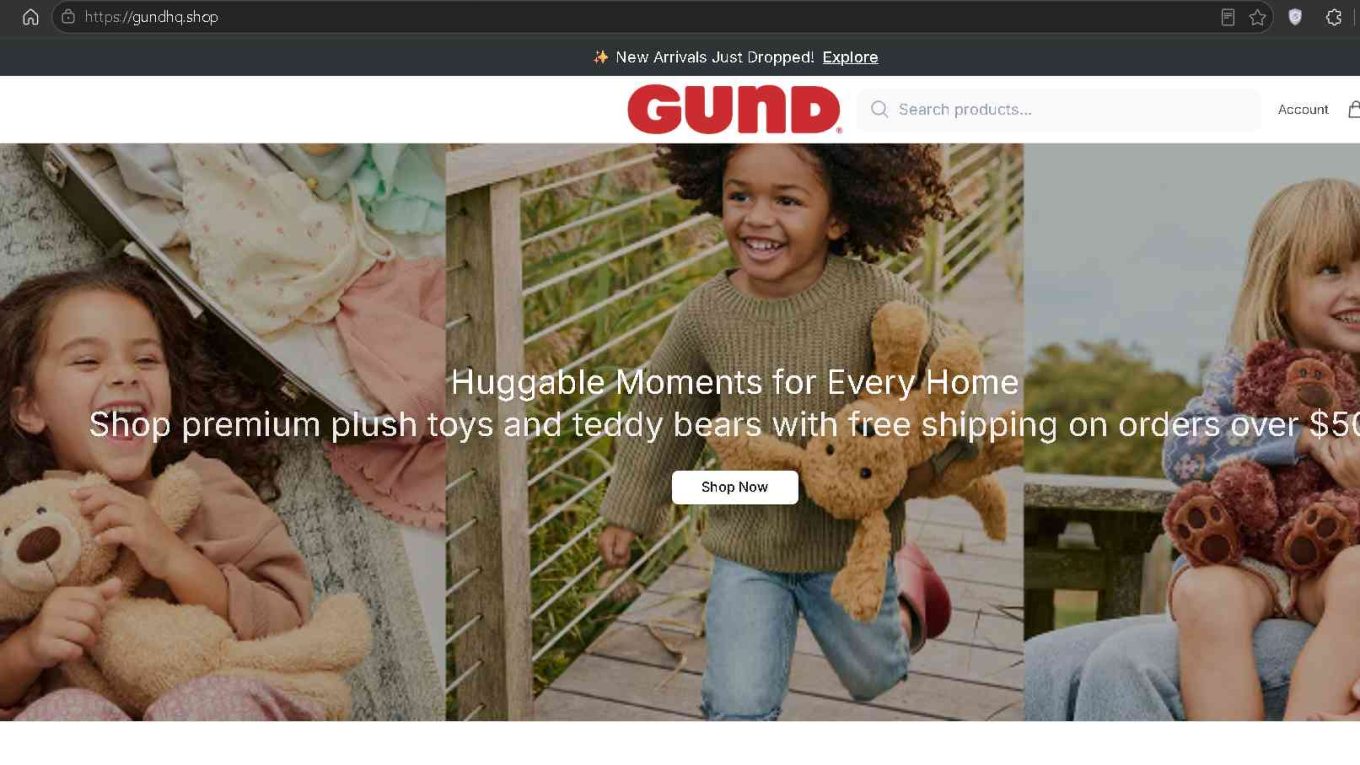
Landing on Gundhq.shop feels remarkably familiar if you know the genuine GUND brand. The top banner sports the signature bold red GUND logo, flanked by high-resolution imagery of smiling toddlers clutching plush teddy bears, warm knit sweaters, and modern nursery accents. The headline reads: “Huggable Moments for Every Home – Shop premium plush toys and teddy bears with free shipping on orders over $50.”
A search bar, account sign-in prompt, and slick navigation menus mimic a fully realized luxury toy retailer. Every single promotional photo, down to the lifestyle shoot of the classic brown bear and floppy-eared bunny, was lifted directly from genuine marketing assets.
The Pricing Trap
The primary red flag lies in the pricing math. Genuine, licensed plushies—such as full-sized Toothpick bears, Snuffles, sustainable plush lines, and interactive singing animated toys—consistently retail between $30 and $80+. They carry premium materials, patented stitching, and strict child safety certifications.
On Gundhq.shop, however, luxury heirloom plushies are slashed by 70% to 85%:
- Premium $70 giant collectible bears are marked down to $18.99.
- Specialty nursery baby sets retailing at $55 are listed for $14.99.
- High-end animated interactive toys sit in the $19.00 to $21.00 bracket.
Legitimate global toy companies do not liquidate current, in-demand catalogs at prices that fail to cover basic freight shipping. These margins are mathematically impossible for a genuine distributor. The prices are calculated to sit well under standard credit card fraud alerts—an easy $35 to $60 total cart value that a buyer might write off as a minor loss when the package never arrives.
The Modus Operandi
Behind the curtain, the site’s infrastructure tells a completely different story:
- The Checkout Pipeline: When a victim proceeds through the shopping cart, the checkout interface frequently shifts to a third-party, insecure merchant processor or an unverified payment gateway disguised under arbitrary business titles.
- Data Harvesting: The checkout form requires full legal names, physical home addresses, phone numbers, email addresses, and unmasked credit card details (card number, expiration date, and CVV). This creates a dual-threat vector: the scammers take your cash upfront and package your personally identifiable information (PII) for resale on dark web illicit credential markets.
- Burn and Rotate: Once consumer fraud complaints accumulate, chargebacks spike, or cybersecurity registrars flag the hosting server, the domain will simply go dark. The creators will abandon
gundhq.shop, launchgund-clearance.storeorgundplushsale.shopovernight using the exact same cloned database, and restart the ad loop.
Forensic Red Flags: Real vs. Fake Comparison
A side-by-side analysis clearly exposes the architectural differences between the authentic manufacturer and the copycat:
| Feature / Metric | Official GUND Store | Gundhq.shop (Scam Site) |
|---|---|---|
| Primary Domain | gund.com | gundhq.shop |
| Parent Entity | Spin Master Ltd. (Publicly traded) | Completely anonymous shell / untraceable entity |
| Domain Age | Decades old (Registered early web era) | Newly registered (Days or weeks old) |
| Corporate Address | Verifiable corporate offices (Toronto/NYC) | Non-existent, residential fake, or PO box |
| Customer Support | Dedicated enterprise ticketing, toll-free phone | Disposable web form or inactive webmail |
| Social Media Links | Verified, active Instagram, FB & TikTok | Broken icon links or redirecting back to home page |
| Discount Reality | Modest sales (10%–20%), occasional holiday promos | Uniform 70%–85% sitewide cuts on all inventory |
| Payment Security | Multi-factor, verified Tier-1 gateways (Shop Pay, PayPal, Apple Pay) | Unvetted gateways, credit card skimming forms |
Deep-Dive Breakdown of the Critical Red Flags
- No Owner or Corporate Information: Genuine retail platforms have an extensive corporate footprint. The official GUND site details its acquisition by Spin Master, lists clear regulatory compliance statements for child toy safety, and provides verifiable contact numbers. Gundhq.shop provides nothing. Its “About Us” page contains generic, copy-pasted boilerplate with grammatical errors and vague statements about “delivering happiness worldwide.”
- Domain Freshness: A WHOIS domain lookup reveals that Gundhq.shop was registered very recently through privacy proxy shields designed to conceal the registrant’s name, country of operation, and hosting address. Established brands do not spin up brand-new
.shopdomains to conduct everyday commerce. - Absence of Real Social Media Infrastructure: While the scammers run paid ads on social channels to fish for traffic, their storefront features broken links to official social profiles. Clicking on the Instagram or Facebook icons either refreshes the page or links to dead, generic URLs because the fraudsters cannot maintain public social channels where duped customers can leave warning comments.
Financial Recovery & Identity Protection
If you placed an order through Gundhq.shop, you must act quickly. Treat this not merely as a lost retail order, but as an active financial compromise.
Follow this step-by-step containment protocol:
Step 1: Execute an Immediate Credit Card Chargeback
Do not wait for a shipping confirmation or spend weeks emailing a fake customer support address.
- Call Your Card Issuer Immediately: Dial the customer service number on the back of your credit or debit card. Inform the fraud department explicitly: “I made an online transaction on a fraudulent website impersonating a legitimate brand.”
- Request an Immediate Card Cancellation: Do not simply dispute the transaction amount. If you typed your full 16-digit card number, CVV, and expiration date into an unverified form, the physical card is compromised. Request an immediate account freeze and have a new card reissued with a new card number.
- Initiate a Zero-Liability Dispute: Credit cards offer strong protections under the Fair Credit Billing Act (FCBA) in the US and equivalent consumer protection laws worldwide.
- If no product arrives: File the chargeback under Condition 13.1 / Code 30: “Services/Merchandise Not Received.”
- If a counterfeit junk item arrives (e.g., a plastic trinket instead of a plush bear): File under Condition 13.3 / Code 53: “Not as Described or Defective Merchandise.” Provide photos of the packaging, customs slips, and the scam storefront’s false claims to your bank’s dispute portal.
Step 2: Lock Down Your Personally Identifiable Information (PII)
Because you entered your physical billing address, phone number, and name alongside payment credentials, fraud rings will try to cross-reference this information.
- Place Fraud Alerts on Credit Bureaus: Contact the three major credit bureaus—Equifax, Experian, and TransUnion. Request an initial 1-Year Fraud Alert placed on your profile. This legally compels prospective lenders and credit card issuers to verify your identity directly by calling your verified phone number before opening any new line of credit in your name.
- Run a Comprehensive Dark Web & Breach Scan: Utilize cybersecurity identity protection tools (such as Bitdefender Digital Identity Protection, Aura, or Norton LifeLock) to audit whether your submitted credentials have already been aggregated into searchable criminal combo-lists.
- Prepare for Follow-Up Social Engineering (Phishing & Smishing): Scammers frequently target known victims a second time. Watch out for SMS messages or emails claiming to be from “USPS,” “DHL,” or “Customs” stating that your parcel is held up and requires a “$1.85 redelivery clearance fee.” This is a classic secondary phishing trap designed to capture your newly issued replacement credit card.
Step 3: Prevent Future Breaches with Virtual Payment Cards
Never expose your primary checking account debit card or high-limit physical credit cards on unfamiliar boutique online storefronts.
- Deploy Disposable Virtual Cards: Services like Privacy.com or virtual card features baked into modern digital banking apps (Revolut, Capital One Eno, Apple Cash) let you generate merchant-locked, single-use debit/credit cards.
- Set Hard Spending Limits: When testing an unfamiliar store, generate a virtual card capped at the exact amount of the purchase. If a rogue merchant attempts to sneak in recurring billing subscriptions or sell your card data, subsequent charges fail instantly because the card expires or hits its strict balance ceiling.
Definitive Final Verdict
Gundhq.shop is an illegitimate, high-risk clone website created solely for financial and identity theft. It has zero affiliation with GUND, Spin Master, or any authorized international toy distributor.
The low prices are illusions designed to capitalize on impulse shopping, the product photography is stolen, and the domain architecture matches known fraudulent retail syndicates.
Keep your wallet closed. If you are shopping for authentic GUND plush toys, bypass third-party discount storefronts entirely and purchase directly from the verified primary domain (gund.com) or through authorized, vetted retail giants like Amazon (via the official brand store), Target, or Barnes & Noble.
Every safe click counts. If this post helped, a coffee gesture fuels more scam‑busting investigations.

Frequently Asked Questions (FAQ)
Is Gundhq.shop Scam?
Yes, Gundhq.shop is a scam. The site is an unauthorized clone impersonating the official GUND brand. It utilizes stolen logos, scraped imagery, and impossibly steep discounts to collect credit card credentials and personal data from unsuspecting buyers. Customers who place orders either receive nothing or get cheap, low-grade counterfeit trinkets.
Is Gundhq.shop Legit?
No, Gundhq.shop is not legit. The website is not an authorized distributor, retailer, or factory clearance outlet for GUND plush toys. It is an anonymously registered storefront using a cheap .shop top-level domain that lacks corporate ownership transparency, physical business addresses, customer service phone lines, and valid commercial certifications.
Scammers buy ads on platforms like Facebook, Instagram, and TikTok because their ad platforms allow precise demographic targeting (such as targeting parents or plush toy collectors) while enabling rapid campaign launches. The ads bypass conventional search engine scrutiny and reach consumers who are scrolling casually and are more prone to making rapid, impulse purchases without running thorough domain safety checks.
Can I get my money back if I bought from Gundhq.shop with a credit card?
Yes. If you used a major credit card, you are protected by zero-liability consumer purchase policies. Immediately contact your credit card issuer’s fraud operations line, state that you were deceived by an unauthorized brand impersonation site, cancel the compromised card number, and file a dispute/chargeback for goods not received or goods grossly misrepresented.
What identity theft risks am I exposed to if I entered my details?
Submitting your information exposes your full name, home delivery address, phone number, and payment credentials. Beyond direct unauthorized charges on your card, your data can be packaged into illegal identity lists sold across dark web forums. This leads to targeted phishing emails, delivery scam text messages (smishing), and potential attempts to open unauthorized accounts if sufficient personal data was intercepted.
How can I check when a domain like Gundhq.shop was registered?
You can verify the age and ownership details of any website using public WHOIS lookup tools (such as ICANN Lookup or Whois.com). Fraudulent storefronts almost universally show registration dates that are only a few days or weeks old, short one-year registration terms, and masked administrative contacts shielded behind third-party privacy proxy services.
Why do clone scam websites disappear after a few weeks?
Scam stores follow a rapid “churn-and-burn” lifecycle. Once customer complaints accumulate, banks initiate waves of payment chargebacks, and web security firms flag the URL as malicious, the payment processors cut off the merchant account and web hosts suspend the servers. Rather than fight the flags, scammers abandon the burned domain and immediately deploy a newly registered URL using the same pre-built retail template.
For more shady sites exposed, check our Shopping Scam Directory — your quick guide to staying safe online.
Help Us Spread Awareness
Please share this article to spread awareness. Follow us on social media for more scam alerts.