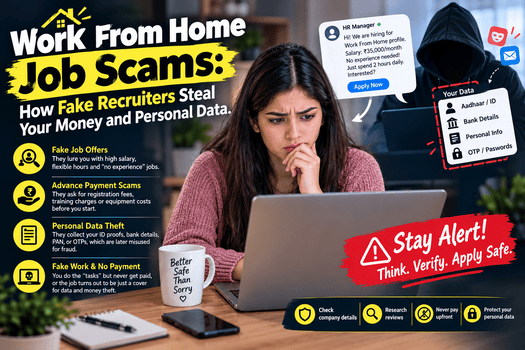
WFH Job Scams: How Fake Recruiters Steal Your Money and Personal Data
The dream of working from home has never been more popular. Flexible hours, zero commuting, and the opportunity to earn from anywhere have made remote jobs highly desirable. Unfortunately, scammers have noticed this trend too.
Today, fake work from home (WFH) jobs are among the fastest-growing online scams. Every day, job seekers receive attractive offers promising high salaries for simple tasks such as typing, data entry, reviewing products, clicking advertisements, or processing payments.
The catch?
Many of these jobs don’t exist.
Instead, they are carefully designed schemes to steal money, personal information, banking details, or even a victim’s identity.
As someone who has spent years in HR and recruitment, I’ve seen countless candidates share screenshots of suspicious job offers. In many cases, the warning signs were obvious, but job seekers overlooked them because they were excited about the opportunity.
This guide explains everything you need to know about fake online work-from-home jobs, how these scams work, and how to avoid becoming a victim.
What Are Fake Work From Home Jobs?
A fake work-from-home job is a fraudulent employment opportunity created to deceive job seekers.
The scammer’s objective may be to:
- Steal money
- Obtain banking information
- Collect sensitive personal data
- Commit identity fraud
- Access financial accounts
- Sell personal information on illegal marketplaces
Unlike genuine employers, scammers are not interested in hiring talent. Their goal is to exploit people who are searching for employment opportunities.
Why Are WFH Job Scams Increasing?
Remote work has transformed the employment landscape.
Today, millions of people search online for:
- Part-time remote jobs
- Data entry jobs
- Freelance opportunities
- Online typing work
- Customer support roles
- Virtual assistant positions
Scammers target these categories because:
- High demand exists
- Job seekers are often eager to start immediately
- Remote hiring processes are less familiar to many candidates
- Communication happens online, making impersonation easier
The result is an ideal environment for fraudulent recruiters.
Common Types of Fake WFH Job Scams
Understanding how scammers operate is the first step toward staying safe.
1. Data Entry Job Scams
This is among the most common online employment scams.
The fraudster advertises:
Earn ₹30,000 to ₹80,000 per month from home with simple typing work.
Victims are then asked to:
- Pay registration fees
- Purchase software
- Buy training materials
- Deposit security fees
After payment is made, the scammer disappears.
Red Flag
Legitimate employers do not charge candidates to apply for jobs.
2. Fake Online Typing Jobs
Scammers promise easy money for typing handwritten documents or converting PDFs into Word files.
Typical claims include:
- ₹1,500 per day income
- No experience required
- Instant joining
After submitting the completed work, victims often hear:
- Quality standards were not met
- Accuracy requirements were not achieved
- Contract penalties apply
The victim may then be pressured to pay alleged penalties.
3. Task-Based Job Scams
These scams have become extremely popular.
The fraudster asks the candidate to:
- Like videos
- Review products
- Subscribe to channels
- Complete app tasks
Initially, victims might receive small payments to build trust.
Eventually, the scammer requests larger “investments” to unlock higher earnings.
Once money is transferred, the scammer disappears.
4. Fake HR Recruiter Scams
Fraudsters impersonate recruiters from:
- IT companies
- Multinational corporations
- Startups
- Government agencies
They may create convincing profiles on:
- Telegram
The victim receives a job offer and is asked to pay for:
- Background verification
- Laptop shipment
- Employee registration
- Security clearance
No legitimate recruiter should ask applicants to pay for hiring.
5. Fake Package Processing Jobs
In this scam, victims are hired to receive and forward packages.
The packages may involve:
- Stolen merchandise
- Fraudulent purchases
- Illegal goods
Without realizing it, victims may become involved in criminal activities.
6. Reshipping and Money Transfer Scams
Fraudsters recruit people as:
- Payment processors
- Financial coordinators
- Local representatives
The job involves receiving money and forwarding it elsewhere.
These scams frequently involve:
- Stolen funds
- Money laundering
- Financial fraud
Avoid any job that requires transferring money through personal accounts.
The Most Common Warning Signs of a Fake WFH Job
Many scams can be identified within minutes if candidates know what to look for.
1. Unrealistically High Salary
Be cautious of offers promising:
- ₹50,000 monthly for simple typing
- ₹1,00,000 for part-time work
- Easy money without skills
If the compensation sounds too good to be true, it probably is.
2. Upfront Payment Requests
This is perhaps the biggest warning sign.
Scammers may request:
- Registration fees
- Security deposits
- Training fees
- Equipment charges
- Background verification fees
Genuine employers pay employees.
Employees do not pay employers.
3. Instant Hiring
Legitimate hiring normally includes:
- Application review
- Screening
- Interviews
- Verification process
Be suspicious if you receive an offer within minutes without any evaluation.
4. Communication Only Through WhatsApp or Telegram
Professional organizations generally use:
- Official email domains
- Corporate communication systems
- Video interviews
Exclusive communication through messaging apps can be a red flag.
5. Poor Grammar and Generic Messages
Scammers often send messages such as:
Dear Candidate, congratulations for selected immediately.
Professional recruiters usually communicate more professionally and clearly.
6. Pressure Tactics
Common scam phrases include:
- Limited positions available
- Pay today to secure your seat
- Offer expires in one hour
- Immediate joining mandatory
Urgency often prevents victims from researching the opportunity.
Real-Life Example of a Fake WFH Job Scam
Imagine a candidate searching for remote or WFH jobs online.
They receive a message:
Congratulations! You have been selected for an international data entry project with earnings of ₹45,000 per month.
The recruiter requests:
- Aadhaar card
- PAN card
- Bank details
- ₹2,500 security deposit
The candidate pays the fee.
The recruiter stops responding.
The website disappears.
The victim loses money and personal information.
This pattern is repeated thousands of times every year.
How Fake WFH Job Scammers Steal Personal Information
Money isn’t always the primary objective.
Many scammers seek:
- Aadhaar details
- PAN information
- Bank account numbers
- Credit card information
- Passport copies
- Digital signatures
This information may later be used for:
- Identity theft
- Loan fraud
- Account creation fraud
- Financial scams
Protecting personal documents is just as important as protecting money.
How to Verify a WFH Job Offer
Before accepting any remote job, follow these verification steps.
Research the Company
Check:
- Official website
- Company registration information
- Social media presence
- Online reviews
A legitimate company usually leaves a substantial digital footprint.
Verify Recruiter Credentials
Look for:
- Corporate email address
- Employee profile
- Company listing
- Professional networking presence
Contact the organization directly if unsure.
Search for Scam Reports
Search terms such as:
- Company name + scam
- Company name + fraud
- Recruiter name + complaint
- Website review
Often, previous victims have already posted warnings.
Check Email Domains
Legitimate email example:
careers@companyname.com
Suspicious examples:
company.hr.job@gmail.com
recruitment123@yahoo.com
Free email providers should trigger additional verification.
Safe Places to Find Genuine Remote Jobs
While no platform is immune from fraud, these sources are generally safer because they provide employer verification and reporting mechanisms.
Trusted Sources
- Company career pages
- Established job portals
- Professional networking platforms
- Freelance marketplaces
- Recruitment agencies
Even on trusted platforms, candidates should perform independent verification.
What to Do If You Have Been Scammed
If you’ve already interacted with a suspicious employer, act immediately.
1. Stop All Payments
Do not send additional money regardless of promises or threats.
2. Save Evidence
Preserve:
- Screenshots
- Emails
- Chat records
- Payment receipts
- Job advertisements
These may be useful for investigations.
3. Inform Your Bank
If financial information was shared:
- Contact your bank immediately
- Monitor account activity
- Request necessary security measures
4. Change Passwords
Update passwords for:
- Email accounts
- Banking applications
- Job portals
- Social media platforms
5. Report the Scam
Report fraudulent activity through appropriate authorities and cybercrime reporting channels available in your jurisdiction.
How HR Professionals Can Help Prevent WFH Job Scams
Organizations also play an important role.
Employers should:
- Publish recruitment policies publicly
- Announce official hiring channels
- Verify recruiter identities
- Warn candidates about impersonation scams
- Clearly state that they never charge application fees
Transparency significantly reduces scam opportunities.
The Psychological Tricks Used by WFH Job Scammers
Scammers understand human behavior.
They frequently exploit:
Financial Stress
People urgently looking for work may take risks they would normally avoid.
Excitement
A surprisingly good offer can cloud judgment.
Urgency
Victims feel pressured to decide quickly.
Authority
Fraudsters claim association with well-known companies.
Understanding these techniques helps candidates stay objective.
Golden Rules for Avoiding Fake WFH Jobs
Always remember:
✅ Never pay to get hired
✅ Verify the company’s website
✅ Research recruiter credentials
✅ Be cautious of unrealistic salaries
✅ Protect personal documents
✅ Avoid money transfer jobs
✅ Read reviews before accepting offers
✅ Trust your instincts when something feels suspicious
Frequently Asked Questions (FAQs)
Are work from home jobs legitimate?
Yes. Many genuine companies hire remote employees. However, candidates should verify every opportunity carefully.
Do legitimate employers charge registration fees?
No reputable employer should require candidates to pay hiring or registration fees.
What is the biggest sign of a fake online job?
An upfront payment requirement is one of the strongest warning signs.
Can scammers misuse Aadhaar and PAN details?
Yes. Personal identity documents can potentially be misused for fraudulent activities if shared with unverified individuals.
Are WhatsApp job offers always fake?
Not necessarily. Many recruiters use WhatsApp for communication. However, candidates should verify recruiter identity before sharing information or making payments.
What should I do if a recruiter asks for money?
Treat the situation as a major warning sign and verify the legitimacy of the opportunity before proceeding.
Final Thoughts
Remote work has opened incredible opportunities for professionals, students, freelancers, and stay-at-home workers. However, the rise of WFH job employment has also created a fertile ground for scammers looking to exploit job seekers.
From fake data entry projects to fraudulent recruiter offers, these schemes often follow predictable patterns: promises of easy money, urgent deadlines, and requests for payment or personal details.
As someone involved in HR and recruitment, my advice is simple: a genuine employer hires you because of your skills, not because of your willingness to pay fees.
Whenever you encounter an online or fake WFH job offer, slow down, verify everything, and trust facts over excitement. A few minutes of research can protect both your money and your identity.
Sweta Rawat is an HR professional with over 2.5 years of experience and an MBA in Human Resources. She writes on modern HR practices, employee engagement, and workplace culture, blending professional expertise with creative insight.