Nuvixart Review: Digital Canvases, Vanishing Ether, and the Fake Marketplace Trap
Independent creators and freelance digital illustrators receiving unsolicited high-dollar commission offers on social media increasingly encounter Nuvixart, an illicit web portal running an organized “Artist Commission / NFT Advance-Fee” Scam. While the platform presents an alluring Web3 interface advertising seamless digital collectibles, the website functions as a front to extract upfront cryptocurrency deposits and compromise non-custodial wallets.
Navigating modern freelance creative work requires recognizing how cybercrime syndicates deploy clone web applications to trap artists eager to monetize their portfolio. This investigative review analyzes how Nuvixart operates, explains the anatomy of advance-fee NFT marketplace schemes, highlights five critical warning signs, and details an immediate recovery playbook to secure your cryptocurrency holdings.
What Is an Artist Commission / NFT Advance-Fee Scam?
An artist commission and NFT advance-fee scam is a predatory social engineering scheme designed to exploit digital artists, 3D modelers, and photographers. Rather than stealing physical goods, fraudsters target the creator’s capital by inventing a fictitious wealthy patron who insists on purchasing original artwork as non-fungible tokens.
In legitimate Web3 ecosystems, creators mint artwork on established, decentralized networks (such as OpenSea, Rarible, Foundation, or SuperRare). These platforms support gasless listing options, lazy minting, or transparent blockchain network gas fees paid directly to node validators, never to private intermediary bank accounts or proprietary off-chain balance portals.
In an advance-fee clone operation:
- The Social Media Bait: A fraudulent account contacts an artist on Instagram, X (Twitter), ArtStation, or Behance, praising their illustrations and offering extravagant compensation—often between 2 and 5 Ethereum (ETH), equivalent to thousands of dollars.
- The Platform Diversion: When the artist agrees to sell, the buyer refuses established platforms like OpenSea under the guise of “network errors,” “high transaction fees,” or “corporate collection policies,” explicitly insisting that the transaction must occur on a specific boutique marketplace like Nuvixart.
- The Fake Minting Extortion: The artist uploads their image and is prompted to connect their wallet and deposit an upfront “minting fee,” “smart contract activation fee,” or “gas validation deposit” (typically 0.05 to 0.25 ETH).
- The Phantom Balance & Withdrawal Freeze: Once the victim deposits the crypto, the scam buyer supposedly “buys” the artwork. The artist’s internal dashboard displays an inflated balance, but any withdrawal attempt is blocked by secondary demands for “KYC tax clearance” or “smart contract liquidity deposits” until the victim stops paying.
E-Commerce Protection Checklist
-
1
Break the In-App Browser Funnel
Never check out inside Instagram or TikTok web-views. Copy the link and open a standalone browser to remove referral tracking tokens and inspect the real root domain.
-
2
Run a 60-Second Background Check
Look up the domain age via WHOIS (avoid sites under 6 months old) and reverse-search product imagery on Google Lens to verify whether cheap wholesale duplicates exist.
-
3
Verify Corporate Entity Details
Check the website footer for a registered legal company name, verifiable physical address on Google Maps, and dedicated phone support—not just an anonymous web form.
-
4
Demand Insulated Payment Options
Refuse direct bank deposits, UPI QR codes, crypto, or debit transfers. Use zero-liability credit cards or protected checkout channels like PayPal Goods & Services.
-
1
Stop Waiting for Merchant Email Replies
Do not waste dispute windows negotiating with automated helpdesks or generic tracking updates. Deceptive pop-up storefronts stall purposely to exhaust chargeback timelines.
-
2
Initiate a Bank Chargeback Within 24-48 Hours
Call the phone number printed on the back of your card. Request an immediate dispute categorized under Merchant Fraud, Goods Not Delivered, or Misrepresentation.
-
3
Freeze Billing and Replace Card Credentials
Instruct your bank’s fraud desk to block future merchant authorizations under that descriptor and re-issue a fresh card number to prevent hidden recurring subscription debits.
-
4
Preserve Order & Ad Evidence
Save full-page screenshots of the product page, transaction debit receipts, and tracking communications to upload directly into your card issuer’s dispute portal.
Case Study: Deconstructing the Nuvixart Operation
Examining Nuvixart reveals the mechanics common to cloned Web3 commission funnels.
           [ Social Media Phishing Outreach ]
        (Fake "Art Buyer" on Instagram/ArtStation)
                           │
       (Offers 2–5 ETH for Artwork; Refuses OpenSea)
                           ▼
   ┌────────────────────────────────────────────────────────┐
   │             Scam Portal: nuvixart.com                  │
   │  ┌─────────────────────────┐  ┌─────────────────────┐  │
   │  │ Cloned Open-Source UI   │  │ Advance-Fee Traps   │  │
   │  │ • "Discover, collect"   │  │ • Upfront "Gas" Fee │  │
   │  │ • Stock syntax errors   │  │ • Phony ETH Balance │  │
   │  │ • Disconnected contracts│  │ • Wallet Drain Risk │  │
   │  └─────────────────────────┘  └─────────────────────┘  │
   └────────────────────────────────────────────────────────┘
                           │
             (Artist Mints & Deposits Crypto)
                           │
       ┌───────────────────┴───────────────────┐
       ▼                                       ▼
 [ Direct Cryptocurrency Theft ]      [ Secondary Extortion ]
 • Upfront fees moved to scam wallet  • "Tax clearance" deposit demand
 • Smart contract approval exploits   • Complete withdrawal lockout
Digital Infrastructure and The Phishing Hook
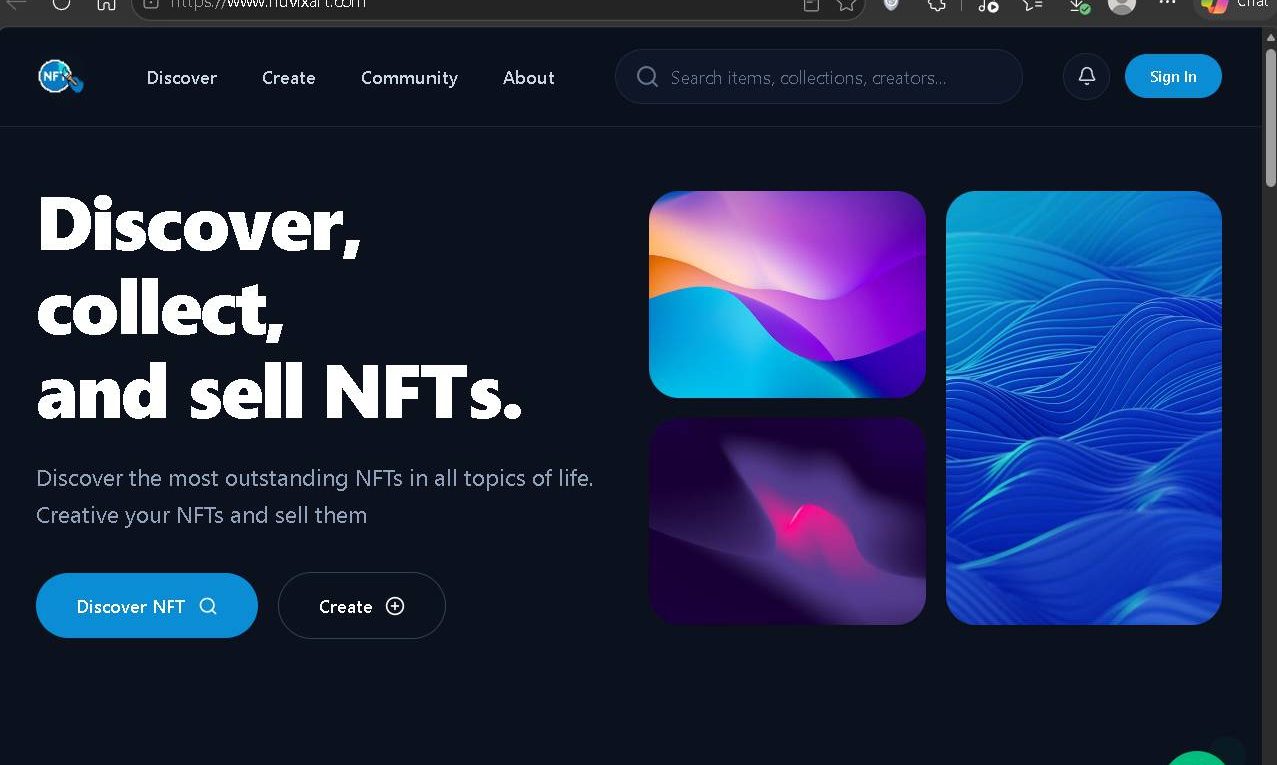
The platform uses a dark-themed Web3 user interface with rounded display cards, search bars, and collection tabs (Discover, Create, Community, About, Sign In). The hero section displays the header “Discover, collect, and sell NFTs”.
However, inspecting the site’s code shows that it is an open-source React/Next.js e-commerce demo scraped directly from public developer repositories. It lacks genuine decentralized smart contract deployment.
The marketplace is not linked to on-chain mainnet liquidity protocols; instead, it is a centralized simulated dashboard running off-chain scripts designed to make manual ledger entries look like active blockchain transactions.
Suspicious Link or Courier SMS?
Verify URLs, APKs, or parcel alerts against our threat database before clicking.
What the Site Claims and Offers
- Seamless Creation Tools: Advertises simple interfaces to “Creative your NFTs and sell them”—copying verbatim a grammatical syntax error found in public code templates.
- Universal Art Aggregation: Claims to host the “most outstanding NFTs in all topics of life,” a placeholder phrase found across dozens of disposable crypto scam domains.
- Automated Web3 Settlement: Promises instant cryptocurrency settlement and global royalty management for participating creators upon smart contract creation.
- Private Clearinghouse Mechanics: Operates an isolated internal payment gateway that prevents users from inspecting public smart contracts on Etherscan or Polygonscan.
5 Critical Red Flags on Nuvixart
1. Template-Copied Errors and Generic Placeholders
The site relies on stock web templates without basic customization. The hero text includes broken grammar: “Creative your NFTs and sell them” (instead of “Create”). Furthermore, the tagline “Discover the most outstanding NFTs in all topics of life” is an unedited template placeholder identical to phrases used on decommissioned phishing portals like nexosnft.com. Legitimate decentralized platforms backed by venture funding or community developers do not deploy unchecked boilerplate text.
2. The Unsolicited High-Dollar “Direct Buyer” Vector
Legitimate art collectors on Web3 purchase established collections through public liquidity pools or accept standard decentralized platforms. If an unknown buyer messages you out of the blue, offers thousands of dollars for random illustrations, and claims they can only complete the transaction on Nuvixart, you are being guided into a targeted trap. The buyer and the site operators are the exact same entity.
3. Upfront “Gas Fee” and Activation Extortion
When an artist attempts to list an image, Nuvixart demands that they transfer an upfront fee in Ethereum or Solana to an unverified external deposit address under the guise of “gas fees” or “account verification.” Legitimate decentralized exchanges (DEXs) never ask users to transfer crypto to an intermediary deposit wallet; genuine blockchain gas fees are calculated in real time by the network and signed directly through your non-custodial browser extension.
4. Malicious Web3 Wallet Signature Risks
Connecting your browser wallet (such as MetaMask, Phantom, or Trust Wallet) to an unverified platform like Nuvixart exposes your wallet to malicious drainer scripts. Attackers frequently embed deceptive signature prompts (such as eth_sign, Permit, or unlimited token allowances) that grant the attacker’s smart contract permission to sweep all pre-existing cryptocurrency and NFTs out of your wallet without secondary confirmation.
5. Fabricated Dashboard Balances and Frozen Withdrawals
If a creator deposits the minting fee and the fake buyer “completes” the purchase, the dashboard shows thousands of dollars in pending crypto. However, clicking the withdrawal button triggers error screens demanding additional deposits—such as an “International Anti-Money Laundering Security Bond” or an “Account Liquidity Fee.” These secondary payment requests are extortion tactics; the website has no automated withdrawal mechanism, and no deposited funds can ever be retrieved.
Action Plan: Steps for Freelancer Protection & Crypto Security
If you have interacted with Nuvixart or entered wallet credentials on the site, take these immediate protective actions:
- Revoke Smart Contract Allowances Immediately: If you connected your non-custodial wallet to Nuvixart, visit a reputable allowance scanner (such as Revoke.cash or Etherscan’s Token Approval Tool). Immediately revoke any active spending approvals, token permissions, or signed allowances linked to the domain to stop automated wallet drainers.
- Migrate Remaining Assets to a Fresh Hardware Wallet: If you signed untrusted signature requests on the site, assume the wallet’s integrity is compromised. Generate an entirely new wallet on an uncompromised device and immediately transfer your remaining cryptocurrency and NFTs off the affected address.
- Never Transfer “Withdrawal Clearance” Deposits: If the website displays a high ETH balance but claims you must pay a 0.5 ETH fee to unlock it, do not send any more funds. Every additional deposit goes directly into the scammer’s private wallet. The displayed balance is simply fake text on a screen.
- Block the Fake Buyer Immediately: Stop communicating with the social media account that directed you to the website. Report the profile on Instagram, X, or ArtStation for advance-fee fraud and phishing.
- Report the Scam Infrastructure: Report the domain name to Google Safe Browsing, the Federal Trade Commission (ReportFraud.ftc.gov), the FBI’s Internet Crime Complaint Center (IC3), and the Chainabuse database to alert blockchain security researchers and take down the hosting server.
Frequently Asked Questions
Is Nuvixart scam?
Yes, Nuvixart is a fraudulent website operating as an advance-fee NFT marketplace scam. It targets digital artists with fake commission offers, demanding upfront crypto deposits for minting and gas fees that cannot be recovered.
Is Nuvixart legit?
No, Nuvixart is not a legit or authorized decentralized platform. It is a cloned, unverified template storefront using boilerplate code to mimic a Web3 marketplace and steal digital assets.
How does the Nuvixart commission scam work?
A fake buyer approaches an artist online offering high payment in Ethereum, but insists on buying only through Nuvixart. The artist is told to pay upfront crypto fees to “mint” the artwork; once paid, the scammer keeps the funds and locks the account.
Can I get my cryptocurrency back from Nuvixart?
Because blockchain transactions are decentralized and irreversible, funds transferred to fraudulent deposit addresses cannot be charged back like credit card transactions. Beware of “crypto recovery experts” messaging you on social media, as they are secondary advance-fee recovery scammers.
What should I do if I connected my MetaMask wallet to Nuvixart?
Use a trusted security tool like Revoke.cash to immediately cancel any smart contract approvals or token permissions. Transfer all remaining crypto and digital collectibles to a newly generated wallet right away.
Why do legitimate platforms like OpenSea not require off-chain deposits?
Legitimate decentralized marketplaces connect directly to public blockchain smart contracts. Real transactions deduct network gas fees transparently during the signing process rather than asking creators to deposit funds into private intermediary wallets.
Why does Nuvixart display typos like “Creative your NFTs”?
The site operators copied open-source web code from public repositories without correcting developer placeholders and grammatical mistakes before launching their fraudulent domain.
How can freelance digital artists avoid NFT commission traps?
Never use obscure, unvetted marketplaces recommended by unknown social media accounts. Direct prospective art buyers exclusively to established platforms like OpenSea or Foundation, or require traditional payment methods (such as direct escrow or wire transfer) before beginning work.
Every safe click counts. If this post helped, a coffee gesture fuels more scam‑busting investigations.

For more shady sites exposed, check our Shopping Scam Directory — your quick guide to staying safe online.
Help Us Spread Awareness
Please share this article to spread awareness. Follow us on social media for more scam alerts.