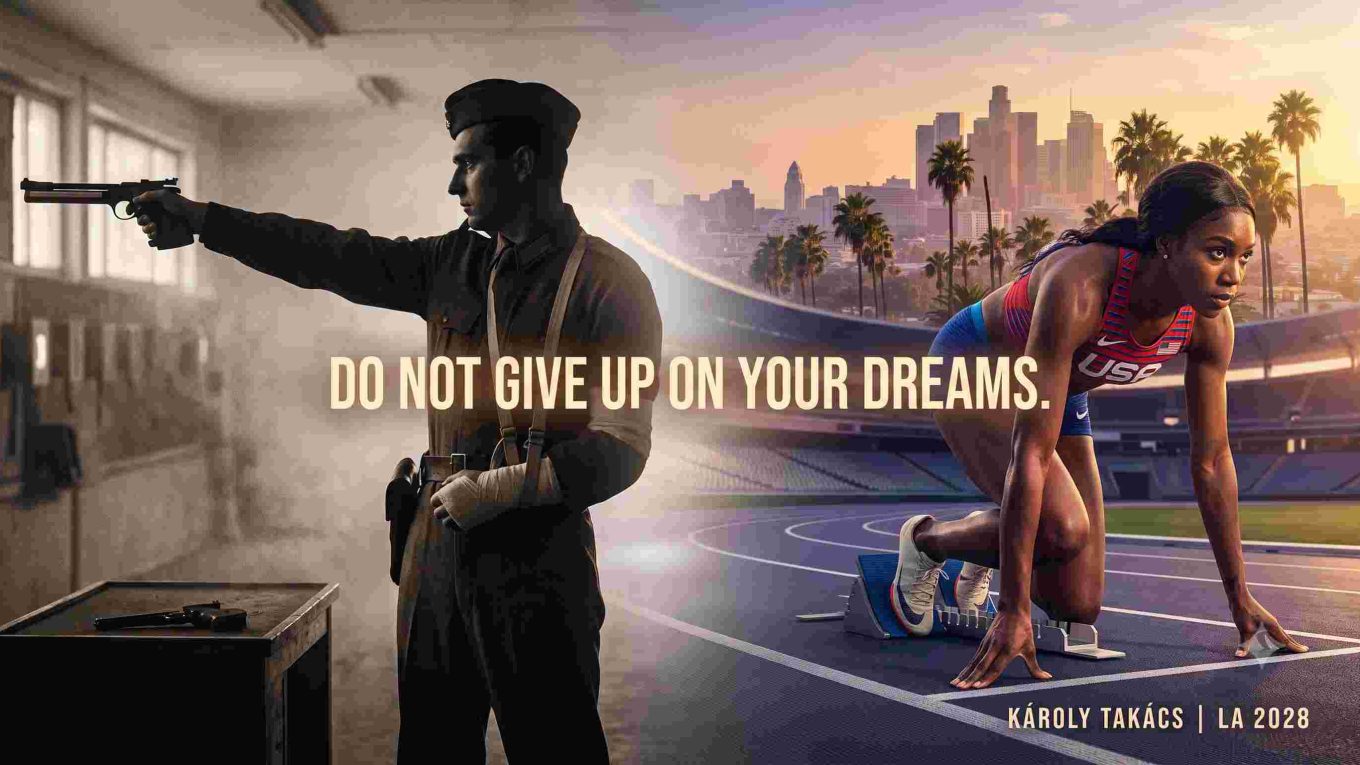
What Károly Takács Teaches Athletes Preparing for the LA 2028 Olympics: Do Not Give Up on Your Dreams
Do not give up on your dreams. No matter how steep the incline becomes, no matter how brutal the isolation feels, and no matter how many times life strips away your momentum—hold the line.
When you pursue elite athletic excellence, failure is rarely abstract. It shows up as ruptured ligaments, missing a national qualifying mark by hundredths of a second, chronic fatigue, financial strain, and the suffocating silence of an empty arena after a career-altering defeat.
Most people look at the Olympic podium and see only natural gifts and triumphant smiles. They ignore the brutal reality that the road to an Olympic Games is a war of attrition against self-doubt and bad luck.
If you are a sportsman staring down the grueling four-year cycle toward the Los Angeles 2028 Olympic Games, wondering whether your body and mind can survive the climb, you must study the story of Károly Takács. His life remains the ultimate blueprint for turning catastrophe into Olympic gold.
The Catastrophe of Károly Takács
In 1938, Károly Takács was a sergeant in the Hungarian Army and one of the finest marksmen on the planet. For years, Hungarian military protocol had barred non-commissioned officers from international competitions. When that rule was finally lifted in the late 1930s, Takács dominated the sport, winning the 1939 world championship team event and emerging as the absolute favorite to capture individual gold at the upcoming 1940 Olympic Games in Tokyo.
Then, his world collapsed.
During army maneuvers, a faulty grenade exploded directly in his right hand. The blast shattered the bones and severed the nerves, leaving his shooting hand mutilated beyond repair. Doctors were forced to amputate.
In a fraction of a second, his identity, his technical mastery, and his Olympic dream were wiped out. Most people in his position would have spent the rest of their lives mourning what was stolen from them, leaning on sympathy and regret.
Takács refused to grieve. He chose not to focus on the hand that was gone, but on the assets he still had: a functioning mind, an iron will, and a healthy left hand.
Without fanfare, without seeking sympathy, and completely out of sight, Takács began rebuilding himself. His left hand was weak, clumsy, and untrained. In the beginning, the pistol trembled violently in his grip. The recoil tore at his unconditioned muscles, and his precision vanished. Day after day, shot after shot, in total solitude, he taught his left hand how to steady the barrel, regulate breath, and squeeze the trigger smoothly.
In 1939, just one year after the explosion, Takács arrived at the Hungarian National Shooting Championship. His competitors came up to comfort him, expressing deep admiration that he had gathered the emotional strength to simply show up and watch.
Takács looked at them and quietly corrected them: “I didn’t come to watch. I came to compete.”
Shooting exclusively with his left hand, Károly Takács defeated Hungary’s finest pistol shooters and won the national title.
A Decade of Waiting: The 10-Year Test of Will
Winning the national championship was an astonishing feat, but history was not done testing him.
The 1940 Tokyo Olympics were cancelled due to World War II. The 1944 Games were cancelled as well. For an entire decade—the absolute peak of an athlete’s physical prime—Takács was denied the chance to stand on the Olympic stage. Ten years of war, isolation, aging, and relentless, solitary training followed.
When the Olympic Games finally returned in London in 1948, a 38-year-old Károly Takács stepped up to the line in the 25-meter rapid fire pistol event.
His main rival, Argentine world champion Carlos Enrique Díaz Sáenz Valiente, asked Takács why he was there. Takács replied, “I am here to learn.”
By the end of the competition, Takács had shattered the world record, won the Olympic Gold medal, and stood atop the podium. At the medal ceremony, Valiente turned to him and said, “You have learned enough.”
Four years later, at the 1952 Helsinki Games, Takács returned and defended his title, becoming the first shooter in Olympic history to win back-to-back gold medals in the 25-meter rapid fire event.
Setting Your Sights on LA 2028: The Crucible of the Quiet Years
The story of Károly Takács is not merely sports history; it is a battle manual for every athlete looking toward Los Angeles 2028.
The journey to LA28 will not be decided under bright stadium lights. It will be decided right now—in the dark, cold hours where nobody is watching, clapping, or reporting on your progress. Between now and 2028, you will face moments that threaten to derail your career. You will deal with injuries, slumps in form, funding shortfalls, missed trials, and the quiet voice that whispers it would be easier to walk away.
When that resistance arrives, ground yourself in three principles:
- Shift focus from what was lost to what remains: If an injury takes away your primary movement, train your core. If you lose a sponsor, streamline your routine. If you miss a qualification mark, treat the data as feedback rather than a final verdict. Adapt your tools, but never abandon the objective.
- Reframe the quiet years: True champions are not minted on the podium; they are revealed there. The four-year cycle is a furnace designed to burn away complacency and panic. If you cannot dominate the quiet, unglamorous days in the gym, you cannot handle the pressure of the Olympic final.
- Make your commitment unconditional: If your motivation depends on smooth weather, flawless health, and constant external praise, you will break. The standard you hold yourself to every morning must exist independent of your current circumstances.
You still have time before the Olympic cauldron is lit in Los Angeles. Clear away the noise, pick up your tools, and step back onto the training floor.
Do not give up on your dreams. LA 2028 is waiting.
FAQ Section
1. Who is Károly Takács and why is his story inspiring for Olympic athletes?
Károly Takács was a Hungarian world-class pistol shooter who lost his dominant right shooting hand to a grenade explosion in 1938. Instead of retiring, he secretly retrained his non-dominant left hand, returned to competition, and won back-to-back Olympic gold medals in the 25m rapid fire pistol event at the 1948 London and 1952 Helsinki Games. His story serves as a benchmark for mental resilience, showing athletes that devastating setbacks do not have to end an Olympic dream.
2. How did Károly Takács train his left hand after losing his dominant shooting hand?
After the grenade blast amputated his right hand, Takács retreated from public view and began drilling fundamentals in total secrecy. Starting with an unsteady grip and poor motor control, he focused on breath regulation, wrist stability, trigger discipline, and progressive repetition. Within roughly a year of solitary practice, his left-hand precision matched and eventually surpassed his previous world-class right-hand level.
3. What injuries or setbacks did Károly Takács overcome before winning Olympic gold?
Beyond the traumatic loss of his shooting hand in 1938, Takács faced prolonged institutional and geopolitical barriers. Early in his career, Hungarian military rules banned non-commissioned officers from international competition. Later, World War II forced the cancellation of the 1940 and 1944 Olympic Games, wiping out nearly a decade of his athletic prime before he finally made his Olympic debut at age 38 in 1948.
4. What lessons can modern sportsmen preparing for LA 2028 learn from Károly Takács?
Takács’ journey provides three critical mental frameworks for athletes targeting the Los Angeles 2028 Games:
- Focus on available assets: Direct all energy toward what you can still control and develop rather than mourning lost opportunities or physical setbacks.
- Embrace the quiet years: Elite performance is built during unpublicized, repetitive training sessions long before the Olympic trials begin.
- Build unconditional commitment: Motivation cannot depend solely on favorable weather, perfect health, or early praise.
5. How to overcome severe sports injuries and stay motivated for the 2028 Olympics?
Recovering from severe athletic injuries during a four-year Olympic cycle requires shifting from passive rehabilitation to active adaptation. Sports psychologists recommend setting micro-goals around mobility and strength, working on non-injured kinetic chains, refining mental imagery, and studying historical comebacks like that of Takács to maintain psychological momentum when physical training is restricted.
6. How many years was Károly Takács forced to wait between his accident and his first Olympic gold medal?
Takács waited 10 years between his career-altering injury in 1938 and his first Olympic gold medal at the 1948 London Games. His patience through two cancelled Olympics (1940 and 1944) highlights why athletes preparing for future Games like LA 2028 must cultivate long-term vision rather than expecting overnight breakthroughs.
7. What Olympic records did Károly Takács set during his shooting career?
At the 1948 London Games, Takács won the 25m rapid fire pistol event while setting a new world record. With his victory at the 1952 Helsinki Games, he became the first shooter in Olympic history to defend a title and win consecutive gold medals in that discipline.
8. How can Olympic hopefuls build mental toughness like Károly Takács for LA28?
Athletes can cultivate comparable mental toughness through deliberate adversity training. This includes reframing mistakes as diagnostic feedback, practicing under simulated high-pressure constraints, isolating the craft from external validation, and anchoring daily routines to personal standards rather than short-term emotions.
9. Why is the 4-year Olympic training cycle so mentally challenging for athletes?
The multi-year cycle demands peak physical output with virtually no immediate public recognition. Athletes must manage cumulative fatigue, financial uncertainty, fear of mistimed injuries, and the pressure of a single qualification window. Surviving the cycle requires balancing long-term vision with strict day-to-day process orientation.
10. How does the story of Károly Takács illustrate the concept of ‘do not give up on your dreams’?
Takács’ life proves that giving up is an active choice, not an inevitable outcome of disaster. By shifting his perspective from grief to utility, he redefined his potential when circumstance suggested his career was over. For any athlete battling doubts on the road to LA 2028, his legacy demonstrates that unbroken resolve can transform an apparent dead end into historic achievement.FAQ Section
What’s Your Take on Károly Takács’ Story?
When a grenade shattered his shooting hand, he trained his left in secret to win back-to-back Olympic Gold. Drop your thoughts below—how do you handle life’s unexpected setbacks?