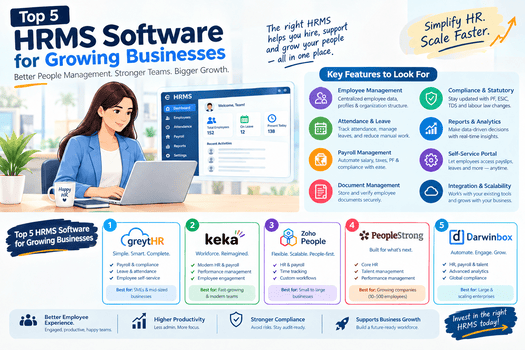
Top 5 HRMS Software for Growing Businesses in 2026: A Complete Guide
As businesses grow, managing people becomes both exciting and challenging. What starts as a small team managed through spreadsheets and emails can quickly evolve into a workforce that requires structured processes, automation, and real-time visibility. This is where Human Resource Management System (HRMS) software becomes indispensable.
Having worked in HR and talent acquisition for several years, I’ve personally experienced the transition from manual HR processes to digital HR management systems. I still remember spending hours reconciling attendance records, answering leave balance queries, and coordinating payroll inputs. While those tasks were manageable with a small workforce, they became increasingly difficult as employee numbers grew.
Today, HRMS software has transformed the way organizations manage employees. From hiring and onboarding to payroll, performance management, and employee engagement, modern HR platforms help businesses streamline operations while improving the overall employee experience.
In this article, we’ll explore the Top 5 HRMS Software solutions for growing businesses, their key features, strengths, and ideal use cases. Whether you’re a startup, SME, or expanding enterprise, this guide will help you make an informed decision.
What is HRMS Software?
A Human Resource Management System (HRMS) is a technology platform that automates and centralizes HR operations.
A modern HRMS typically includes:
- Employee database management
- Attendance tracking
- Leave management
- Payroll processing
- Recruitment management
- Performance evaluation
- Employee self-service
- Compliance tracking
- Workforce analytics
Instead of managing these functions separately through multiple tools, an HRMS brings everything together in a single platform.
Why Growing Businesses Need HRMS Software
Growth creates complexity. As organizations add more employees, managers, departments, and locations, manual HR processes often become inefficient.
Common challenges include:
- Payroll errors
- Attendance discrepancies
- Delayed approvals
- Increased compliance requirements
- Employee data management issues
- Recruitment bottlenecks
- Lack of workforce visibility
A robust HRMS helps eliminate these challenges by automating repetitive tasks and giving HR teams more time to focus on strategic people initiatives.
How We Selected the Top HRMS Software
The following HRMS platforms are widely recognized for their ability to support businesses through various stages of growth. They are evaluated based on:
- Core HR features
- Payroll capabilities
- Attendance management
- Employee experience
- Scalability
- Ease of implementation
- Reporting and analytics
- Compliance support
1. Darwinbox
Best For: Mid-sized and Large Enterprises
Darwinbox has emerged as one of the most popular HRMS platforms, particularly among rapidly growing organizations. The platform is designed to provide an end-to-end employee lifecycle experience while offering AI-powered capabilities and advanced analytics.
Key Features
- Core HR management
- Recruitment and onboarding
- Payroll integration
- Performance management
- Employee engagement tools
- Workforce analytics
- Mobile-first employee experience
Strengths
One of Darwinbox’s biggest advantages is its scalability. Organizations can start with core HR modules and gradually expand usage as the business grows.
The platform also focuses heavily on employee experience, which is becoming increasingly important in today’s competitive talent market.
Ideal For
- Large organizations
- Fast-growing companies
- Multi-location businesses
- Enterprises seeking digital transformation
Personal Take
What stands out about Darwinbox is its ability to balance enterprise-level functionality with user-friendly design. Employees are more likely to use systems that feel intuitive rather than administrative.
2. Keka HR
Best For: Startups and Growing Companies
Keka has become a favorite among startups and mid-sized businesses due to its simple interface and robust payroll capabilities.
It combines traditional HR functions with modern employee-centric features.
Key Features
- Payroll automation
- Attendance management
- Leave tracking
- Recruitment workflows
- Performance reviews
- Employee self-service
- Expense management
Strengths
Keka is widely appreciated for simplifying payroll processing and attendance management. The platform is relatively easy to deploy and requires minimal technical expertise.
Ideal For
- Small businesses
- Startups
- Mid-sized organizations
- First-time HRMS adopters
Personal Take
As someone who has worked extensively with attendance and payroll processes, I understand how much time these activities can consume each month. Keka’s automation significantly reduces administrative burdens for HR teams.
3. greytHR
Best For: Small and Medium Businesses
greytHR has established itself as one of India’s most trusted HR and payroll platforms. It provides a strong foundation for businesses looking to automate routine HR operations without overwhelming complexity.
Key Features
- Payroll processing
- Attendance management
- Leave automation
- Employee database
- Compliance management
- HR reporting
- Employee self-service portal
Strengths
Compliance management is one of greytHR’s strongest areas. Businesses dealing with statutory requirements often find its automation highly valuable.
Ideal For
- Small businesses
- Medium enterprises
- Compliance-driven organizations
- Payroll-focused HR teams
Personal Take
Many HR professionals spend considerable time ensuring payroll and compliance accuracy. greytHR helps reduce those concerns by automating critical administrative tasks.
4. Zoho People
Best For: Businesses Already Using the Zoho Ecosystem
Zoho People offers a flexible and highly customizable HR solution.
The platform integrates seamlessly with other Zoho applications, creating a unified business environment.
Key Features
- Employee lifecycle management
- Attendance tracking
- Leave management
- Performance reviews
- Workflow automation
- Learning management
- Employee self-service
Strengths
Customization is a major advantage. Organizations can configure workflows according to their unique business requirements.
Ideal For
- Zoho users
- Small businesses
- Technology-driven organizations
- Companies seeking workflow automation
Personal Take
I particularly appreciate platforms that adapt to business processes instead of forcing organizations to adapt to software limitations. Zoho People offers considerable flexibility in this regard.
5. PeopleStrong
Best For: Enterprise Workforce Management
PeopleStrong focuses on helping large organizations build data-driven HR operations. The platform combines HR administration, talent management, learning, and analytics within a single ecosystem.
Key Features
- Talent acquisition
- Employee lifecycle management
- Payroll support
- Learning management
- Performance management
- AI-powered insights
- Employee engagement solutions
Strengths
Organizations with large workforces benefit from PeopleStrong’s advanced analytics and talent management capabilities.
Ideal For
- Large enterprises
- Multi-location organizations
- Talent-focused companies
- Businesses requiring advanced HR analytics
Personal Take
As HR increasingly becomes a strategic business function, platforms like PeopleStrong help leaders make data-backed workforce decisions rather than relying on assumptions.
Comparison of the Top 5 HRMS Software
| Software | Best For | Major Strength |
|---|---|---|
| Darwinbox | Large Businesses | Scalability and employee experience |
| Keka | Growing Companies | Payroll and ease of use |
| greytHR | SMBs | Compliance and payroll automation |
| Zoho People | Zoho Users | Customization and integrations |
| PeopleStrong | Enterprises | Talent management and analytics |
Key Features to Look for in Any HRMS
Regardless of which platform you select, certain features are essential.
Payroll Automation: Payroll should be accurate, automated, and compliant.
Attendance Management: Look for features such as:
- Biometric integration
- Mobile attendance
- Leave tracking
- Shift management
Employee Self-Service: Employees should be able to access payslips, leave balances, and personal records independently.
Recruitment Management: A good HRMS should support:
- Job postings
- Candidate tracking
- Interview scheduling
- Offer management
Performance Tracking: Continuous feedback and goal tracking improve employee productivity and development.
Analytics and Reporting: Data-driven insights help HR leaders make informed decisions.
Common Mistakes When Choosing an HRMS
Many organizations focus only on price when evaluating HR software. However, it’s important to consider:
Future Growth: Will the software still meet your needs when your workforce doubles?
User Experience: Complicated software often results in low adoption rates.
Integration Capability: Can the HRMS connect with your payroll, accounting, and recruitment systems?
Security: Employee data is highly sensitive and must be protected.
Customer Support: Even the best software occasionally requires technical assistance.
The Future of HRMS Technology
HR technology is evolving rapidly. Future HRMS platforms are expected to offer:
- AI-powered recruitment
- Predictive analytics
- Automated employee support
- Personalized learning recommendations
- Advanced workforce forecasting
- Intelligent performance insights
These innovations will allow HR teams to become even more strategic while delivering better employee experiences.
Conclusion
Selecting the right HRMS software is one of the most important decisions a growing business can make. The right platform not only automates administrative tasks but also improves employee experiences, enhances compliance, and enables data-driven decision-making.
From my own HR journey, I have learned that technology works best when it supports people rather than replaces them. The most successful HRMS solutions are those that eliminate repetitive tasks, allowing HR professionals to spend more time on meaningful conversations, talent development, and culture building.
Whether you choose Darwinbox, Keka, greytHR, Zoho People, or PeopleStrong, the key is selecting a solution that aligns with your organization’s size, goals, and growth plans.
As businesses continue to evolve, investing in the right HRMS software today can create the foundation for a more productive, engaged, and future-ready workforce tomorro
Sweta Rawat is an HR professional with over 2.5 years of experience and an MBA in Human Resources. She writes on modern HR practices, employee engagement, and workplace culture, blending professional expertise with creative insight.