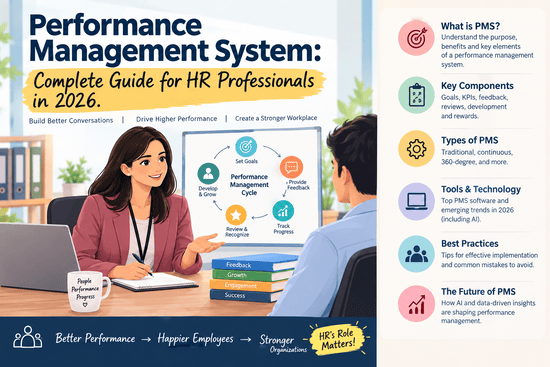
Performance Management System: Complete Guide for HR Professionals in 2026
Discover how a well-designed Performance Management System (PMS) can transform employee productivity, engagement, and business success while creating a growth-focused workplace culture.
Introduction
Imagine conducting annual performance reviews where employees appear surprised, managers struggle to recall achievements from months ago, and the entire process feels like a formality rather than a meaningful development conversation. Unfortunately, this scenario still exists in many organizations.
As an HR professional, I have observed that employees rarely leave organizations solely because of compensation. More often, they leave because they feel undervalued, receive little feedback, or see limited growth opportunities. This is where an effective Performance Management System (PMS) becomes a game-changer.
A Performance Management System is no longer just an annual appraisal process. It is a strategic framework that aligns individual performance with organizational objectives, encourages continuous feedback, drives employee development, and creates a culture of accountability.
In today’s competitive business environment, companies that actively manage performance gain a significant advantage in attracting, retaining, and developing top talent.
This comprehensive guide will help HR professionals understand the concept, components, benefits, implementation process, challenges, and best practices of performance management systems.
What is a Performance Management System (PMS)?
A Performance Management System (PMS) is a structured process used by organizations to assess, monitor, and improve employee performance while aligning individual goals with organizational objectives.
It involves continuous communication between managers and employees regarding:
- Goal setting
- Performance expectations
- Ongoing feedback
- Skill development
- Performance evaluation
- Rewards and recognition
Unlike traditional performance appraisals that focus only on annual ratings, modern performance management emphasizes continuous improvement and employee growth.
Simple Definition
A Performance Management System is a framework that helps organizations ensure employees are working effectively, developing professionally, and contributing to business success.
Why Performance Management Matters
Many organizations invest heavily in recruitment but fail to focus equally on employee development after hiring.
A strong PMS helps organizations answer critical questions:
- Are employees meeting expectations?
- Which employees are ready for promotion?
- What skills need development?
- How can business goals be achieved more efficiently?
- Which employees need coaching and support?
When implemented correctly, performance management creates transparency, accountability, and engagement across the workforce.
Objectives of a Performance Management System
The primary goals of performance management include:
1. Align Individual Goals with Business Objectives
Employees perform better when they understand how their work contributes to organizational success.
For example, if a company’s goal is to increase customer satisfaction by 20%, customer service executives must have performance goals aligned with this objective.
2. Improve Employee Performance
Regular monitoring and feedback help employees identify strengths and areas for improvement.
3. Support Employee Development
Performance management highlights skill gaps and creates personalized development plans.
4. Facilitate Fair Reward Systems
Organizations can make objective decisions regarding increments, bonuses, promotions, and recognition.
5. Increase Employee Engagement
Employees who receive constructive feedback and development opportunities tend to be more engaged and motivated.
6. Enable Succession Planning
Performance data helps identify future leaders and high-potential employees.
Key Components of a Performance Management System
An effective PMS consists of several interconnected components.
1. Goal Setting
The foundation of performance management begins with clear goals.
Goals should follow the SMART framework:
- Specific
- Measurable
- Achievable
- Relevant
- Time-bound
Example:
Instead of:
“Improve sales performance.”
Use:
“Increase monthly sales revenue by 15% in the next six months.”
Clear goals eliminate confusion and provide employees with a roadmap for success.
2. Performance Planning
Performance planning defines expectations regarding:
- Job responsibilities
- Key Result Areas (KRAs)
- Key Performance Indicators (KPIs)
- Competencies
- Behavioral expectations
This stage ensures employees understand what success looks like.
3. Continuous Feedback
One of the biggest shifts in modern HR practices is moving away from annual feedback toward continuous conversations.
Effective feedback should be:
- Timely
- Specific
- Constructive
- Action-oriented
Personal Insight
One of the most common concerns employees raise during engagement surveys is:
“I only hear from my manager when something goes wrong.”
Continuous feedback changes this narrative by recognizing achievements and addressing challenges proactively.
4. Performance Monitoring
Managers regularly track:
- Progress toward goals
- Quality of work
- Productivity
- Behavioral competencies
- Attendance and reliability
Modern HRMS software makes this process significantly easier through automation and dashboards.
5. Performance Review
Performance reviews evaluate employee achievements against predefined goals.
Reviews may occur:
- Annually
- Bi-annually
- Quarterly
- Monthly
Many organizations now conduct quarterly check-ins to ensure agility and responsiveness.
6. Employee Development Planning
A robust PMS is not just about ratings.
It should answer:
- What skills should the employee develop?
- What training is required?
- Is coaching needed?
- Can the employee be prepared for leadership roles?
Development-focused discussions improve retention and career satisfaction.
7. Rewards and Recognition
Performance outcomes often influence:
- Salary increments
- Bonuses
- Incentives
- Promotions
- Recognition programs
Employees are more motivated when high performance is acknowledged and rewarded fairly.
Types of Performance Management Systems
Organizations can choose different approaches depending on their culture and objectives.
1. Traditional Annual Appraisal System
Employees are evaluated once a year.
Advantages
- Easy to administer
- Less time-consuming
Limitations
- Delayed feedback
- Reduced agility
- Recency bias
2. Continuous Performance Management
Managers provide ongoing feedback throughout the year.
Advantages
- Faster improvements
- Better employee engagement
- Stronger manager-employee communication
This is currently considered one of the most effective performance management approaches.
3. 360-Degree Feedback System
Feedback is collected from:
- Managers
- Peers
- Subordinates
- Internal customers
- Self-assessment
Benefits
- Holistic evaluation
- Improved self-awareness
- Leadership development
4. Management by Objectives (MBO)
Employees and managers collaboratively establish measurable objectives.
Performance is evaluated based on goal achievement.
5. Competency-Based Performance Management
Focuses on critical competencies such as:
- Leadership
- Communication
- Problem-solving
- Teamwork
- Adaptability
This approach is particularly useful for leadership and succession planning.
Benefits of Performance Management System
Benefits for Employees
Clear Expectations: Employees understand their roles and goals.
Career Growth: Continuous development discussions create growth opportunities.
Fair Evaluation: Structured processes reduce subjective assessments.
Increased Motivation: Recognition drives employee engagement.
Benefits for Managers
Better Team Performance: Managers can address issues before they become major problems.
Improved Communication: Regular discussions strengthen relationships.
Objective Decision-Making: Performance data supports promotion and compensation decisions.
Benefits for Organizations
Higher Productivity: Employees focus on measurable outcomes.
Reduced Turnover: Growth-oriented cultures improve retention.
Stronger Talent Pipeline: High-potential employees can be identified early.
Better Business Results: Performance management aligns workforce efforts with organizational goals.
Performance Management Process: Step-by-Step
Step 1: Define Organizational Goals
Establish company-wide objectives.
Example:
- Revenue growth
- Customer satisfaction improvement
- Market expansion
Step 2: Cascade Goals
Translate organizational goals into departmental and individual objectives.
Step 3: Set Performance Standards
Clearly define success metrics.
Examples:
- Sales targets
- Customer ratings
- Project completion deadlines
Step 4: Conduct Regular Check-ins
Schedule monthly or quarterly discussions.
Topics include:
- Progress updates
- Challenges
- Development needs
- Support requirements
Step 5: Provide Coaching
Managers should act as coaches rather than judges.
Coaching drives learning and performance improvement.
Step 6: Conduct Formal Evaluation
Evaluate outcomes against predefined KPIs and competencies.
Step 7: Recognize and Reward
Celebrate achievements and reinforce desired behaviors.
Step 8: Create Development Plans
Identify growth opportunities and future goals.
The cycle then begins again.
Common Challenges in Performance Management
Even the most thoughtfully designed PMS can fail if execution is weak.
1. Bias in Evaluations
Common biases include:
- Halo effect
- Horn effect
- Recency bias
- Similarity bias
Solution:
Train managers on objective evaluation techniques.
2. Lack of Continuous Feedback
Many managers still rely on annual reviews.
Solution:
Encourage monthly performance conversations.
3. Unclear Goals
Employees cannot meet expectations they do not understand.
Solution:
Create measurable and well-defined KPIs.
4. Resistance to Change
Employees and managers may view PMS as administrative work.
Solution:
Communicate benefits and simplify processes.
5. Inconsistent Manager Practices
Different managers may apply standards differently.
Solution:
Conduct calibration sessions to improve consistency.
Best Practices for HR Professionals
Make Performance Management Continuous: Shift from annual reviews to ongoing conversations.
Focus on Development, Not Just Ratings: Growth-oriented systems are more effective than score-focused systems.
Use Technology
HRMS and performance management tools simplify:
- Goal tracking
- Feedback collection
- Review documentation
- Analytics
Train Managers
Managers play a critical role in system effectiveness.
Provide training on:
- Feedback delivery
- Coaching
- Performance conversations
- Objective evaluation
Encourage Employee Participation
Employees should actively contribute to:
- Goal setting
- Self-assessment
- Development planning
Measure Effectiveness
Track key metrics such as:
- Employee engagement
- Productivity
- Turnover rate
- Goal achievement
- Internal promotions
Future Trends in Performance Management
The future of performance management is increasingly data-driven and employee-centric.
Emerging trends include:
AI-Powered Performance Analytics: Organizations use predictive analytics to identify performance patterns and development needs.
Real-Time Feedback Tools: Digital platforms facilitate instant recognition and feedback.
Skills-Based Performance Management: Focus is shifting from job titles to skill development and capability building.
Employee Experience-Centered PMS: Organizations are integrating performance, engagement, learning, and well-being into a unified employee experience strategy.
Personalized Development Plans: Employees increasingly expect customized learning and growth opportunities.
Conclusion
Performance Management Systems have evolved far beyond annual appraisal forms and rating scales. Modern PMS frameworks serve as powerful tools that connect employee performance, business objectives, engagement, leadership development, and organizational growth.
As HR professionals, our responsibility is not merely to evaluate employees but to help them succeed. The most effective performance management systems create a culture where feedback is frequent, goals are transparent, achievements are recognized, and development never stops.
From my experience in HR, the organizations that treat performance management as a continuous conversation rather than a yearly event consistently build stronger teams, retain top talent, and achieve better business outcomes. Employees want to know where they stand, how they can improve, and how they can grow. A well-designed Performance Management System answers all three questions.
In today’s talent-driven economy, organizations that invest in robust performance management practices are not simply managing employees. They are building future leaders, strengthening workplace culture, and creating sustainable competitive advantages.
Sweta Rawat is an HR professional with over 2.5 years of experience and an MBA in Human Resources. She writes on modern HR practices, employee engagement, and workplace culture, blending professional expertise with creative insight.