Wearmistletoes Review: Unmasking Seasonal Holiday Scams & Viral Dropshipping Footwear Traps
When holiday enthusiasm collides with aggressive social media marketing, consumers frequently encounter Wearmistletoes (operating via wearmistletoes.com and related mirror domains like themistletoes.com). Promoted as the definitive source for viral, candy-cane-striped Christmas footwear—most notably “The Mistle Boots”—the storefront represents a classic seasonal dropshipping trap built on fabricated social proof, unverified merchant gateways, and heavy artificial scarcity.
The rapid growth of pop-up seasonal retail schemes allows anonymous operators to spin up polished single-product landing pages just in time for Q4 holiday shopping spikes. In this comprehensive forensic evaluation, we analyze the digital infrastructure behind Wearmistletoes, audit what the site promises versus what consumers actually receive, identify five core operational red flags, and detail critical consumer recovery steps to safeguard your financial ledger.
A seasonal impulse-buying scheme operates by capitalizing on fleeting holiday trends—such as festive parties, Christmas parades, and themed social media posts—to sell low-cost, unverified synthetic footwear at high-end boutique pricing.
Handcrafted Holiday Footwear
- • Custom designer candy-cane boots
- • Integrated magical glow/comfort
- • Seamless 30-day money-back window
Unvetted Overseas Mass Production
- • Low-density vinyl & synthetic PVC
- • Flimsy construction & chemical odors
- • Restrictive overseas return barriers
This high-converting marketing framework relies on specific psychological levers:
- Artificial Urgency & Scarcity: Urgency banners declaring “Limited Sale – Up to 50%” alongside dynamic stock countdowns (“X Units in Stock”) compel buyers to complete purchases impulsively before checking the store’s track record.
- Comment-to-Buy Social Hijacking: On platforms like Facebook and Instagram, promotional videos urge viewers to comment keywords like “Boots” to trigger automated bot links via direct messages, bypassing public search validation entirely.
- Ghost Logistics: The merchant stocks zero boots domestically. Once a customer checks out, the operator uses automated fulfillment plugins to order cheap plastic boots from third-party overseas wholesale markets, pocketing massive markups while passing long shipping delays onto the buyer.
Email: ApexLegalSolutionsMumbai@gmail.com
Case Study: Investigating Wearmistletoes (“The Mistle Boots”)
Examining Wearmistletoes reveals a textbook single-product seasonal storefront engineered specifically to capture early holiday gift buyers.
wearmistletoes.com(Instant Merchant Processing)
What the Website Claims and Offers
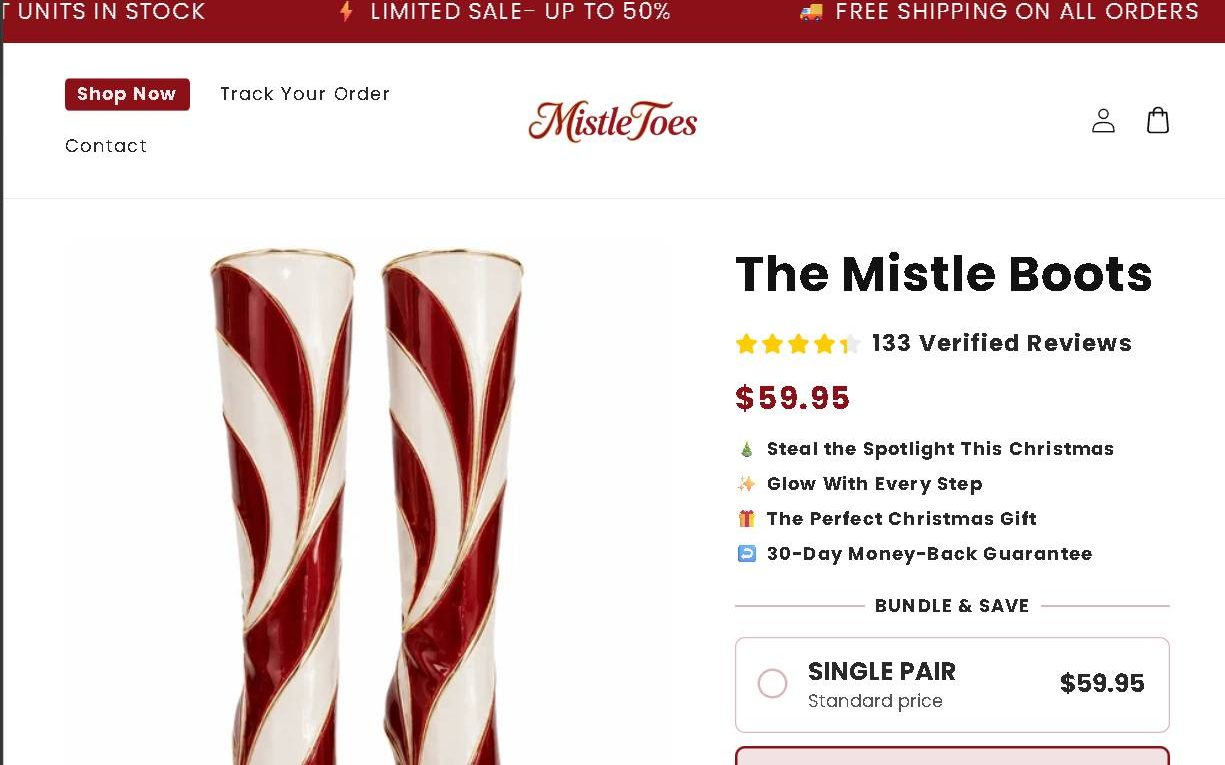
Wearmistletoes centers almost its entire storefront on a single flagship item: The Mistle Boots.
The product page advertises:
- The Pitch: “Steal the Spotlight This Christmas,” “Glow With Every Step,” and “The Perfect Christmas Gift.”
- Pricing & Bundling: $59.95 for a single pair, heavily incentivizing bulk orders via “Two Pairs: $109.90 (Save $10.00)”.
- Promises of Security: Bold badges proclaiming “Free Shipping on All Orders” and a “30-Day Money-Back Guarantee.”
- Manufactured Reviews: Claims of “133 Verified Reviews” maintaining a near-perfect 5-star rating, displayed directly on a recently registered portal.
Suspicious Link or Courier SMS?
Verify URLs, APKs, or parcel alerts against our threat database before clicking.
How the Back-End System Functions
Behind the festive holiday color palette lies a disposable e-commerce framework:
- Off-the-Shelf Theme: The website runs on a standard template hosted on cloud e-commerce platforms, utilizing minimal navigation options (
Shop Now,Track Your Order,Contact). - Domain Redundancy: Operators frequently cycle through multiple domain variations—such as
wearmistletoes.comandthemistletoes.com—to redirect ad traffic if one domain gets flagged by payment gateways or ad networks. - Fabricated On-Page Proof: The review counter is hard-coded into the product template rather than integrated through verified independent platforms like Trustpilot, Google Customer Reviews, or Judge.me.
5 Critical Operational Red Flags on Wearmistletoes
1. Disposable Domain Lifecycle & Recent Creation
Technical WHOIS records show that the domains associated with this operation (such as themistletoes.com and wearmistletoes.com) were registered immediately ahead of the upcoming holiday season. Pop-up stores of this nature routinely launch in September or October, harvest Q4 orders, and abandon the domain before post-holiday returns surge in January.
The product page presents over a hundred “verified” five-star reviews. However, these testimonials lack third-party verification, clickable customer profiles, or independent timestamp metadata. Outside the merchant’s private ecosystem, independent consumer complaint forums report either non-delivery or severe quality discrepancies.
3. Commercial Redundancy & Address Obscurity
The website displays no verifiable physical corporate address, no state incorporation records, and no customer service telephone number. Legitimately branded apparel manufacturers maintain clear headquarters and verifiable business entities to comply with basic consumer transparency mandates.
4. Asymmetrical Overseas Return Trap
While the product page displays a prominent “30-Day Money-Back Guarantee,” hidden terms of service typically require that returns be shipped in their original packaging to overseas distribution hubs at the customer’s expense. International return postage for knee-high boots often exceeds $40–$60, rendering returns economically impractical.
5. Supply-Chain Fulfillment Disconnect
High-heeled knee-high boots manufactured with proper arch support, durable zips, and quality synthetics require specialized shoemaking processes. Automated dropshipping operators, however, source ultra-thin PVC shell boots that frequently arrive crushed in unpadded plastic mailers, smelling heavily of industrial adhesive and deviating sharply from studio-lit promotional clips.
Expectation vs. Reality: Seasonal Footwear Dropshipping
Every safe click counts. If this post helped, a coffee gesture fuels more scam‑busting investigations.

FAQ Section
Is Wearmistletoes a scam?
Yes, Wearmistletoes operates with classic deceptive retail practices. While it processes payments via standard merchant gateways, it uses stolen/stock creative imagery, fabricated 5-star review counters, and hidden overseas fulfillment pipelines to market cheap, low-grade plastic boots as premium holiday apparel.
Is Wearmistletoes legit?
No, Wearmistletoes is not a legitimate, established footwear brand. It possesses no verifiable corporate registry, no domestic business premises, and operates via newly registered domains that are typically abandoned once seasonal chargebacks begin.
What are “The Mistle Boots” sold on Wearmistletoes?
“The Mistle Boots” are mass-produced candy-cane-striped novelty boots sourced from cut-rate wholesale marketplaces in East Asia. Despite being advertised as luxury holiday footwear for $59.95, the actual physical items are made of thin vinyl or PVC with poor stitching and minimal support.
How do I get a refund from Wearmistletoes if my boots never arrive?
If your order fails to arrive in time for Christmas or tracking remains stalled with an unverified courier, contact your credit card issuer immediately. Request a chargeback under billing error regulations or non-fulfillment, providing your order confirmation as proof.
Why does Wearmistletoes have multiple domain names?
Pop-up dropshipping networks regularly register several variations—such as wearmistletoes.com and themistletoes.com—to distribute ad traffic, bypass social media ad account bans, and stay ahead of negative consumer reviews.
Are the customer reviews on Wearmistletoes genuine?
No. The “133 Verified Reviews” displayed on the product page are hard-coded into the store’s template. The site does not utilize independent, verifiable review collection APIs, meaning the ratings and testimonials are fabricated by the site administrator.
Can I return my boots to an address in the United States?
Almost certainly not. Even if the website lists prices in USD and targets American consumers, the return terms often require customers to pay for tracked return postage to an address in Asia, which often costs as much as the boots themselves.
Look for recently registered domains, comment-triggered sales bots on social media ads, absence of a physical headquarters or phone number, generic “@gmail.com” support addresses, and promises of huge discounts alongside aggressive “limited stock” countdown timers.
For more shady sites exposed, check our Shopping Scam Directory — your quick guide to staying safe online.
Help Us Spread Awareness
Please share this article to spread awareness. Follow us on social media for more scam alerts.