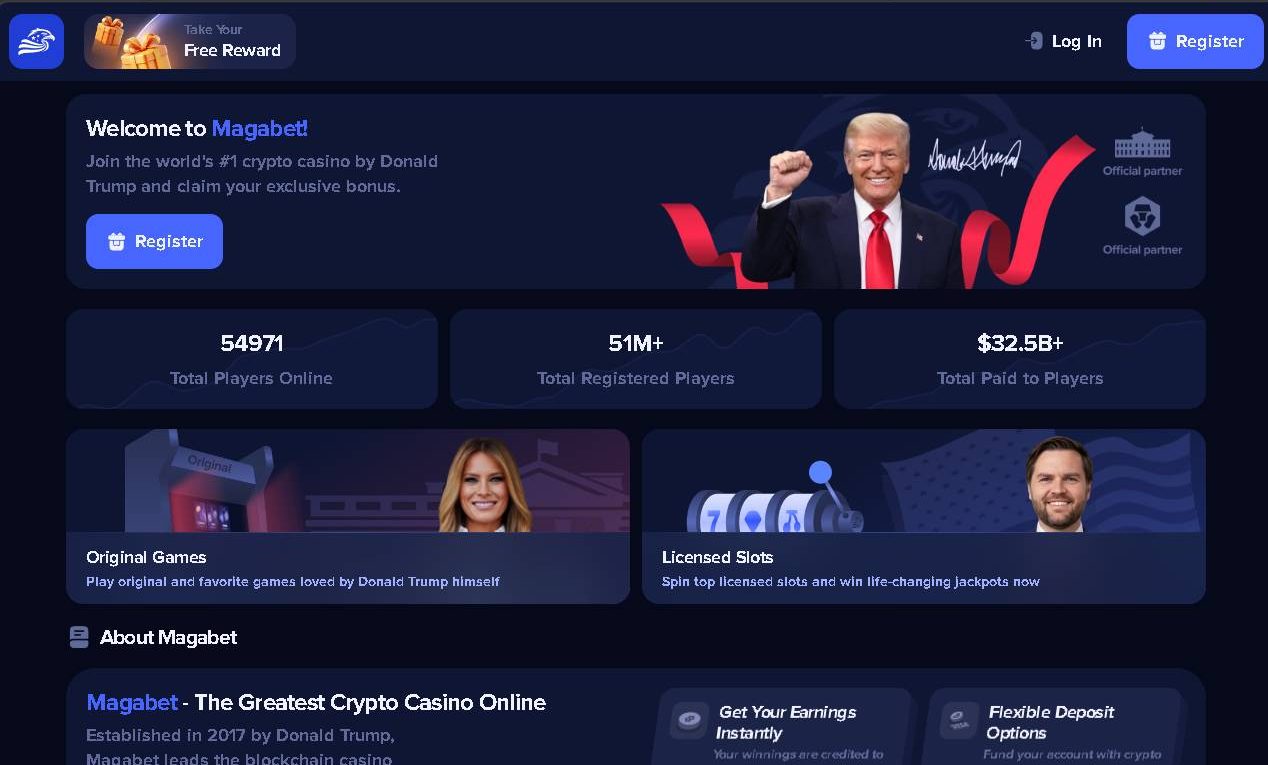
Magabet.me Review: Beware This Donald Trump Casino Scam
If you recently came across promotional social media ads, viral Telegram invites, or direct web redirects pointing you toward the Magabet platform, you need to pause before funding an account.
The domain serves as the centerpiece of a predatory Donald Trump Casino Scam, which lures retail web users and cryptocurrency holders onto an unlicensed, rigged iGaming simulation. Search interest for Magabet, Maga Bet review, and related scam warnings has climbed sharply as people try to verify whether this patriotic-themed crypto casino and its promised multi-thousand-dollar sign-up bonuses are authentic.
At first glance, the site looks like a high-tech, patriotic decentralized gaming portal featuring polished graphics, prominent imagery of Donald Trump, and massive sign-up reward banners.
Beneath the sleek presentation lies a turnkey cyber-fraud funnel. Instead of connecting to legitimate blockchain gaming contracts or audited casino servers, the operator runs an advance-fee trap designed to capture user deposits, manipulate client-side win algorithms, and drain connected Web3 wallets.
This investigation breaks down how the operation works, exposes its forensic red flags, and provides an actionable recovery plan to safeguard your money and personal data.
Anatomy of the Donald Trump Casino Scam
To see through the facade of the Magabet platform, it helps to understand how syndicates construct a modern Donald Trump Casino Scam. Fraud rings constantly capitalize on viral political headlines, cultural movements, and election hype to create instant, unearned trust. Rather than building complex casino software from scratch, these groups license off-the-shelf “Gambler Panels”—white-label scripts engineered to simulate real-time trading, slots, crash games, and crypto deposits.
Social Media Lure (AI Voice Clones / Free $3,000 Promo Codes)
                           │
                           ▼
               Landing Portal: Magabet
                           │
            ┌──────────────┴──────────────┐
            ▼                             ▼
Unauthorized Political Lures      Rigged Simulation Engine
• Stolen Trump likeness/quotes    • Client-side winning scripts
• "Official Patriotic Gaming"     • Phantom $3,000 voucher balances
• Unbacked decentralized claims   • Guaranteed jackpots on Plinko/Crash
            │                             │
            └──────────────┬──────────────┘
                           │
                           ▼
          The Advance-Fee Extraction Wall
          • Withdrawal requests instantly locked
          • Demands $250 to $500 "AML Verification Deposit"
          • Deploys malicious Web3 wallet drainers
The underlying scheme relies on four calculated stages:
- Unauthorized Political Impersonation: Scammers plaster Donald Trump’s face, family name, and recognizable “Make America Great Again” slogans across landing pages, framing the casino as an exclusive patriotic initiative or a decentralized financial gaming project. In truth, Donald Trump, his family, and his corporate entities have zero involvement, ownership, or licensing affiliation with this platform.
- The High-Value Promo Code Lure: Automated social media bots and deepfake video clips across social video platforms promote special voucher codes. Entering these codes on the site instantly credits an unbacked balance of thousands of dollars in simulated Bitcoin, Solana, or Tether into the user dashboard.
- Rigged Gameplay Feedback Loops: When users play demo rounds or spend promotional tokens on mini-games like Crash, Plinko, or digital roulette, the outcome is rigged to let them win repeatedly. The visual balance rapidly climbs into five figures, triggering excitement and making the visitor believe they have secured a massive windfall.
- The Advance-Fee Extraction Trap: The moment a user attempts to withdraw that balance, the platform blocks the payout. The system displays an urgent security alert stating the player must complete an Anti-Money Laundering wallet activation deposit or pay an upfront network clearance fee of around $250 to $500 in crypto. Once real cryptocurrency is sent, the funds are swept into private mixing wallets while the withdrawal remains permanently frozen.
📧 Need Legal Assistance?
Contact the author for legal consultations, case evaluations, and professional inquiries.
Dedicated Case Study: Investigating Magabet.me
The Magabet platform markets itself as a premier Web3 crypto casino and sportsbook, claiming to offer high-return slot machines, provably fair mini-games, and decentralized betting options. However, examining the site’s underlying infrastructure reveals that it is not delivering genuine gaming entertainment—it is an unbacked data-harvesting and deposit-siphoning operation.
Marketing Claims versus Economic Reality
The primary service Magabet claims to provide is access to exclusive, patriotic crypto gambling rooms with return-to-player (RTP) rates advertised at an impossible 98% to 99%. To draw in traffic, the platform’s promotional banners promise:
- Instant Sign-Up Vouchers: Free 3,000 USDT welcome credit requiring zero initial deposit
- Instant, Unrestricted Crypto Cashouts: Payouts to external non-custodial Web3 wallets in under five minutes
- Official Celebrity Endorsement: Claims that the platform is backed by political figures and high-profile decentralized finance investors
These claims collapse under basic economic scrutiny. Real casinos operate on razor-thin house edges (typically 1% to 5%) and fund payouts through strict liquidity pools and player rollover rules. No business model can survive by handing out thousands of dollars in free, liquid, withdrawable crypto to anonymous registrations. The money shown on Magabet is merely an unbacked database integer typed into local software—not real assets stored on a blockchain ledger.
The Underlying Modus Operandi
When a user registers an account and attempts to interact with Magabet, the platform executes a multi-step financial extraction:
- Unsecured Card On-Ramps: If a user deposits using fiat currency, the site redirects them through unvetted third-party payment links or collects unencrypted card numbers, cardholder names, and CVV codes directly on the page.
- Sweeper Script Crypto Addresses: If the user deposits via Bitcoin, Ethereum, or USDT, the destination address is controlled by automated sweeper scripts that immediately move incoming transactions through decentralized exchanges and cross-chain bridges.
- Malicious Smart Contract Approvals: Users attempting to connect browser extensions like MetaMask or Phantom are prompted to sign a transaction disguised as wallet verification. In reality, this signature is often a malicious smart contract approval (such as Permit2 or an unlimited ERC-20 approval function) that grants the scammer direct access to drain the tokens stored in that wallet.
Forensic Red Flags on Magabet
An objective security audit reveals clear warning signs proving Magabet is an active scam:
| Verification Vector | Authentic Licensed Casino | Magabet |
| Domain Lifecycle | Multi-year registration history | Fresh registration with short one-year lifespan |
| Corporate Ownership | Verified parent entity and physical headquarters | Masked WHOIS data; anonymous operators |
| Licensing Badges | Dynamic, clickable certificates from regulators | Static PNG graphics linking to dead anchors |
| Promotional Math | Modest match bonuses with turnover rules | Free 3,000 dollar vouchers requiring upfront activation fees |
| Game Server Origin | Secured APIs linked to audited studios | Pirated client-side scripts running on private origins |
| Social Media Footprint | Active, verified community channels | Dead social media buttons; bot-driven comment spam |
1. Completely Anonymous Ownership
Authentic iGaming portals must register with financial authorities and state their operating company and jurisdiction. Magabet displays no corporate entity name, no registration numbers, and no physical address. Domain records show that all ownership data is concealed behind privacy proxy services.
2. Disposable Domain Infrastructure
Magabet is hosted on a newly minted domain. Disposable scam syndicates purchase short-lived domain names, run high-intensity social ad funnels for several weeks, and abandon the address once threat intelligence feeds and browser security engines flag it as malicious.
3. Fabricated Licensing Seals
The footer of Magabet displays graphic badges claiming oversight by regulators like the Curacao Gaming Control Board. On a legitimate platform, clicking that badge opens an official cryptographic validation certificate. On Magabet, the image is a dead element that does not link to any regulatory registry.
The site features automated tickers showing live player wins every few seconds. Inspecting the browser’s developer console reveals that these alerts are hardcoded JavaScript loops cycling through fake names and arbitrary numbers. Furthermore, all icons for Twitter, Telegram, and Discord link back to an empty anchor.
High-RPM Action Guide: Financial Recovery and Identity Protection
If you submitted credit card details, transferred cryptocurrency, or connected a Web3 wallet to Magabet, execute the following containment measures immediately to limit your financial exposure.
INCIDENT RESPONSE PROTOCOL:
[Credit Card Transaction]  ──► Call Issuing Bank ──► File FCBA Fraud Dispute ──► Invalidate Card
[Web3 Wallet Connected]    ──► Open Revoke.cash ──► Revoke Smart Contract Allowances ──► Transfer Assets
[Personal Identity Leaked] ──► Place 1-Year Credit Fraud Alerts ──► Monitor Against Smishing
1. Credit Card Chargeback Procedure
If you entered card details on the site or used a fiat on-ramp:
- Call Your Bank Fraud Department: Dial the number on the back of your card immediately. Inform the representative that you were misled by a deceptive merchant engaging in digital misrepresentation.
- File Under the Fair Credit Billing Act: Request a formal chargeback citing Services Not Received or Fraudulent Processing.
- Demand a Card Cancellation and Replacement: Because unvetted payment pages can capture your primary account number, expiration date, and CVV, do not settle for a temporary card lock. Demand that the account be canceled and reissued with a new card number to block recurring merchant-initiated billing tokens.
2. Web3 Wallet Hardening and Asset Migration
If you connected a non-custodial wallet (such as MetaMask, Trust Wallet, Coinbase Wallet, or Phantom):
- Revoke Smart Contract Permissions: Go to an on-chain authorization scanner like Revoke.cash or the approval verification tool on blockchain explorers like Etherscan and BscScan. Audit all approved contracts and immediately terminate any allowances granted with unlimited limits or Permit2 access.
- Abandon Compromised Addresses: If you signed a malicious cryptographic transaction, your private key or address may be flagged by automated sweeper bots. Transfer all remaining tokens and NFTs to an entirely new wallet generated from a fresh recovery phrase.
- Avoid Secondary Recovery Scams: Reject any solicitations on Telegram, X, or Reddit from individuals claiming to be crypto recovery experts or ethical hackers. Direct blockchain transactions cannot be reversed by third parties; these offers are secondary scams targeting previous victims.
3. Contain Exposed Personal Information
If you shared your legal name, phone number, email address, or identity documents for KYC verification:
- Place Free Credit Bureau Fraud Alerts: Contact the three major credit reporting agencies—Equifax, Experian, and TransUnion—to place a complimentary one-year fraud alert on your credit file. This requires lenders to verify your identity directly before opening any new credit accounts.
- Perform Dark Web Credential Scans: Check whether your email and password combinations appear in public breach dumps, and update credentials across all sensitive banking and personal accounts.
- Watch for Phishing and Smishing: Expect targeted follow-up messages pretending to be from delivery couriers, legal firms, or tax authorities demanding payment to unlock assets. Delete them immediately.
4. Use Virtual Cards for Future Transactions
To protect yourself from online storefront and gaming traps, avoid entering primary debit or credit card details on unvetted websites. Use virtual card platforms like Privacy.com or the single-use virtual card features offered by modern banking apps. These tools allow you to create merchant-locked card numbers with strict one-dollar spending limits, ensuring unauthorized charges decline automatically. numbers with strict $1 spending limits, ensuring unauthorized charges decline automatically.
Every safe click counts. If this post helped, a coffee gesture fuels more scam‑busting investigations.

Definitive Final Verdict
Magabet.me is an active, unlicensed Donald Trump Casino Scam. The platform pairs stolen political imagery and fabricated $3,000 voucher codes with rigged client-side games designed to drain user deposits.
The balances shown on the site are entirely fake, and any attempt to cash out will result in non-refundable advance-fee demands. Keep your wallets disconnected, never send cryptocurrency to this domain, and do not share your payment information with Magabet.me.
Frequently Asked Questions
Is Magabet a Scam?
Yes, Magabet is an active online scam. The platform operates an unlicensed, rigged Donald Trump Casino Scam that uses unauthorized political branding, simulated demo winnings, and advance-fee withdrawal traps to steal cryptocurrency and banking credentials from unsuspecting visitors.
Is Magabet Legit?
No, Magabet is completely illegitimate. It possesses no authentic corporate registry, holds no active gambling licenses from recognized authorities, and operates on a newly registered offshore domain hidden behind anonymous privacy shields.
Can you actually withdraw the free promo code balance on Magabet?
No, the account balances unlocked by promo codes on Magabet are fictional database numbers. The platform has no real cryptocurrency reserves backing these figures, and any withdrawal request will be blocked behind demands for an upfront activation deposit.
What happens if you connect your crypto wallet to Magabet?
Connecting your non-custodial Web3 wallet to Magabet can expose your assets to malicious smart contract drainers. The site frequently prompts users to sign deceptive permissions, such as Permit2 or unbounded approvals, that allow attackers to drain the tokens stored in your wallet.
Can cryptocurrency sent to Magabet for verification be recovered?
No, direct cryptocurrency transactions are irreversible once confirmed on the blockchain. Once funds are transferred to the scammers’ wallet addresses, they cannot be recalled. Avoid third parties claiming they can recover your crypto for an upfront fee, as these are secondary recovery scams.
How can you verify the true age of the Magabet domain?
You can look up any website’s registration timeline using free public WHOIS directories such as ICANN Lookup or Whois. Entering the domain name reveals its creation date, registrar name, and status, exposing its complete lack of an established operating history.
Why do clone casinos like Magabet constantly change domain names?
Fraudulent platforms operate on brief lifecycles. Once cybersecurity researchers, regulatory bodies, and search engine security algorithms blacklist a domain, the operators abandon the address, copy the exact same software template, and launch it under a new disposable domain name within hours.
Want to see how fraudulent Web3 and blockchain gaming traps manipulate deposit funnels? Explore our in-depth investigative guide:
Online Crypto Casino Scam: How Blockchain & Web3 Traps Exploit PlayersHelp Us Spread Awareness
Please share this article to spread awareness. Follow us on social media for more scam alerts.