Why Am I Losing More RR Than I Gain in Valorant? MMR vs. RR Explained
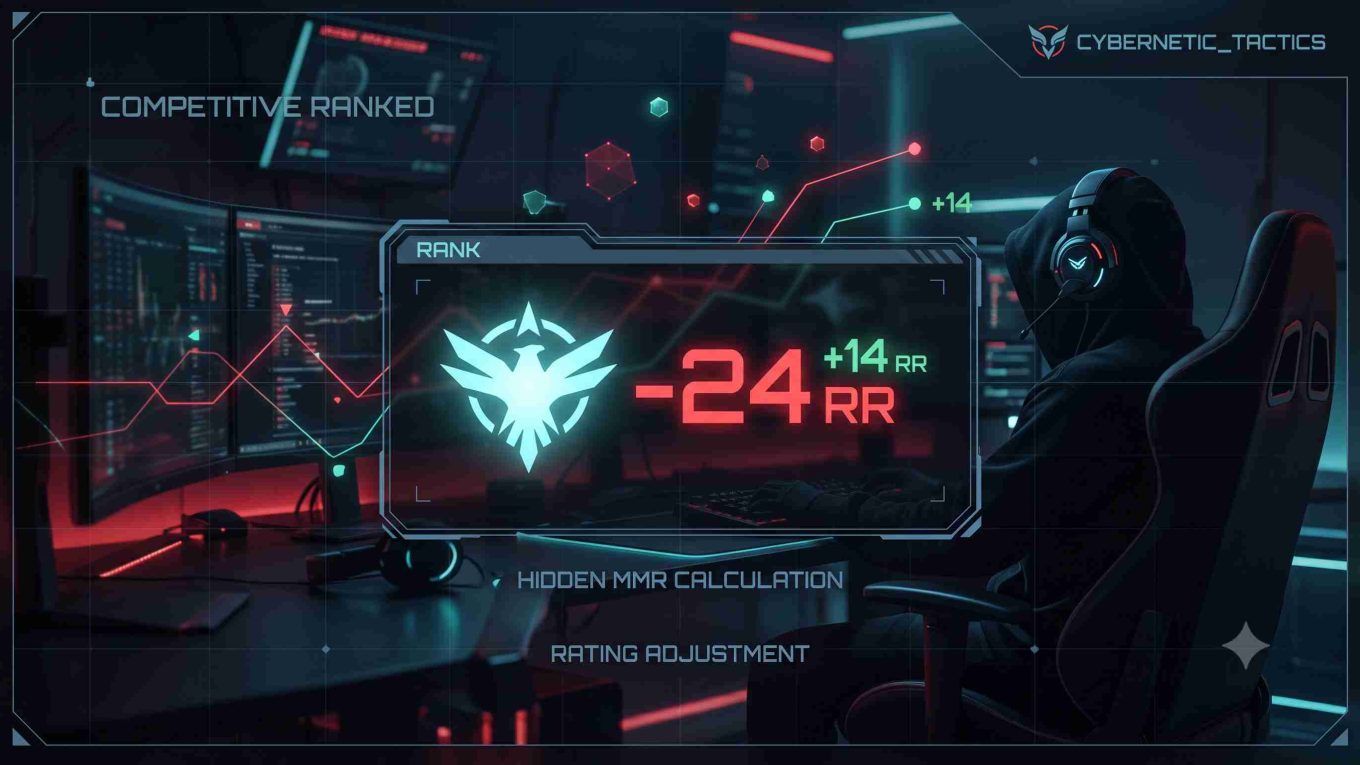
Finishing a hard-fought overtime win only to see +14 RR, followed by a single loss that docks you -24 RR, is one of the most tilting experiences in Valorant competitive queue. It often feels like the game is penalizing you for playing.
This asymmetry is neither a bug nor a personal penalty. It is the direct result of Riot Games’ ranked engine: the mechanical tug-of-war between your visible Rank Rating (RR) and your hidden Matchmaking Rating (MMR).
Here is how the system actually calculates your matches, what causes your rating to become desynced, and how to stabilize your account.
To understand why your gains feel uneven, you have to separate your badge from your internal matchmaking file.
- Rank Rating (RR): The visible point meter (0 to 100) that moves you through tiers like Silver, Gold, Platinum, and Diamond. It acts as an engagement and reward system, smoothing out the emotional impact of game-to-game volatility.
- Matchmaking Rating (MMR): A fluid, hidden numerical score. Riot competitive engineers describe this as a giant ladder where every active player holds an exact rung. No two players share a spot. MMR is the only metric Riot uses to construct competitive 5v5 lobbies.
Your public rank is an aesthetic layer placed over your MMR. You never see your true MMR number, but your post-game RR gains reveal exactly where Riot thinks you belong.
2. The Mechanics of “Rank Convergence”
Riot uses an algorithmic process called convergence. The matchmaker constantly attempts to pull your visible rank toward your hidden MMR rung.
Your net RR payouts directly mirror the gap between these two metrics:
| MMR vs. Visible Rank Status | Net RR for a Win | Net RR for a Loss | System Objective |
| MMR is Higher than Visible Rank | +24 to +32 RR | -10 to -14 RR | Accelerate player to a higher tier |
| MMR Matches Visible Rank | +18 to +21 RR | -18 to -21 RR | Maintain parity; player is at true rank |
| MMR is Lower than Visible Rank | +10 to +15 RR | -22 to -28 RR | Apply downward drag toward true skill level |
If your losses hurt twice as much as your wins reward you, your visible rank has outpaced your hidden skill rating. The system believes your current badge overstates your consistency, applying downward drag to keep competitive integrity intact.
3. How Your Account Got Desynced
Accounts typically develop negative convergence through three distinct match patterns:
The Fluke Win Streak
A 6-game win streak will award you over 120 visible RR, easily pushing you through a promotional tier. However, hidden MMR moves much more conservatively than visible rank. Riot’s matchmaking treats short streaks as variance; it will not boost your MMR permanently until you consistently hold your own against tougher competition over dozens of games.
Abusing Demotion Protection
When sitting at 0 RR in any tier (e.g., Diamond 1, 0 RR), losing a match leaves you at 0 RR or triggers a brief demotion buffer. While your badge remains protected from dropping, your hidden MMR absorbs the full penalty of that loss. Suffering two or three losses at 0 RR heavily damages your MMR foundation while leaving your visible rank artificially inflated.
Blown Round Differentials
Riot calculates team MMR adjustments using round margins. Scraping together 13-11 or 14-12 overtime wins nudges your MMR up only slightly. Conversely, suffering 2-13 or 4-13 blowouts deals severe damage to your MMR.
Related Read: Keep over-flicking your shots? Find your perfect eDPI in our guide to the Best Sensitivity for Valorant Wrist Aim.
4. Encounter MMR vs. Win/Loss MMR
Riot separates MMR into two foundational sub-layers:
- Win/Loss MMR: Dictated strictly by match outcomes and round margins. This is the dominant metric for higher tiers (Ascendant, Immortal, and Radiant).
- Encounter MMR: Evaluates your individual performance in direct engagements against enemy players (duels won, first bloods, ability effectiveness, and trade equity).
Note on Lower Elos: In ranks from Iron through Gold, Encounter MMR carries higher weight. If you consistently win duels against players who hold higher MMRs than you, your hidden rating adjusts upward faster, helping you break out of negative RR loops.
5. What About the Performance Bonus Star?
At the end of a match, you will occasionally receive a gold or silver star next to your RR gain, awarding a flat +2 to +5 bonus RR.
This bonus occurs when your Encounter MMR outpaces the system’s pre-match expectations for you against specific opponents. While a performance bonus softens the blow of a low-gain match, it does not mean your account is fixed. It is simply a one-off performance adjustment; long-term convergence only shifts when your overall match win rate stabilizes.
You cannot manually wipe or reset your hidden MMR, but you can force the algorithm to recalibrate:
- Maintain a 52%+ Win Rate Over 25+ Matches: Short sample sizes do not change the system’s confidence interval. You need sustained volume to prove that your current tier represents your genuine skill floor.
- Fight for Garbage Rounds: Never concede or stop calling comms during a blowout. Losing a match 8-13 instead of 3-13 preserves substantial Win/Loss MMR.
- Stop Stacking with Lower-MMR Friends: Queuing with friends whose MMR is significantly lower than yours drags the average lobby MMR down. If you lose against an opponent lobby with a lower average MMR, the penalty to your personal rating is severe.
Once your hidden MMR catches up to your division, the downward pressure will lift, your gains will equalize to roughly +20 / -20, and your climb will progress normally.
Please share this article and Follow us on Facebook, Twitter, and Instagram.
Frequently Asked Questions (FAQ)
No. Riot Games does not make your raw Matchmaking Rating (MMR) visible or accessible through any public API or third-party stat tracker. Tracker sites can only monitor visible Rank Rating (RR) and estimated match histories. Your MMR is strictly an internal matchmaking value.
How many games does it take to fix bad MMR in Valorant?
It typically takes between 15 to 30 competitive matches with a consistent win rate above 50% to normalize your MMR. Short 3- or 4-game streaks are treated as statistical variance by the algorithm; sustained performance over a larger sample is required to expand the system’s confidence interval.
Does getting Match MVP fix your MMR faster?
Only partially. Individual performance metrics like Match MVP affect Encounter MMR, which has a stronger weighting in lower divisions (Iron through Gold). However, in higher tiers (Platinum, Diamond, and above), Win/Loss MMR dominates, meaning round margins and match victories impact your rating far more than individual frag counts.
Why did I get placed much lower after a new Episode reset?
Riot implements a “soft reset” at the start of each Episode to clear out rank inflation and force players to prove their standing. While your visible badge may drop by several divisions (for example, from Ascendant 1 to Gold 3 or Platinum 1), your hidden MMR remains largely intact. Because your MMR sits above your lowered badge, the convergence engine awards large gains (often +28 to +35 RR) until you return to your expected tier.
No. Dodging agent select inflicts a flat penalty on your visible Rank Rating (typically -3 RR for a first offense) and a temporary queue timeout, but it does not lower your hidden MMR. The system only updates your skill rating based on completed round outcomes and direct combat encounters.