
The Loneliness of Being Unseen: Navigating Social Comparison in the Subterranean Phase
There is a distinct, quiet agony in dedicating yourself to work that has no surface expression yet.
You wake up every day to build a foundation that nobody can see. You pour energy into unformed ideas, foundational skill-building, prototypes, or internal reinvention. But to the outside world, your graph is completely flat. There are no title upgrades to post, no ceremonial promotions to celebrate, and no tangible milestones that register on standard social dashboards.
Meanwhile, your peers are moving predictably along the traditional conveyor belt. They are collecting recognizable trophies: the corporate ladder titles, the steady annual increments, the conventional rites of passage that society readily understands and validates.
This creates a sharp, disorienting friction: the collision between your internal conviction and external silence.
The Tax of the Unvalidated Phase
The hardest part of building something non-linear isn’t the difficulty of the work itself; it is the psychological toll of the unvalidated phase.
Human psychology is deeply wired for feedback loops. When you enter a structured institution—a university, a legacy corporate hierarchy, a professional track—feedback is institutionalized. You put in effort, and a system hands you a grade, a raise, or a title. Even if the work is grueling, the social currency is immediate.
When you step off that track to build something from first principles, those feedback loops break.
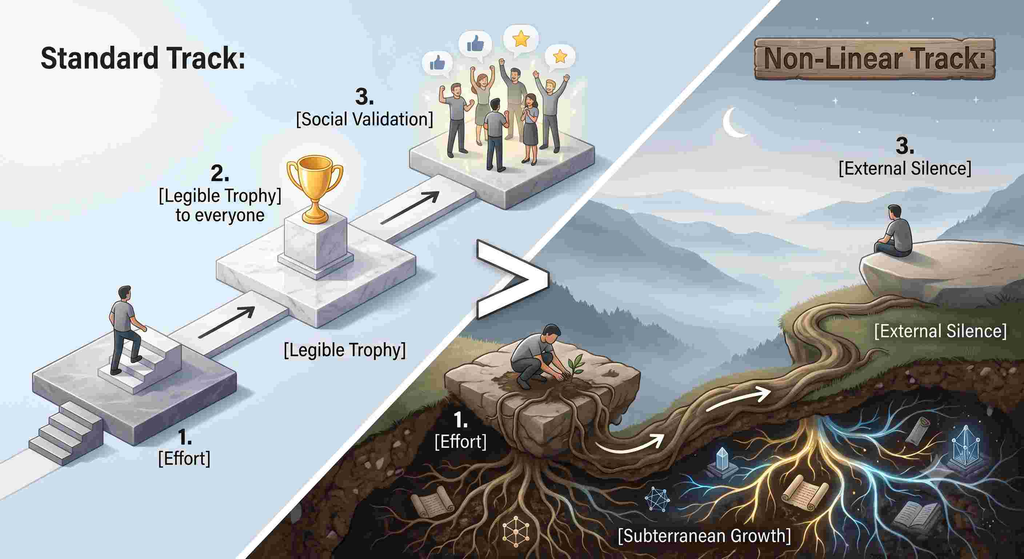
In the subterranean phase, your progress is compounding invisibly beneath the soil. But because the human eye is drawn to the canopy, people assume that what isn’t visible doesn’t exist. When friends ask, “So what have you been up to lately?” you are forced to translate months of deep, ambiguous labor into an answer that inevitably sounds undercooked.
In that silence, the mind turns against itself. You begin comparing your raw, unedited backstage with everyone else’s polished, legibly validated highlight reel.
Non-Linear Clocks vs. Standard Time
The core mistake during this phase is expecting a linear society to understand exponential or asymmetrical bets.
Standard careers run on arithmetic progression:
$$1, 2, 3, 4, 5$$
Subterranean, foundational pursuits operate on power-law or latent compounding curves:
$$0.1, 0.2, 0.4, 0.8, 1.6 \dots \text{until a sudden inflection.}$$
For the first four iterations, the linear path appears to be winning decisively. It looks faster, safer, and undeniably more impressive from the outside.
When you operate on non-linear time, you must get comfortable with being misunderstood by people living on a standard clock.
If you demand that traditional spectators evaluate your latent trajectory using their arithmetic metrics, you will always feel inadequate. They are measuring height while you are deepening your root system.
Defending Your Conviction Against Social Comparison
Surviving the invisible phase requires shifting how you anchor your self-worth before external evidence arrives:
1. Audit Your Metrics of Progress
When external applause disappears, your internal instrumentation must become twice as precise. Replace visible outcomes with lead measures:
- Did I execute the deep work block today without distraction?
- Is my domain clarity higher this week than it was a month ago?
- Did I resolve a foundational flaw that would have collapsed later?
2. Recognize the Fragility of Legible Validation
Conveyor-belt milestones feel reassuring because they are legible, but legibility is often a lagging indicator of compliance rather than uniqueness. The standard track buys social ease at the cost of personal divergence.
3. Treat the Silence as Insulation
Being unseen is lonely, but it is also a tactical advantage. The absence of public attention means you are free to experiment, fail, iterate, and build without the pressure of managing an audience’s expectations. The dark is where root systems develop enough tensile strength to hold up a massive tree.
The Work in the Dark
Every meaningful, outlier trajectory passes through this exact crucible—the valley where faith in your vision must outlast the awkward silence of the room.
The goal in the subterranean phase is not to convince everyone around you that you are making progress. The goal is to build something so solid beneath the surface that when the inflection point finally arrives, the foundation holds without breaking.
Suyesh Gusain explores the intersections of psychological resilience, discipline, and the mechanics of navigating non-linear paths. He writes essays on philosophy, mindset, and self-mastery at Wisdomganga.